Start by identifying the claim
An admissions result is useful only when you understand what it measures. “Students admitted to a top university,” “applications accepted” and “students admitted to their first choice” describe different outcomes. A large percentage can be accurate and still answer a different question from the one your family is asking.
Read the definition before comparing the number. Establish the group of students, the universities, the application rounds, the admissions cycles and the outcome being counted. Then consider what the figure cannot show: the students’ starting profiles, what would have happened without the service and the probability for a different student in a future cycle.
This guide explains how to read those distinctions, including the limits of The Ivy Centre’s own published results. The aim is to make a more informed decision about a mentoring relationship, rather than to turn marketing statistics into a league table.
Ask what is in the numerator and denominator
The numerator is the outcome being counted. The denominator is the group it is being counted against. In an application acceptance rate, one student may contribute several applications. In a student success rate, a person may count once if they receive at least one qualifying offer. Those measures are not interchangeable.
Here is an invented arithmetic example, unrelated to any firm’s records. If a group submits 20 applications and receives five offers, its application acceptance rate is 25%. That does not tell you how many distinct students received offers. Nor does it tell you whether the colleges were highly selective, affordable or appropriate for those students.
Now imagine a claim that every participant received an offer from at least one university. That could be valuable evidence of a successful list strategy. It is still not the same as every participant being admitted to their first choice. The label must match the calculation.
Establish who was included
Ask whether the figure includes every applicant in the defined group or only students who completed a particular program, met certain academic thresholds or followed every recommendation. Ask whether scholarship students, recruited students, transfers or students from earlier service models are included. Different definitions can produce very different figures.
Selection matters even when there are no exclusions after enrollment. A program that admits students who already have unusually strong profiles begins with a different group from a program supporting a broad range of starting points. A success rate does not remove that difference.
This does not make the outcomes meaningless. It changes their interpretation. They describe what happened among the included students. They do not isolate the additional effect of the adviser, and they should not be presented as the odds for a new student without much stronger evidence.
Put the guide into practice
What does the claim actually establish?
Use these distinctions when reading any firm’s results, including ours.
01A high acceptance rate
It describes an outcome for a defined group. You still need the denominator, cycles, rounds, inclusion rules and selection context. It does not establish an individual probability.
02An independently reviewed figure
Find out what was reviewed, by whom and with what exclusions. A calculation check, a records review and evidence of causal impact are different things.
03Many years of experience
Identify the people actually assigned to the student, their relevant recent work and their availability. An organization’s aggregate is not the experience of one mentor.
04A compelling student story
It can illuminate one relationship and outcome. Ask about consent and context, and do not treat a selected story as a representative statistical sample.
Keep application rounds and time periods distinct
An early round result should be labeled as an early round result. Combining it with a university’s overall acceptance rate can suggest a comparison between groups that were admitted through different processes. Early and later applicants can also differ in their preparation, circumstances and eligibility for particular opportunities.
A figure pooled across several cycles smooths over year to year variation. It should state the cycles and be updated consistently. A university’s priorities and applicant pool can change, so a historical result does not become a forecast merely because it is recent.
All nine of The Ivy Centre’s published university percentages cover early application rounds, across the 2021 to 2022 through 2025 to 2026 admissions cycles. They do not include Regular Decision outcomes. The plans differ:
| Universities | Early plans included |
|---|---|
| Columbia and the University of Pennsylvania | Binding Early Decision. |
| Stanford, Harvard, Yale and Princeton | Restrictive or Single Choice Early Action, which is nonbinding but restricts certain other early applications. |
| Caltech | Early Action in the first cycle of our window, followed by Restrictive Early Action after its fall 2022 policy change. |
| MIT | Early Action, which is nonrestrictive and nonbinding. |
| University of Chicago | Early Action, Early Decision I and Early Decision II. The Early Decision options are binding. |
The historical Caltech distinction matters: applying today’s name to every cycle would be inaccurate. Current policies should always be checked directly for the student’s application year. Official references: Columbia, Penn, Stanford, Harvard, Yale, Princeton, Caltech’s 2022 announcement, MIT and Chicago.
We do not divide these figures by a university’s overall acceptance rate to calculate an admissions multiplier. Different application groups and different review processes cannot be made comparable by placing their percentages next to one another.
The Ivy Centre’s published university results
About these results
01 · How we calculate these numbers
Each published percentage above represents the share of The Ivy Centre students who applied to that university and were admitted during the 2021 to 2022 through 2025 to 2026 admissions cycles. All nine university figures cover early application rounds only. Columbia and Penn: binding Early Decision. Stanford, Harvard, Yale and Princeton: Restrictive or Single Choice Early Action. MIT: nonrestrictive, nonbinding Early Action. Chicago: Early Action, Early Decision I and Early Decision II. Caltech: Early Action in the first cycle, then Restrictive Early Action after its fall 2022 policy change. Regular Decision outcomes are not included. Every applicant is counted, with no exclusions.
These figures include all of our paying students, students in our scholarship program, and students mentored before we introduced our current three founder model. Before that model, students followed the same core program under one lead mentor, our founder Lara David.
Our scholarship students are selected from a large pool of highly qualified applicants, so they naturally tend to start with stronger profiles. Even so, outcomes for our scholarship and paying students differ by less than 5 percentage points in every published metric.
Figures are calculated from our internal records and updated every May, once the admissions cycle has closed. Last updated: May 2026. Percentages are always rounded down as a conservative measure, and differences between groups always rounded up, to the nearest 5, so numbers are never overstated. “Students mentored” figure includes every student we have worked with since 2015, across all of our programs.
02 · Why we don’t publish applicant counts
Unlike volume driven college admissions firms, we mentor a deliberately small group of students each year. We protect every family’s privacy, and for the many high profile families we work with, that privacy is essential (if not non negotiable).
Community is also a big part of being an Ivy Centre student. Our students and families know one another, so even simple figures, like the number of students applying to a specific university in a given year, could easily reveal who applied and who was admitted. We know many firms rely on detailed figures like these to build trust, and that not publishing them may raise questions. We have, however, deliberately chosen to limit the figures we publish: protecting our families’ privacy and our relationships will always matter more to us than any statistic we could share.
We do not publish or share student level admissions records, including records with identifying details removed. Our published percentages are aggregate summaries, not individual student files. Every student’s information stays within our secure environment. In the rare cases where we connect a prospective family with a current or past family, we ask that family for permission individually, every time. Any student story we share publicly is shared with that student’s consent.
We also stand behind the mentorship with a full, no questions asked money back guarantee within the applicable two or four week introductory period. The service is paid upfront; the period is confirmed before enrollment.
The disclosure above explains the included students, the rounding approach, the update schedule and our privacy policy. These figures are based on internal records. They are not presented as an independently audited measure of the effect of our mentorship. A reader should consider both the outcomes and the limits of the available information.
Why we do not publish applicant counts
The Ivy Centre mentors a deliberately small community. Students and families often know one another. A count for a particular university, year or applicant category could therefore reveal more than it appears to reveal, especially when combined with information already known within that community.
Removing names does not necessarily remove that risk. We do not publish or share student level admissions records, including records with identifying details removed. We also do not publish applicant counts or detailed breakdowns by university, year or student category. Our published percentages are aggregate summaries, not individual student files.
This distinction allows us to discuss overall outcomes without offering a student’s educational history for public scrutiny or external statistical review. Public student stories are separate, consent based choices; a family is asked individually before an introduction to a prospective family. Protecting the families who trust us, including those with a high public profile, takes priority over publishing more detailed marketing evidence.
That choice limits what an outside reader can independently reproduce. We acknowledge the limitation rather than implying that privacy is a substitute for verification. Families can instead examine the stated methodology, meet the founders, explore the actual framework and assess the experience during the applicable introductory period.
Protecting privacy and being clear about evidence can coexist. We can explain how we calculate a figure and what it means without making a student’s private educational history available for someone else’s evaluation.
We want our work to contribute to better education far beyond the families we currently mentor. We will not pursue that ambition by compromising a student’s privacy. Our small community makes this a meaningful operating choice, while also limiting the independent evidence available to an outside reader. We state both parts openly.
What does an independent review actually verify?
“Verified,” “audited” and “reviewed” can describe different engagements. Ask who performed the work, whether the report is available and precisely what was checked. A review of arithmetic is different from checking all underlying admissions decisions. Checking records is different from demonstrating that mentoring caused an improvement.
Also ask what the review did not cover. Were exclusions, scholarship selection, application rounds and the relevant time period examined? Was the engagement independent of the firm’s marketing? A badge or an isolated sentence should not be asked to carry more meaning than the underlying report supports.
An independent review can strengthen confidence in a defined claim. It cannot turn a historical group outcome into a personal guarantee. Conversely, a lack of external verification should be disclosed honestly and considered with the rest of the evidence, rather than hidden behind reassuring language.
A useful report should let a reader understand the boundary of the conclusion. Consider these checks:
| Question for the report | Why the answer changes its meaning |
|---|---|
| Which claim was reviewed? | Checking a percentage does not necessarily check claims about improvement, first choices or individual admission chances. |
| Which records were examined? | A sample, every record supplied by the firm and the complete eligible population are different scopes. |
| Who determined eligibility? | A calculation can be correct even if the underlying definition excludes unsuccessful students. The inclusion rule needs to be explicit. |
| What evidence supported each outcome? | A self reported spreadsheet and admissions decision records provide different kinds of support. |
| Were time periods, rounds and selection addressed? | A verified calculation may still be unsuitable for comparison with another group. |
| What limitations did the reviewer state? | The marketing summary should not imply a broader conclusion than the report actually reached. |
Verification has value when its scope is clear. It is neither a guarantee of future admission nor an empty exercise. Paying for a review does not by itself invalidate it; independence, methods and evidence must be assessed. Equally, a badge without an accessible explanation gives a family less to evaluate.
When no external review exists, ask the firm why and consider whether the explanation fits its circumstances. A larger organization may have different resources and privacy risks from a small, closely connected practice. Size alone does not settle whether its explanation is sound. The same standard applies to us: our privacy policy explains our decision, while our figures remain internally calculated rather than independently verified.
How much should a difference between two acceptance rates matter?
An 85% figure and a 90% figure do not establish which adviser will help your student more. First ask whether the universities, rounds, cycles, eligibility rules and starting profiles are comparable. Without counts and a sound comparison, you cannot know how much of a difference reflects chance, selection or the service. Neither a small gap nor a large gap proves the quality of a mentoring relationship by itself.
At The Ivy Centre, scholarship and paying students’ outcomes differ by less than five percentage points in every published metric. Scholarship students are selected from a large pool of highly qualified applicants, so they may begin with stronger profiles. Reporting the close outcomes across our two groups adds context, but it does not eliminate selection differences or establish a causal effect.
Use the numbers to ask better questions. Then examine the mentors, their method, their availability and the work they would undertake with your student. If the service does not fit the student’s needs, a higher historical percentage cannot repair that mismatch.
Read rankings and reviews in context
Some comparison pages are published by firms that also sell admissions services. Others may use affiliate relationships, advertising or editorial criteria that are not fully visible. Before relying on a ranking, identify its publisher, commercial relationships, sources and methodology. A polished table does not make different definitions comparable.
For examples of the questions being discussed publicly, see this provider’s explanation of success statistics and this comparison site’s published methodology. Their ownership and purpose matter when interpreting them. They are perspectives to examine, not independent evidence of another firm’s effectiveness. We use those questions to clarify our own disclosures rather than repeat rankings or allegations.
Testimonials can help you understand how a student experienced a relationship. They do not establish a representative outcome for every participant. Ask whether a story is shared with consent, what part of the program it describes and whether the student’s starting point resembles yours. A family reference, when appropriate, should also be arranged with that family’s individual permission.
Evaluate experience claims with the same care
A headline such as “500 years of combined experience” may aggregate many people, roles and periods. It does not tell you which adviser will work with your student or whether that person has relevant recent experience. Nor does it tell you how much time they have available.
Ask instead about the assigned people, their responsibilities and how they stay current. A former admissions role can be valuable, but its institution, scope and recency matter. A mentor’s professional background can also be valuable when it helps a student think more deeply about a field or develop the skills to pursue it.
The Ivy Centre’s three founders bring engineering, management consulting, psychology, medicine and research into the work. We make those backgrounds visible so families can assess their relevance. The practical question remains how those people will help this student, within the program being proposed.
Explore the founders’ backgrounds
Interpret alumni earnings as a different kind of information
About the alumni figure
The Ivy Centre alumni figure is $125K+.
01 · How we calculate this figure
The Ivy Centre figure is the median annual compensation reported by alumni who completed their undergraduate degree in the 2023 to 2026 academic years and chose to share their pay with us, measured within 6 months of graduation. It includes alumni from all of our programs, including our scholarship program. Because it is voluntary and self reported, and measured at a different career stage from the university figures, it is not a like for like comparison. University figures are early career median pay from the 2026 U.S. News / PayScale College Salary Report. As a conservative measure, our figure and all comparisons are rounded down to the nearest 5, so results are never overstated. Figures are updated every May. Last updated: May 2026.
02 · Why we don’t publish response counts
We mentor a deliberately small group of students each year, and our alumni stay closely connected. At that scale, even a median could reveal an individual’s salary, so we don’t publish how many alumni responded, or figures by university, year or field. We do not publish or share individual alumni compensation records, including records with identifying details removed. The published median is an aggregate summary. Every alumnus’s information stays within our secure environment.
Our alumni figure is voluntary and self reported. It describes respondents, not necessarily every alumnus, and it is not evidence that mentorship caused a particular salary. Degree, field, location, working hours and the definition of compensation can affect comparisons. A figure collected within six months of graduation should not be treated as directly comparable to a broader early career measure without explaining the difference.
The same privacy policy applies here. We do not publish response counts or breakdowns by university, year or field. The figure is context about reported outcomes, with limitations, rather than a financial return promised to a family considering mentorship.
How families can evaluate our mentorship directly
We believe in the service strongly enough to put our own time, reputation and responsibility behind it. This is the kind of mentorship we would choose for our own children. That conviction is an invitation to examine the work, not a substitute for evidence and not a promise of an admissions outcome.
Families meet the founders who actually deliver the mentorship. They can explore our framework, ask how the weekly discussions work and understand how Triple Quality Control brings three perspectives to the application. Undergraduate, master’s, STEM PhD, medical school and MBA applicants can discuss the expertise and scope relevant to their own stage.
Our introductory period is paid upfront with a full, no questions asked money back guarantee if the family cancels within the applicable two or four weeks, as set out for the student before enrollment. It is not a free upfront trial or an admission guarantee. It gives the family time to experience the relationship and decide whether it is right for them.
We deliberately limit the number of students we mentor because our model depends on continuing founder involvement. One paying student supports one scholarship student, and our wider education work includes ProDuca. We want to grow our impact while preserving the attention that makes each relationship meaningful.
Explore the framework behind our mentorship
Understand the programs and founder involvement
Use evidence to inform the decision, then examine the relationship
After reading the methodology, return to the work your student needs. Who will advise them? How will the mentors understand their context? What will change in the student’s decisions, habits and ability to communicate? What can you observe before an admissions result exists?
A careful family can value strong outcomes while recognizing their limits. It can also value judgment, continuity and developmental support that no acceptance percentage fully captures. Ask for clear answers on both. A mentoring relationship should be understandable in its own terms, rather than justified by a number alone.
Questions to ask a prospective consultant
What consulting can and cannot change
See the strategy in practice
Look beyond the number and examine the method.
Our free masterclass lets you see how we assess a student’s profile, identify priorities and build an application strategy.
Full masterclass included with free and immediate access
Explore the 15 chapters
Free with masterclass 00:0001What does a strong application actually need?
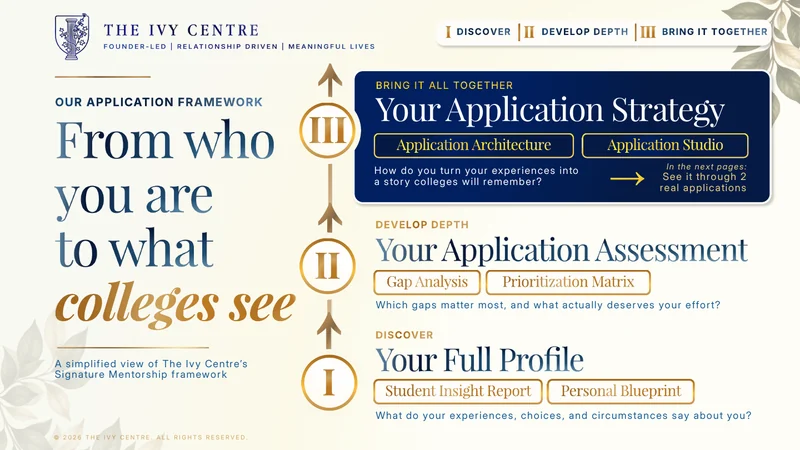 06:3502The five stages of every strong application strategy
 09:2003What makes you memorable to admissions officers?
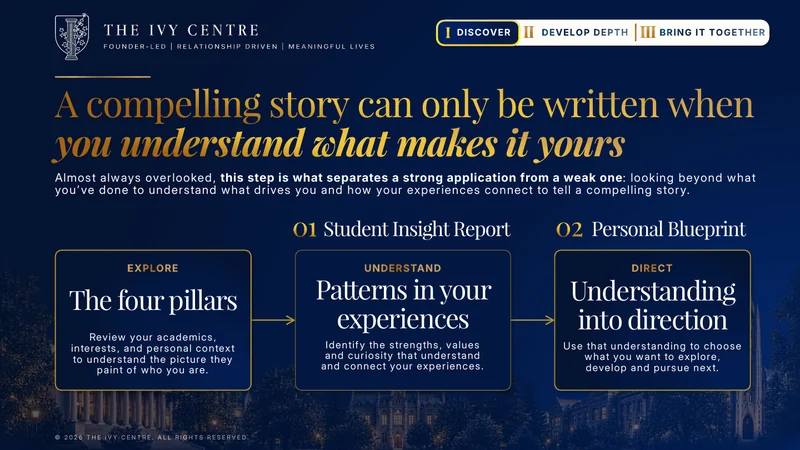
 10:4504The four pillars behind every student profile
 12:2705Turn your strengths, values, and curiosity into direction
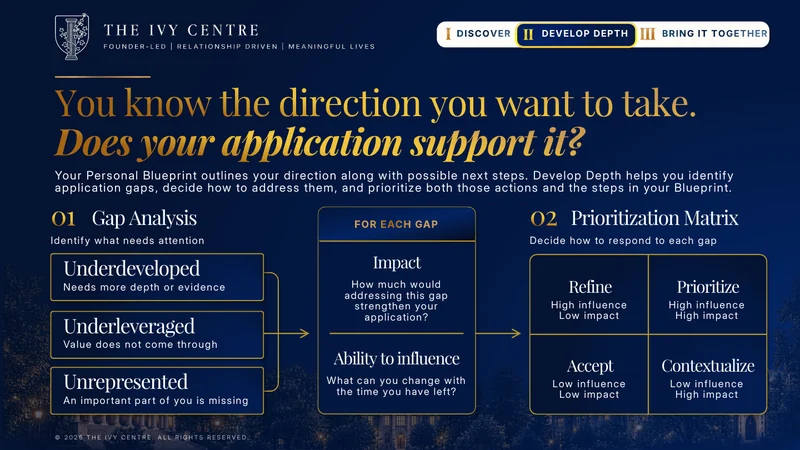 13:5306What is your application actually missing?
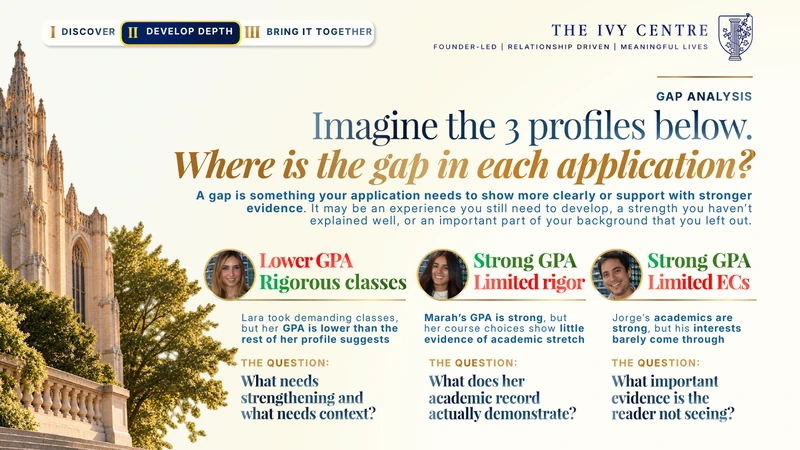 15:2607How to spot weaknesses in your college application
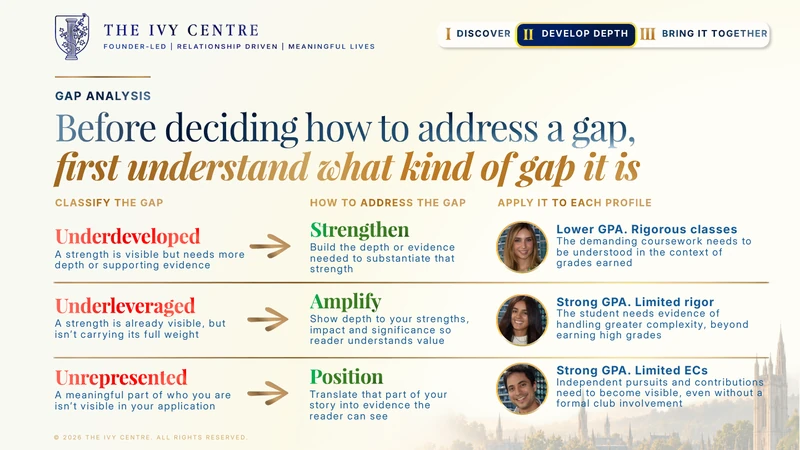 17:0108There's only 3 types of gaps. Each with a different way forward.
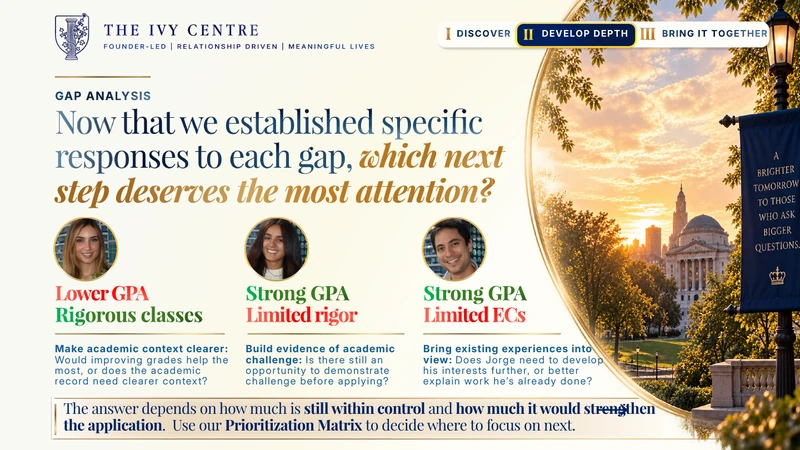 18:5509What can you still change before you apply?
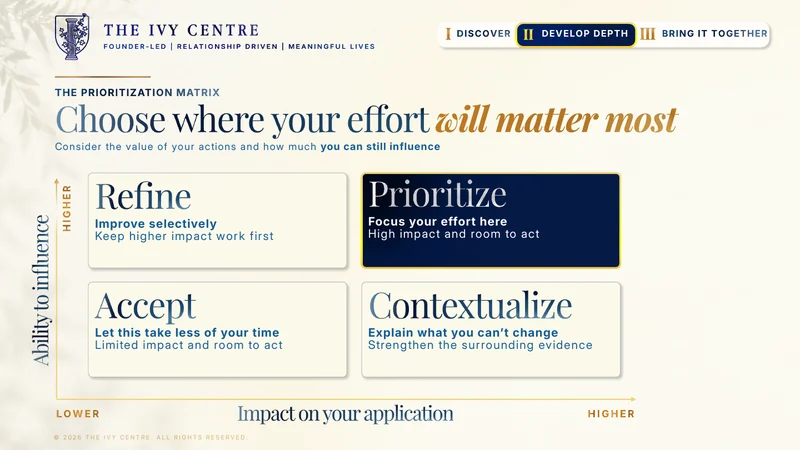 20:2610What deserves your effort, and what can wait?
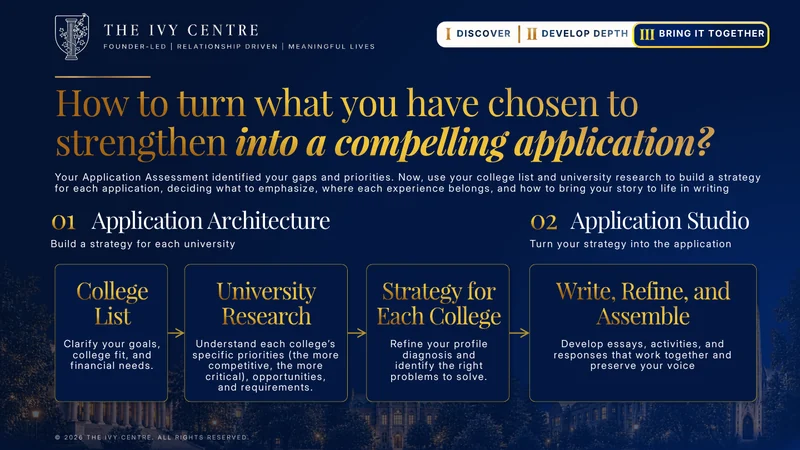 21:3711Why each university needs a different strategy
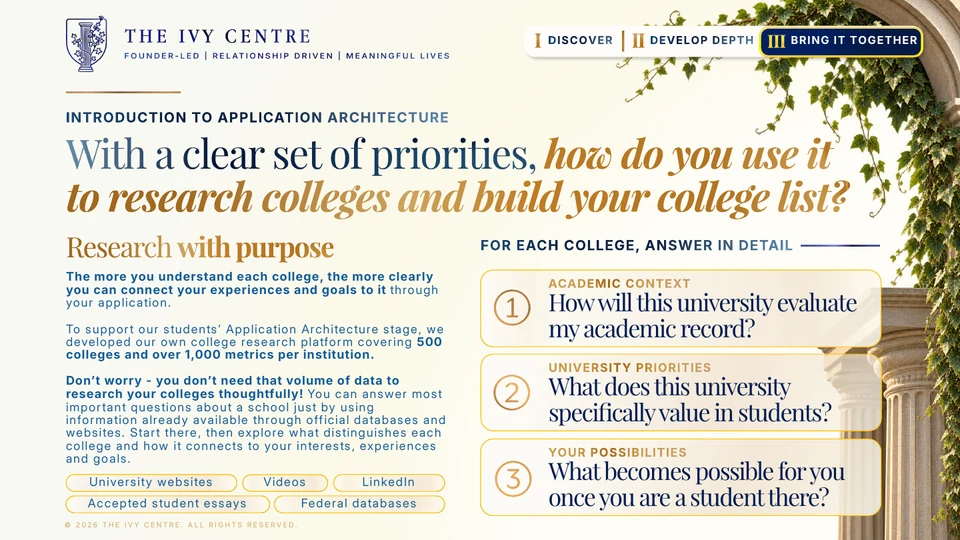 22:3612How to research colleges the right way
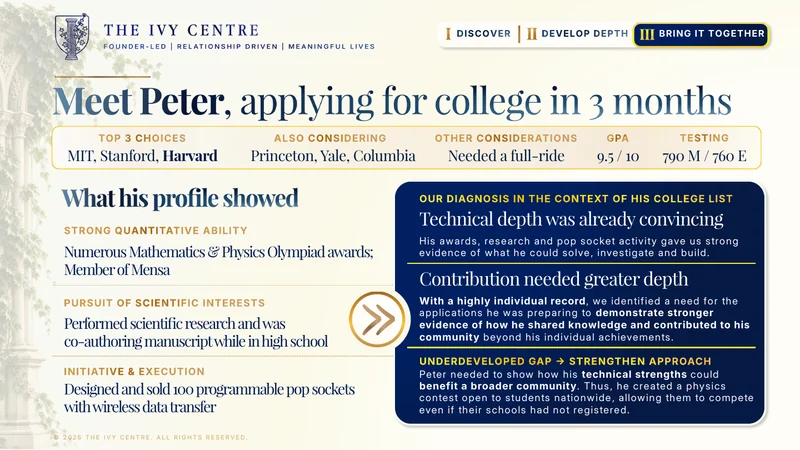 24:4513Peter: Highly technical profile but no differentiator
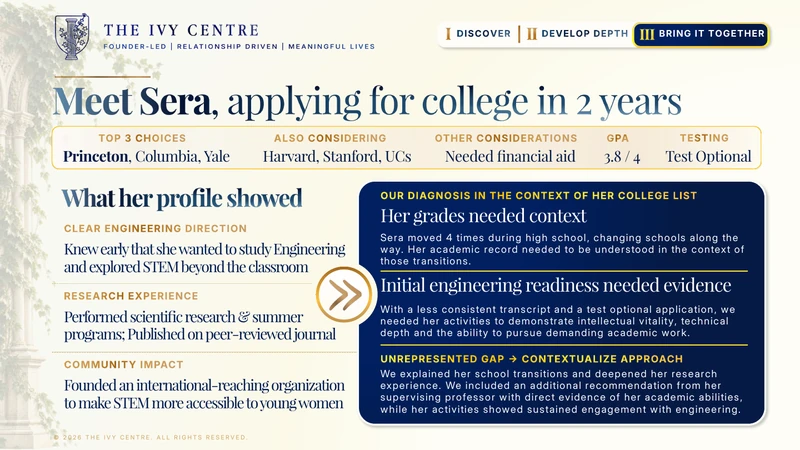 26:3714Sera: Low GPA and SAT, but strong depth in context
 27:5615What should you do next?
Six downloadable resources
Free with masterclass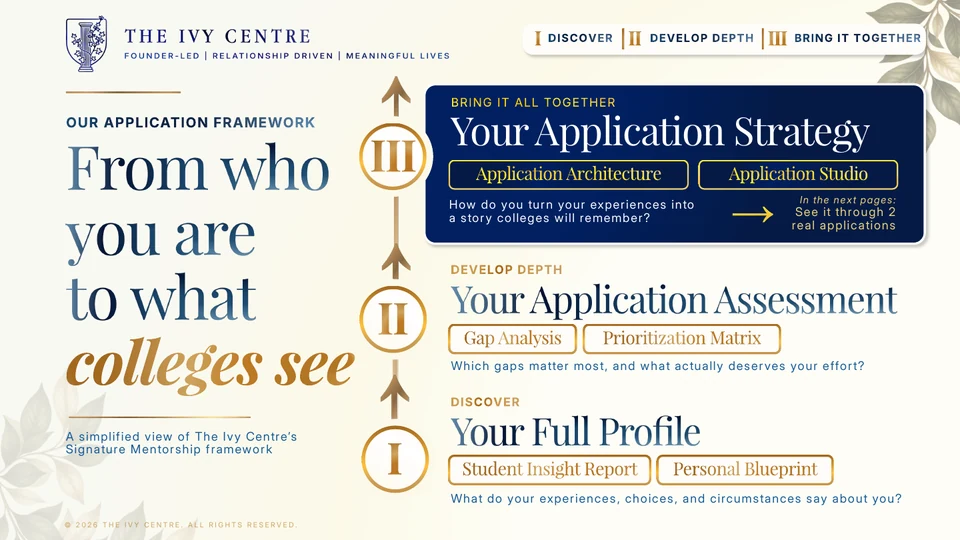 College Application Strategy Map
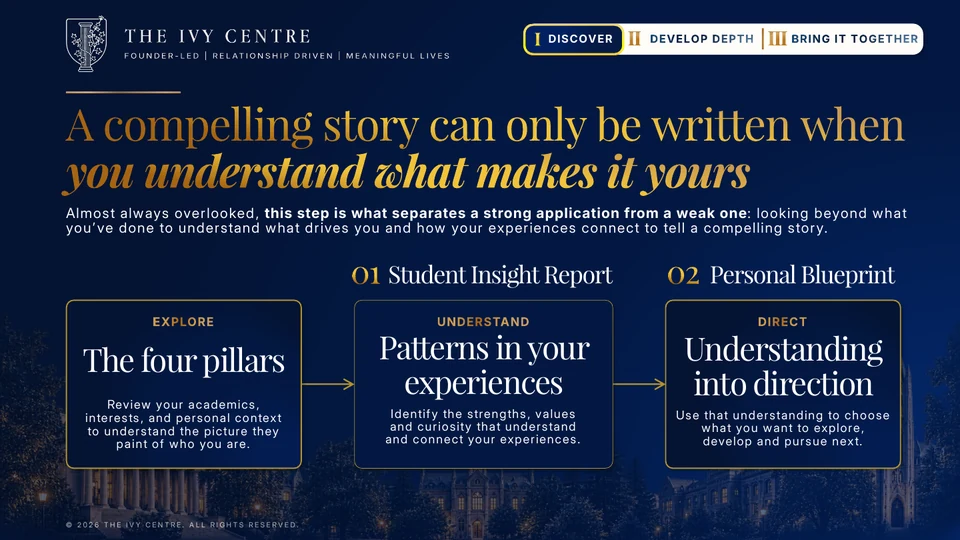 Discover What Sets You Apart
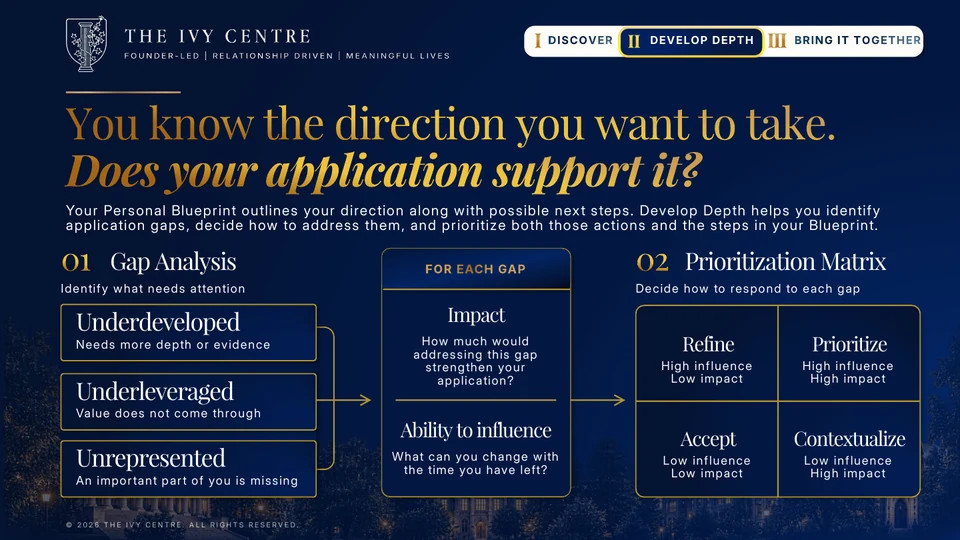 Find and Address Your Specific Application Gaps
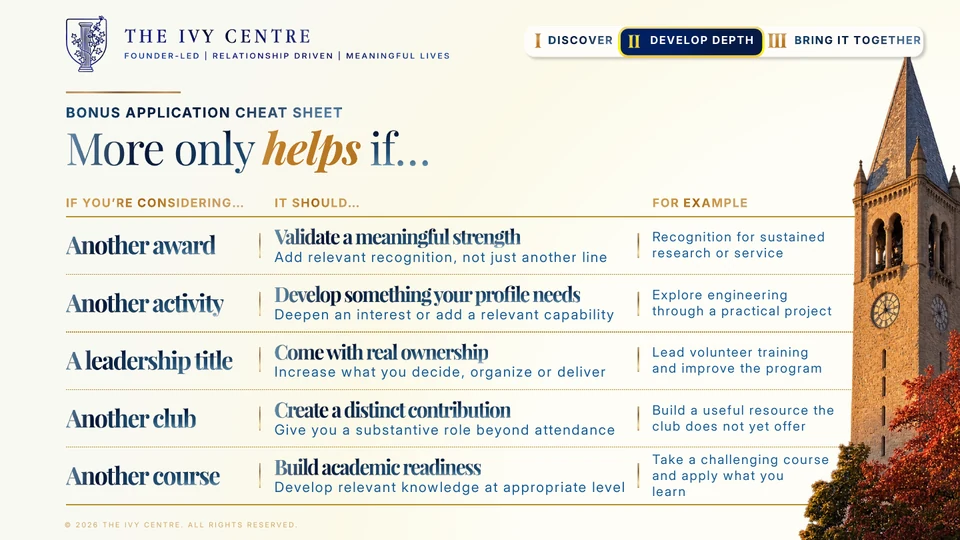 What to Strengthen Next: Your Priorities Cheat Sheet
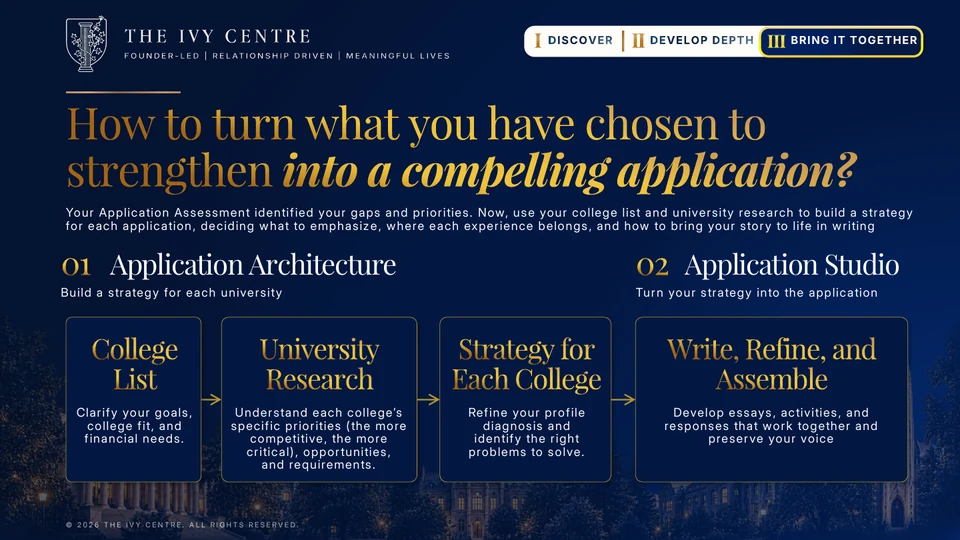 Turn Your Profile into a REALLY Compelling ApplicationHow to Research Colleges and Shape Your Strategy for Each
All 15 chapters and six guides are included with free access and also shared with you over email.
Explore the free masterclassChoose the version for you. Free access, with no commitment to mentorship.
Reviewed by Lara David for The Ivy Centre. Our program descriptions draw on our published mentorship framework and masterclass. Linked external sources support the specific comparisons identified in this guide. Illustrative examples are labeled; individual outcomes are not predictions.