What are you actually hoping to change?
College admissions consulting can be worth the investment when the people involved help a student make better decisions, develop meaningful strengths and carry those strengths into a thoughtful application. The value depends on the student’s starting point, the work still ahead, the relationship and the family’s priorities. A service that is useful for one student can be unnecessary for another.
Some families already have the knowledge, time and school support to navigate the process confidently. Others want a second perspective even when things are going well. Neither choice says anything about a student’s ability. The decision is whether additional expertise will open useful possibilities and whether the proposed support is worth its cost to your family.
Start by completing this sentence: “We would consider this worthwhile if, by the end, our student could…” Make the answer more specific than “get into a good college.” It might be explaining what they want to study, completing work without constant parental reminders, choosing universities for informed reasons or presenting an unusual academic history clearly. Admission matters, but it is a decision made by a university. These other goals give you something concrete to evaluate along the way.
Put the guide into practice
What would you like support to change?
Open the situation closest to yours. This is a conversation starter, not a recommendation to purchase a particular service.
01We need a final review
A focused review may suit an application that is already researched and substantially complete. Establish which documents are included, who reviews them and whether you can clarify or act on the feedback before the deadline.
02We need clearer direction
Explore whether the uncertainty concerns interests, college research or priorities. Continuing mentorship may be useful when the student needs to try things and reflect over time, rather than receive a single answer.
03We need help following through
Ask how the program teaches planning and independence. More reminders alone may not address the reason tasks are stalling. Discuss the student’s willingness to participate and any existing school support.
04We want to explore more possibilities
Bring the student’s existing strengths and questions. Ask how the mentors would help investigate opportunities and evaluate tradeoffs without adding commitments simply to make the profile longer.
Match the support to the work ahead
| Your starting point | Support worth considering | What to establish first |
|---|---|---|
| A researched list, completed drafts and a clear direction | A focused application or essay review | Which documents are reviewed, whether revisions are included and who explains the feedback |
| Several interests, but no clear priorities | Developmental mentorship | How the mentor will help the student explore, make choices and test those choices through experience |
| A strong profile with a complicated application calendar | Application strategy and coordination | Who owns the overall strategy and how school requirements, essays and deadlines connect |
| Difficulty initiating tasks or sustaining routines | Mentorship with explicit executive functioning support | How planning, accountability and independence will be taught, and the limits of the service |
| A future master’s, PhD, medical school or MBA application | Guidance appropriate to that particular pathway | Relevant expertise, preparation requirements and the difference between college and graduate admissions |
These are starting points for a conversation, not diagnoses or automatic recommendations. A student might need several kinds of support. The important distinction is between a task that needs expert feedback and a pattern that needs time, practice and a continuing relationship.
What does college admissions consulting cost?
Published prices describe different products. An asynchronous review, a block of counseling hours and a continuing mentorship do not buy the same work. Comparing them only by their price can be as misleading as treating every educational program as equivalent because each includes meetings.
The five examples below were checked on October 27, 2026. The first three are published service prices; the last two are dated press reports about longer engagements. A historical reported fee is not a current quote. These examples show the breadth of scope and price, not a market average or a ranking. Confirm current terms directly with each provider.
| Published example | Price shown | What the price refers to |
|---|---|---|
| College Essay Guy | $597 | An asynchronous review of the Common App and supplemental essays for one school. Live calls are not included. |
| Marks Education | $525 per hour | Counselor consulting for the July 2026 to June 2027 contract year. Other staff arrangements and packages have different prices. |
| Olympus College Prep | $15,000, $30,000 and $40,000 | Three college counseling tiers in its April 2026 package comparison. |
| Crimson Education | Up to $200,000, reported in October 2024 | Sherwood News, citing The Wall Street Journal, described a broad program including test tutoring and application advice. This is a historical press report, not a current published tariff. |
| Command Education | $500,000 for four years or $750,000 for six years, described in a June 2023 interview | Its founder described engagements beginning in ninth or seventh grade respectively. The interview is reproduced on the company’s website; it is not a current quote. |
Sources: College Essay Guy’s complete application review, Marks Education’s college counseling fees and Olympus College Prep’s package comparison.
Historical sources: Sherwood News on Crimson Education, October 16, 2024 and Command Education’s founder interview, dated June 1, 2023. Fees alone cannot establish who provides better support. Duration, access, assigned people and the work included differ substantially.
At The Ivy Centre, Collaborative Mentorship starts at $15,000. The appropriate program depends on the student’s stage, timeline and the level of founder involvement. Ask for the proposed scope in writing. Support for SAT preparation, student development, executive functioning and future graduate study should be discussed in relation to that scope; the starting price is not a promise that every possible service or future application is included.
Explore our mentorship programs
Why do admissions services have such different prices?
There are several substantial costs behind a mentoring relationship: time spent understanding the student, preparation between meetings, the experience of the people doing the work, coordination across different parts of the application and the length of the engagement. Technology can make that work more connected. It does not remove the need for people to read carefully, exercise judgment and build trust.
A larger specialist team might distribute work across a strategist, essay adviser and subject specialists. An individual consultant may provide continuity through one relationship. A recent graduate may bring an accessible perspective on campus life. A founder led boutique may involve the people responsible for the business directly in the student’s development. Each arrangement needs to be evaluated on its actual delivery, not its label.
Our model puts three founders into that continuing relationship. Lara brings engineering, strategy and experience at Boston Consulting Group; Marah brings psychology and student development; Jorge brings medicine, research and the humanities. Their perspectives inform a shared plan. The price reflects the time and depth this work requires, rather than a charge for access to a university name.
Compare the different consulting models
Within the selected program, the commitment of founder attention remains consistent while its focus adapts. A student who already has a strong testing result may need more attention on research, university choices or communication. A student who needs help organizing work may need that foundation first. Personalization means directing the same care toward the work that matters most, not requiring every student to use an identical checklist of services.
There is also a practical reason for our price. Substantive mentorship requires experienced people to prepare, think, discuss and follow through between meetings. We automate coordination so that more attention can go to those human decisions. We do not reduce the depth of that work to compete with the price of a single essay review. The family should decide whether that continuing relationship is the investment they want.
What will the student and family need to contribute?
Before comparing proposals, ask what the student and family must contribute. A detailed plan still requires the student to attend, reflect, try things, write and revise. A busy student may benefit from clearer priorities, but a program that adds more activities without removing anything can make the problem worse.
Ask about preparation, work between sessions, meeting frequency, feedback turnaround and parent communication. Establish what happens during examinations or a difficult school term. Find out whether additional schools, extra essay rounds, testing support or an extended timeline change the price. Agree how the mentor will respond when a plan is no longer realistic.
Then consider opportunity cost. Would the same time or money be more useful for targeted subject support, transport to an existing activity, an affordable college visit or simply a more sustainable weekly schedule? This is a family decision. A worthwhile investment needs to fit your finances as well as your ambitions.
A worked example: buying the right kind of help
Imagine an eleventh grader who earns strong grades, participates in robotics and enjoys explaining science to younger students. The family believes the missing ingredient is a prestigious summer program. The student, meanwhile, is struggling to finish an existing project and is unsure whether engineering is the right direction. This is an illustrative scenario, not a client record.
An application review would not resolve the immediate problem because there is no application to review. More activity suggestions might add pressure. A useful mentoring conversation would examine what the student enjoys about the existing work, why the project has stalled and what evidence would help them make an informed choice about engineering.
The next step might be finishing a smaller version of the project, seeking feedback from its intended users and recording what the student learned. It might instead be exploring a different academic interest. The point is not to prescribe robotics as an admissions tactic. It is to use the student’s experience to make a better decision before committing another summer to an assumption.
You can evaluate the support before admission decisions arrive: did the student gain clarity, complete meaningful work and become more capable of directing their next step? Those changes do not guarantee an offer. They are nevertheless real educational outcomes.
What a consultant can influence, and what remains outside their control
An adviser can help a student notice an opportunity, research a university, prioritize effort, explain context and communicate accurately. A mentor can also help the student build habits and confidence through repeated practice. Neither can change a university’s capacity, institutional priorities or the strength and composition of its applicant pool.
For that reason, a firm’s acceptance rate cannot tell you your own probability of admission or prove what would have happened without its support. Strong results deserve a clear methodology. They should be considered alongside the actual people, the quality of their thinking and the way the student responds to them.
Understand what admissions support can influence
Learn how to read results responsibly
What The Ivy Centre is designed to build
Our work begins with the person behind the application. The Student Insight Report brings together strengths, values, interests and areas for growth. The Personal Program Blueprint turns those findings into priorities. Application Architecture then connects the student’s evidence to the requirements of each university, with all three founders involved in the strategy.
The connected student environment helps preserve context across conversations, projects and decisions. It is useful because the founders can see how one part of the student’s journey affects another. A dashboard alone is not the mentorship; the value is in what the mentors notice and how the student learns to act on it.
This perspective also extends beyond undergraduate admission. The Ivy Centre offers graduate school support, particularly for master’s degree, STEM PhD, medical school and MBA pathways. Research direction, professional experience and long term goals require different preparation in each case. Families should discuss whether they need support now, later or through a separate engagement.
See our connected five stage journey
Explore how our student environment works
A useful decision before you commit
Write down the three changes you most want to see, the budget you are comfortable allocating and the kind of relationship your student would welcome. Ask a prospective adviser to explain how their proposed work connects to each priority. A thoughtful answer should include what they would investigate, what they cannot yet know and what the student will be expected to do.
You may conclude that targeted feedback is enough. You may decide that continuing mentorship is the investment your family wants to make. The stronger decision is the one based on the student, the scope and the people, rather than a sales promise or an impressive percentage alone.
See the strategy in practice
Watch how we choose what matters next.
Our free masterclass shows how we examine a profile, identify gaps and decide where effort can make a meaningful difference.
Full masterclass included with free and immediate access
Explore the 15 chapters
Free with masterclass 00:0001What does a strong application actually need?
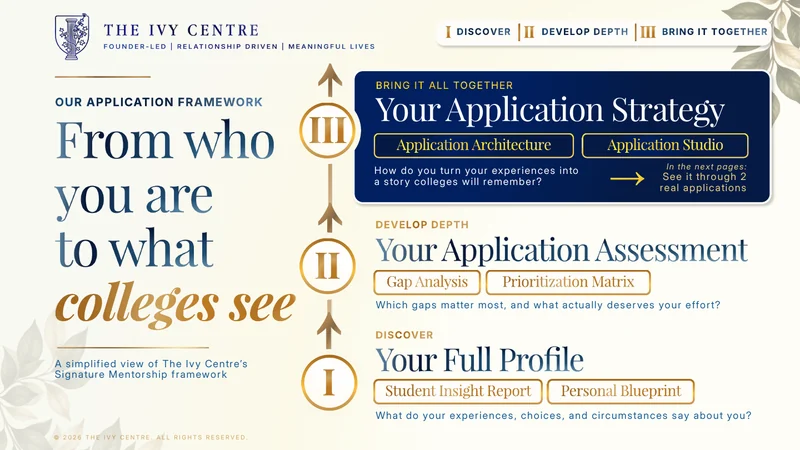 06:3502The five stages of every strong application strategy
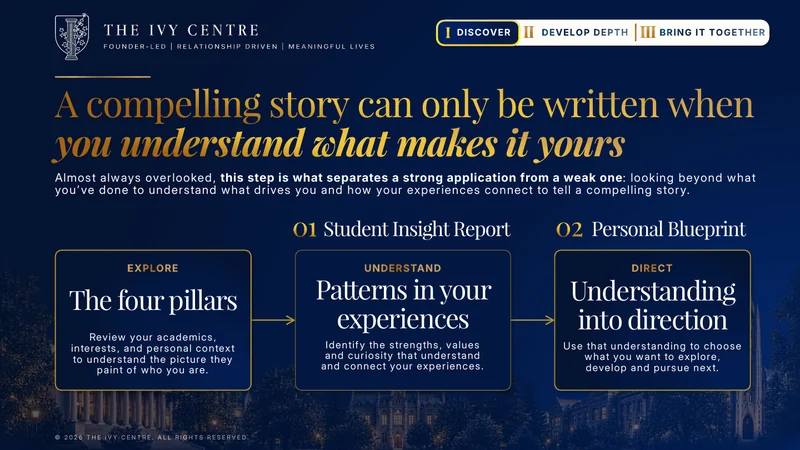 09:2003What makes you memorable to admissions officers?
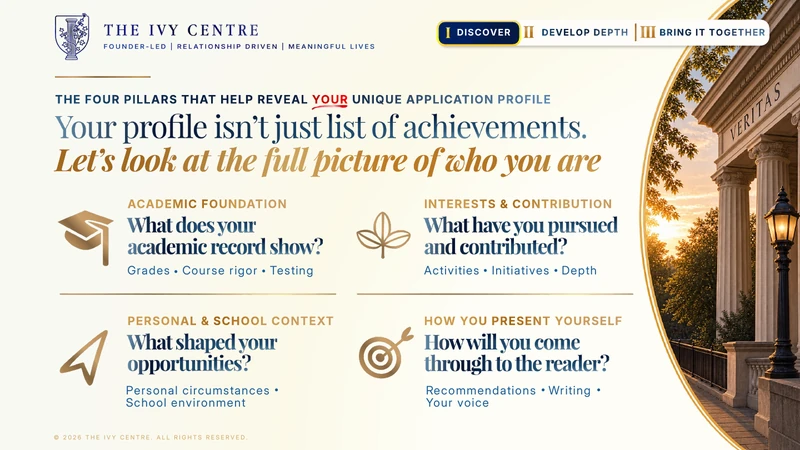 10:4504The four pillars behind every student profile
 12:2705Turn your strengths, values, and curiosity into direction
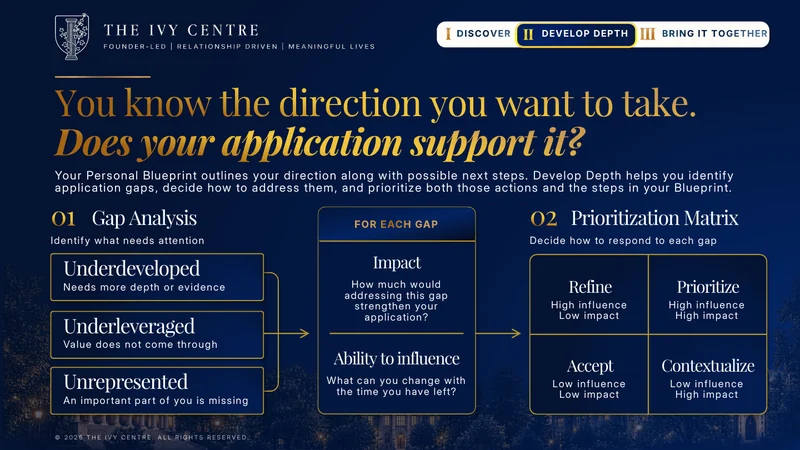 13:5306What is your application actually missing?
 15:2607How to spot weaknesses in your college application
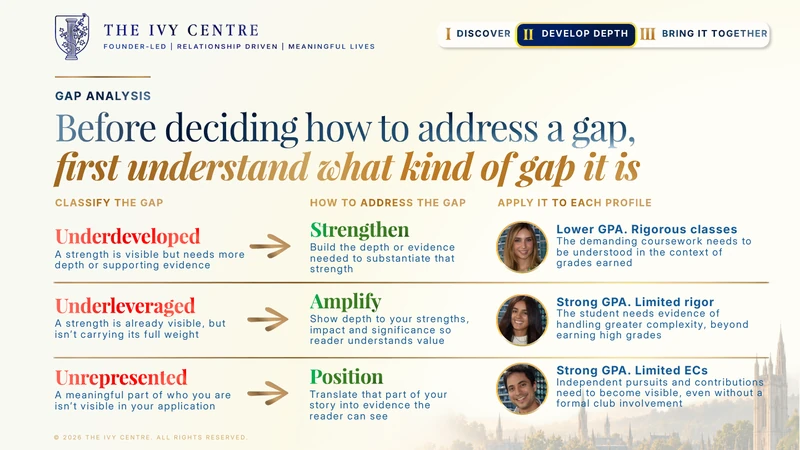 17:0108There's only 3 types of gaps. Each with a different way forward.
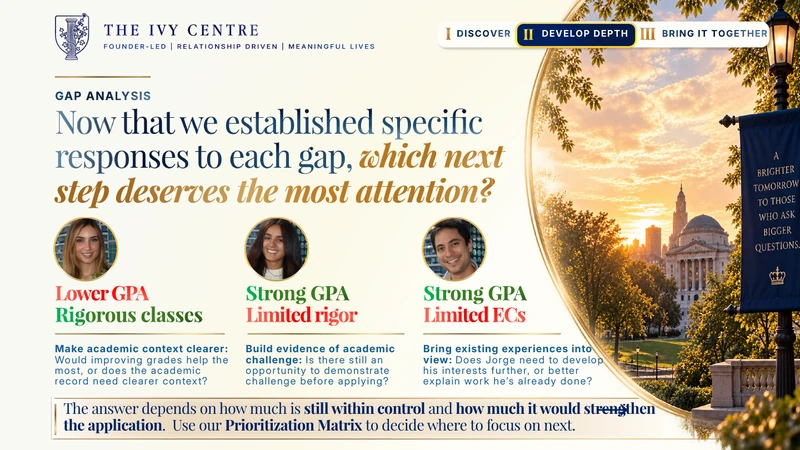 18:5509What can you still change before you apply?
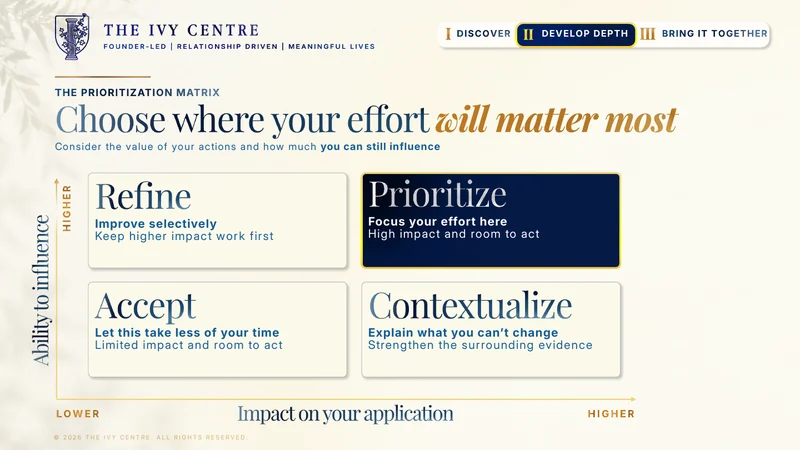 20:2610What deserves your effort, and what can wait?
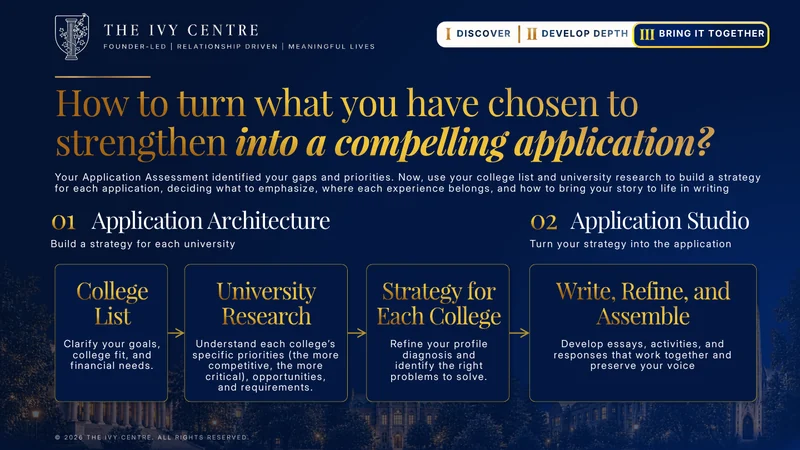 21:3711Why each university needs a different strategy
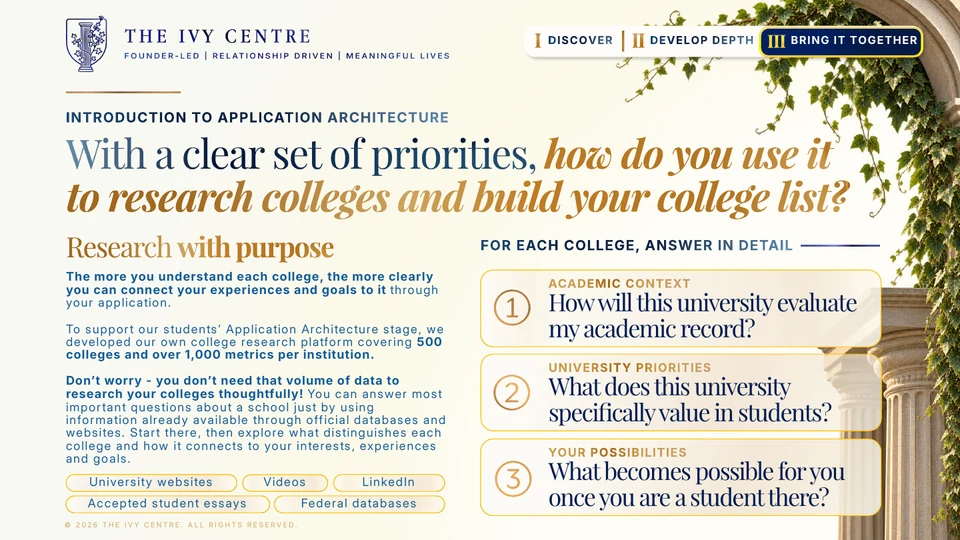 22:3612How to research colleges the right way
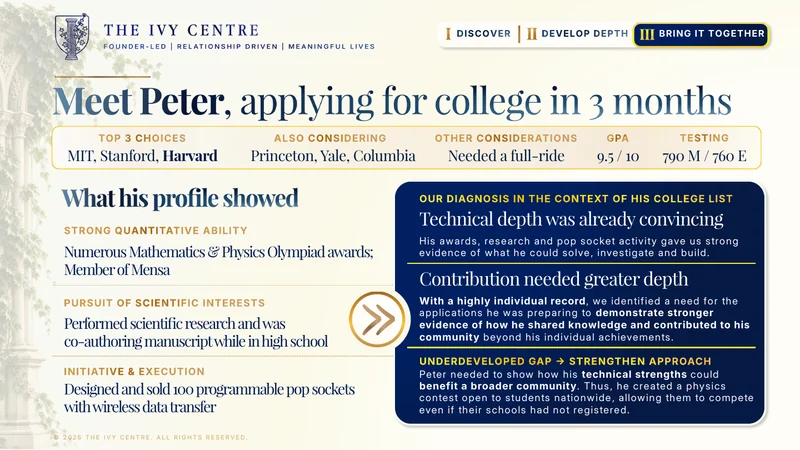 24:4513Peter: Highly technical profile but no differentiator
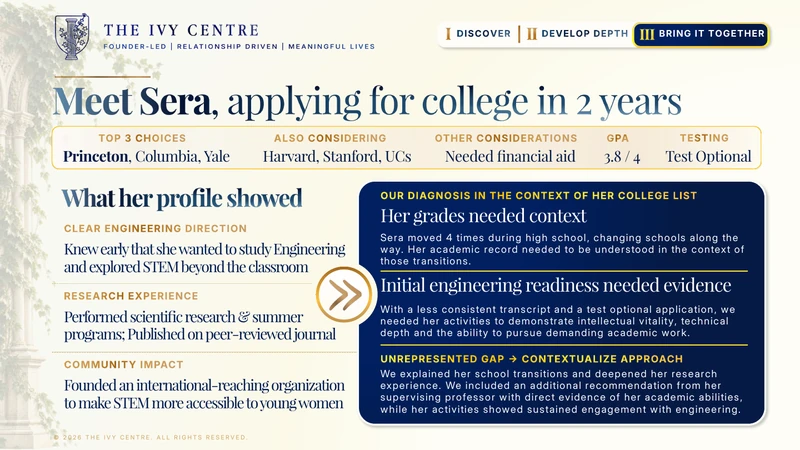 26:3714Sera: Low GPA and SAT, but strong depth in context
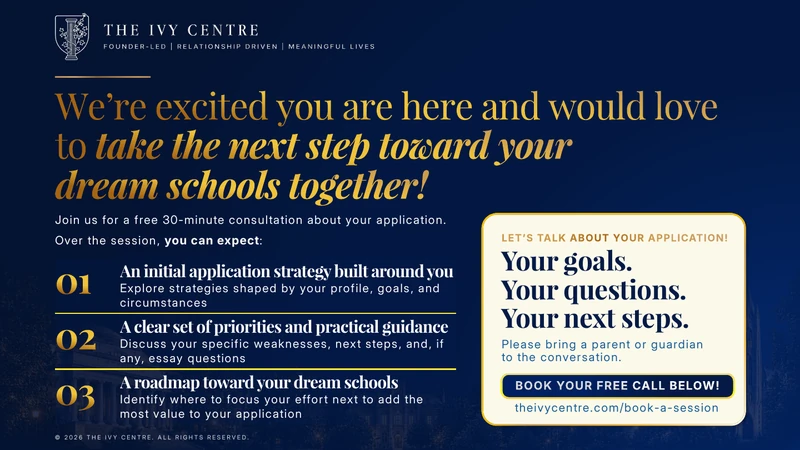 27:5615What should you do next?
Six downloadable resources
Free with masterclass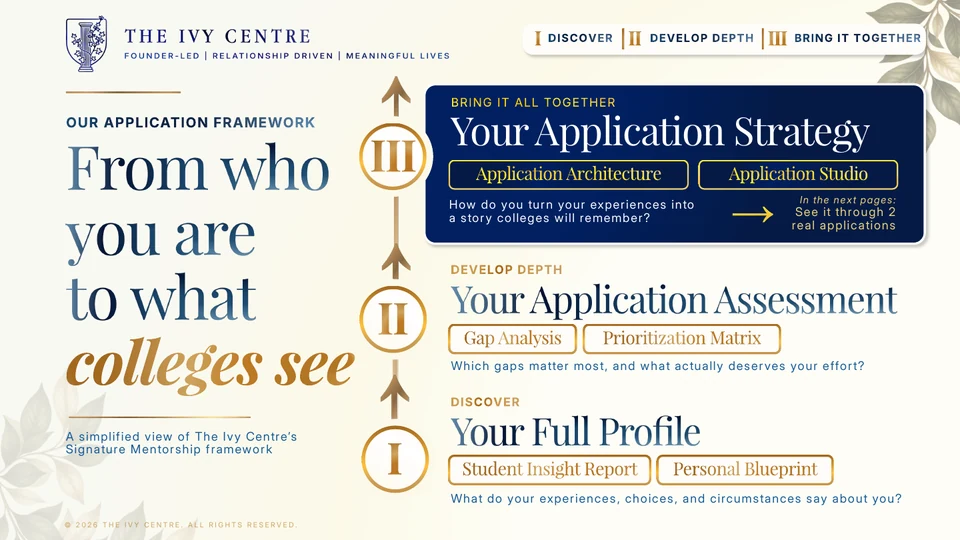 College Application Strategy Map
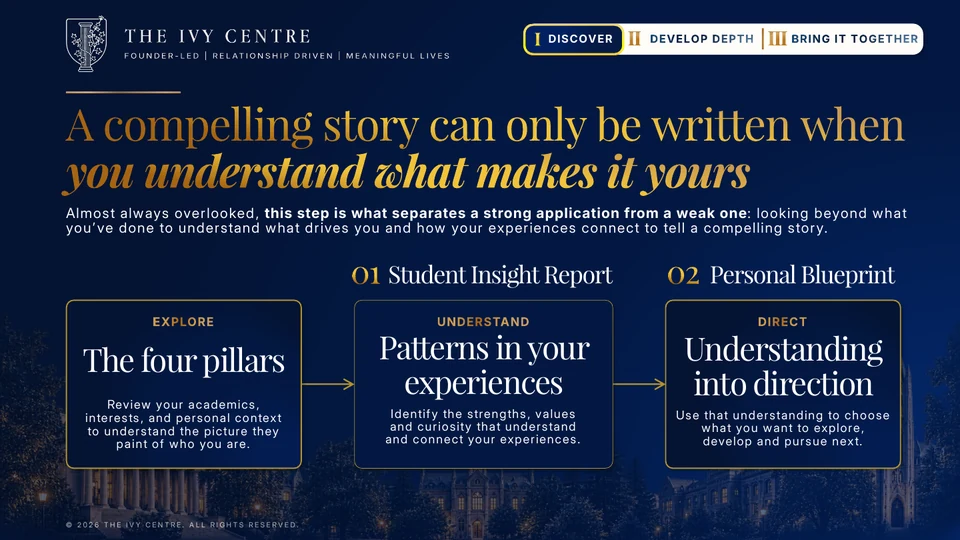 Discover What Sets You Apart
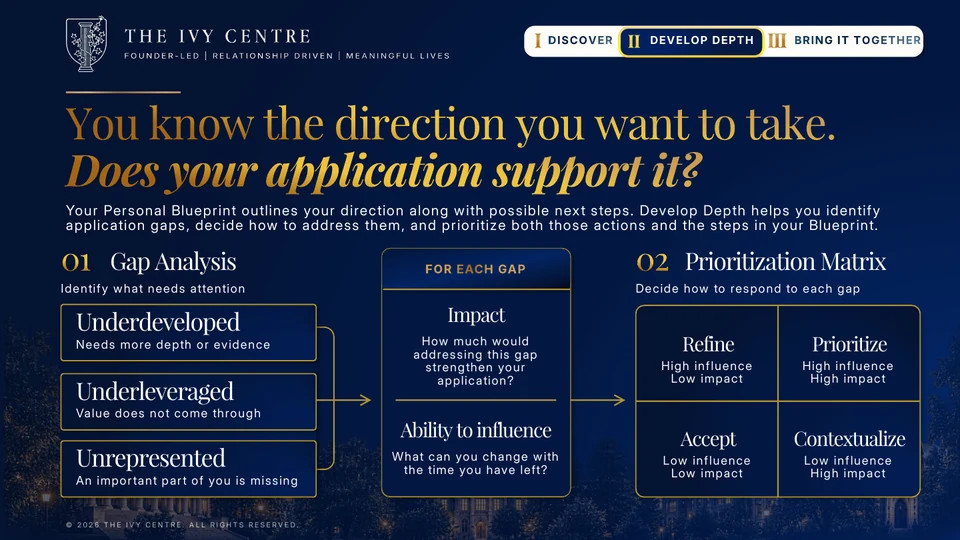 Find and Address Your Specific Application Gaps
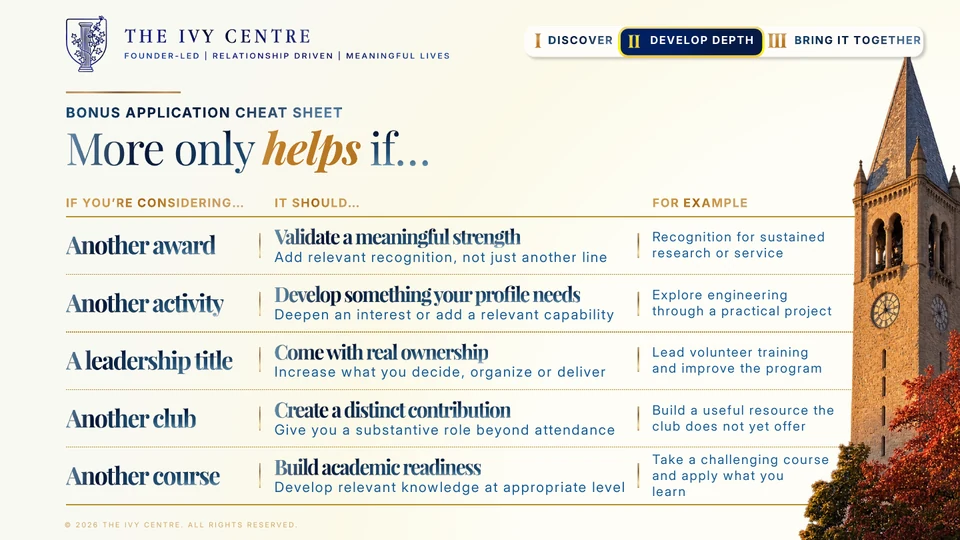 What to Strengthen Next: Your Priorities Cheat Sheet
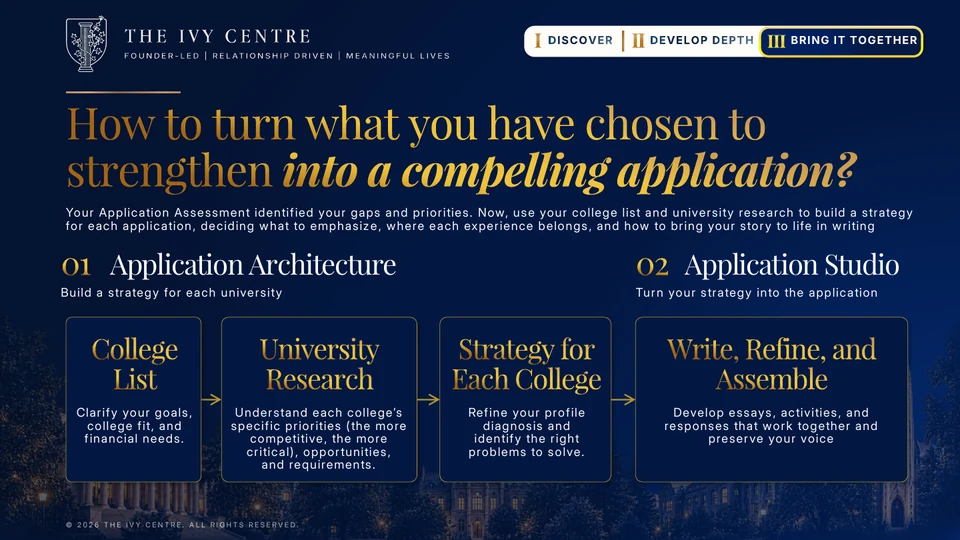 Turn Your Profile into a REALLY Compelling ApplicationHow to Research Colleges and Shape Your Strategy for Each
All 15 chapters and six guides are included with free access and also shared with you over email.
Explore the free masterclassChoose the version for you. Free access, with no commitment to mentorship.
Reviewed by Lara David for The Ivy Centre. Our program descriptions draw on our published mentorship framework and masterclass. Linked external sources support the specific comparisons identified in this guide. Illustrative examples are labeled; individual outcomes are not predictions.