A strong profile needs evidence behind its claims
A competitive application profile helps a reader understand how a student learns, what they care about, what they contribute and how they have used the opportunities available to them. Strong grades matter, but a profile is more than a transcript and a list of activities. The pieces need to reveal a person with substance and direction.
There is no universal set of activities that guarantees admission to an Ivy League university. Students have different interests, responsibilities, resources and school contexts. The useful task is to understand what the current evidence shows, what is missing and what can realistically be developed before applying.
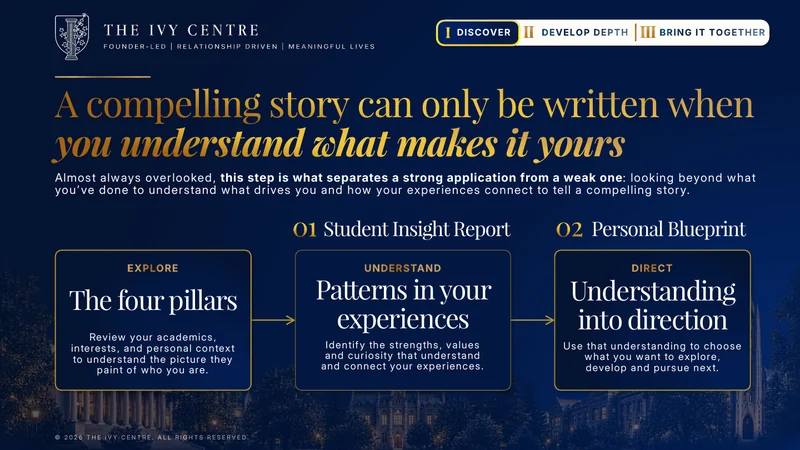
Begin with claims you might make about yourself: intellectually curious, persistent, collaborative, committed to a field. For each one, ask what experience demonstrates it. If the only evidence is an adjective in an essay, the claim may need more thought, stronger examples or a different description.
Explain what you achieved, contributed and learned
An achievement records a result. A contribution explains what you did. Reflection explains what you learned and how it changed your thinking. A convincing profile can include all three, but they are not interchangeable.
For example, an award may establish recognition without explaining your individual role in a team project. A substantial responsibility may demonstrate commitment without a formal award. A thoughtful reflection can illuminate an experience, but it cannot substitute for work that did not happen.
This distinction helps you inventory your profile accurately. Include schoolwork, employment, family responsibilities, independent interests and community contributions where relevant. The goal is not to make every experience sound extraordinary. It is to identify what is meaningful and explain it precisely.
Put the guide into practice
Audit one claim in your profile
Choose a statement you make about yourself and follow the evidence.
01What do I claim?
Use a precise statement about an interest, quality or contribution. Avoid relying on broad adjectives that could describe almost any applicant.
02What demonstrates it?
Identify the work, decision or responsibility that supports the claim. Separate your own contribution from the result of the wider team.
03What is missing or unclear?
Decide whether you need deeper experience, better reflection or clearer communication. These needs require different responses.
04What can I do next?
Choose an action appropriate to the time available. Define what you will do, what feedback you need and when you will review the result.
Strengthen academic readiness in context
Review your academic preparation against the subjects and programs you are considering. Look at the opportunities available at your school and the choices you made within them. A gap in preparation may call for learning or a revised plan, rather than a more persuasive explanation.
If your record includes disruption or unusual circumstances, identify what context is relevant and how to present it accurately. Context should help a reader understand the record. It should not become a request to disregard academic readiness or an excuse to disclose more personal information than you wish to share.
Testing decisions also need current information. Check each institution’s requirements for your cycle and consider what your score contributes in context. Broad advice to always submit or never submit can overlook important differences between institutions and applicants.

From The Ivy Journal
Lower Test Scores Can Still Strengthen Your College Application.
Read the articleBuild depth through questions you actually want to pursue
Depth often develops when you stay with a question long enough to encounter difficulty, feedback and revision. You might investigate an idea, create something, contribute to an existing effort or develop a skill. The value lies in how you engage with the work, not simply in choosing an activity with an impressive name.
If you are interested in research, begin by understanding what research in that field involves. Read appropriate material, learn necessary methods and seek legitimate guidance where available. Paying for an activity with “research” in its title does not automatically establish intellectual depth.
If you are interested in leadership, look at the responsibilities you already hold. Improving a process, helping a group make decisions or consistently supporting others can be more meaningful than collecting another position. Ask what you contributed and how you know it was useful.
Diagnose the gap before choosing the solution
Different weaknesses require different responses. You may need to develop evidence, strengthen an existing experience or communicate context more clearly. Treating every gap as a reason to add another activity can waste time and make the profile less coherent.
| What you notice | What to investigate | A possible response |
|---|---|---|
| A stated interest has little supporting experience | Whether the interest has been tested through actual work | Explore an appropriate question or opportunity before making a larger commitment |
| Several activities remain superficial | Why the student has not gone deeper | Reduce competing commitments and develop one meaningful contribution |
| A strong experience is hard to explain | The student’s role, decisions and learning | Recover accurate details and reflect before writing |
| An academic record looks inconsistent | Preparation, circumstances and the time available | Strengthen what can change and explain relevant context accurately |
| Every essay repeats the same strength | Which dimensions of the student remain unseen | Reconsider the purpose of each application component |
These are illustrative responses, not automatic prescriptions. A thoughtful strategy investigates the cause and the time available before deciding what to do.
An example: help an engineering student show more than grades
Imagine a student with excellent mathematics performance, several technical activities and a strong interest in engineering. Their first description of the profile sounds like a list of achievements shared by many other applicants. This is an illustrative scenario, not a disclosure of a client’s record.
The next question is not necessarily “What prestigious activity is missing?” It may be “What do your choices reveal that the list does not?” Perhaps the student repeatedly builds tools for other people, enjoys explaining difficult concepts or becomes absorbed in the practical limitations of an elegant solution. Those patterns need evidence before they become an application theme.
With time available, the student might pursue a project that tests one of those interests and seek feedback from people who use the result. Close to the deadline, the work may instead involve identifying overlooked evidence already present. The strategy depends on the starting point, not on a generic requirement to be more distinctive.
Research colleges as environments, not prizes
A competitive profile does not remove the need for a thoughtful college list. Investigate what a university actually offers in your area of interest, how undergraduates access opportunities and what kinds of learning and community you value. Consider practical constraints and affordability alongside ambition.
Connect each finding to a reason. If a course sequence, teaching approach or opportunity matters to you, explain why it relates to what you have already learned or want to explore. This research supports your decision, your university specific essays and your interviews.
Avoid copying the institution’s language back to it without interpretation. Naming a program shows that you found it. Explaining how it connects to your questions and preparation shows that you have thought about it.

From The Ivy Journal
The Research University Trap: Why a Famous Lab Is Not College Strategy
Read the articleTurn the profile into a coherent application
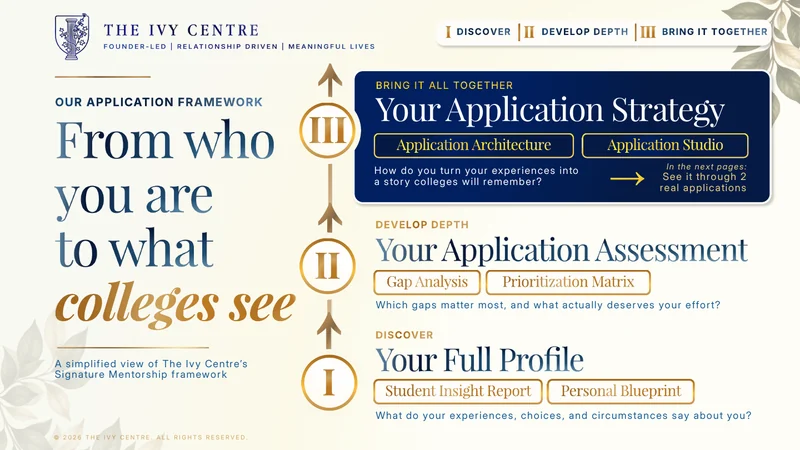
At The Ivy Centre, Application Architecture assigns a purpose to each part of the application before writing begins. The student’s experiences, goals and context are considered alongside each university’s questions. The aim is to reveal different dimensions without creating contradictions or repetitive essays.
The personal statement does not need to summarize every achievement. The activities section should describe real work accurately. Supplements should respond to the particular prompt. Additional information should provide necessary context rather than become a second résumé. Each component earns its place by helping the reader understand something relevant.
Our Triple Quality Control process brings all three founders into reviewing the complete application. The student remains the author, and the application must remain true to their experience. Clear strategy should make the student more visible, not cover them with polished language that could belong to anyone.
Explore our application strategy framework
Look beyond the immediate admission
The habits behind a strong profile can remain useful in college and later applications: asking better questions, working through difficulty, seeking feedback and communicating evidence. For students interested in master’s degree, STEM PhD, medical school or MBA pathways, those habits support future preparation, although each pathway has its own requirements.
The Ivy Centre offers support across these later stages as well as undergraduate admissions. We connect development and application strategy while keeping the scope of each engagement clear. A high school student should not feel obliged to predict their entire career before they are allowed to explore.
For a master’s applicant, academic prerequisites, the choice between taught and research study and the purpose of the degree may become central. A strong profile is evidence that fits the next stage, not an accumulation of activities that looked impressive at an earlier one.
Choose your next step deliberately
Make a short inventory of what your profile already demonstrates, what is unclear and what can still change. Select one priority that is both meaningful and achievable. Define the work, the feedback you need and when you will review the result.
A stronger profile is not always a longer one. It may be a more substantial body of work, a better supported academic direction or a clearer explanation of experiences you already have. The right next step is the one that follows from your actual evidence.
Plan meaningful development in ninth and tenth grade
See the strategy in practice
See how we assess what is missing.
Explore the masterclass chapters on profile strengths, application gaps and where your effort can make the most difference.
Full masterclass included with free and immediate access
Explore the 15 chapters
Free with masterclass 00:0001What does a strong application actually need?
 06:3502The five stages of every strong application strategy
 09:2003What makes you memorable to admissions officers?
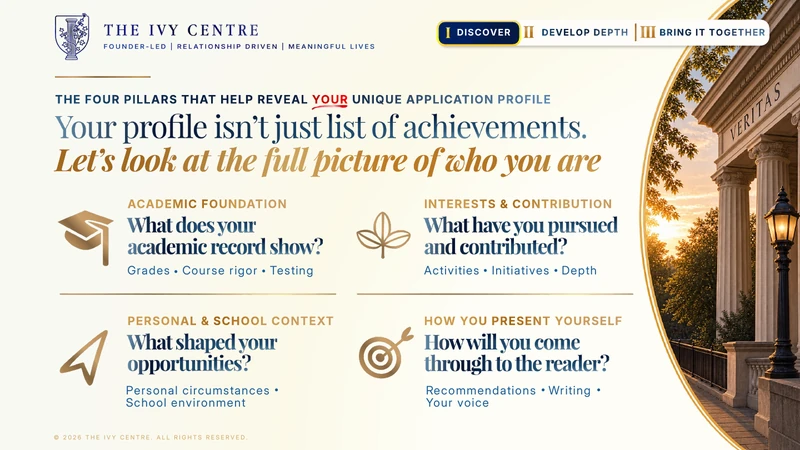 10:4504The four pillars behind every student profile
 12:2705Turn your strengths, values, and curiosity into direction
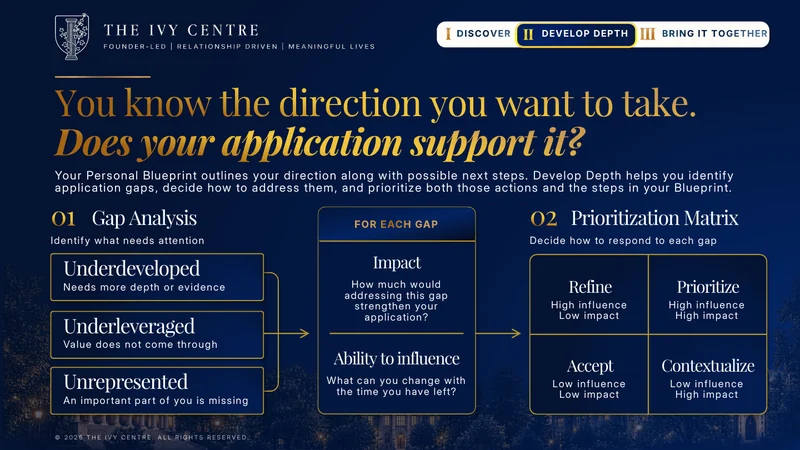 13:5306What is your application actually missing?
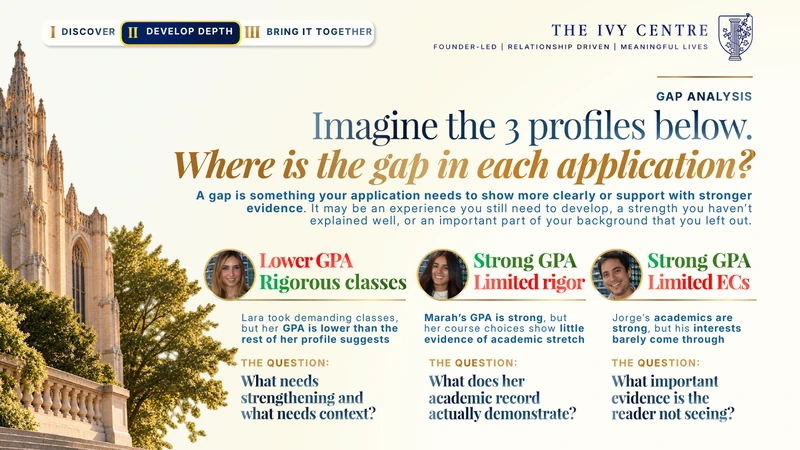 15:2607How to spot weaknesses in your college application
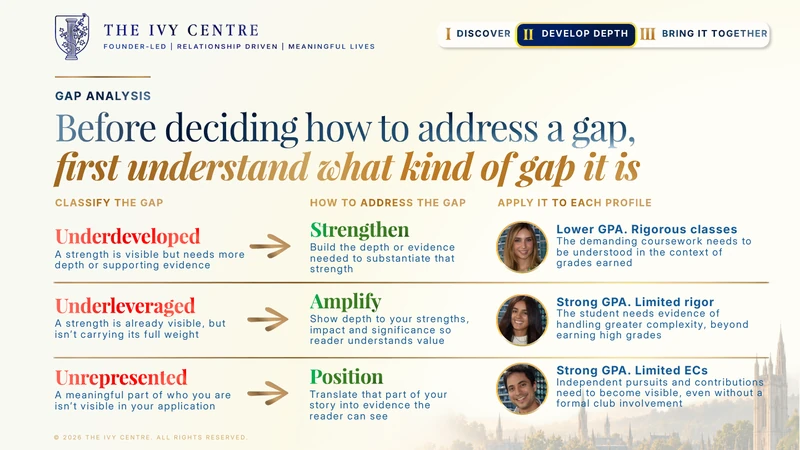 17:0108There's only 3 types of gaps. Each with a different way forward.
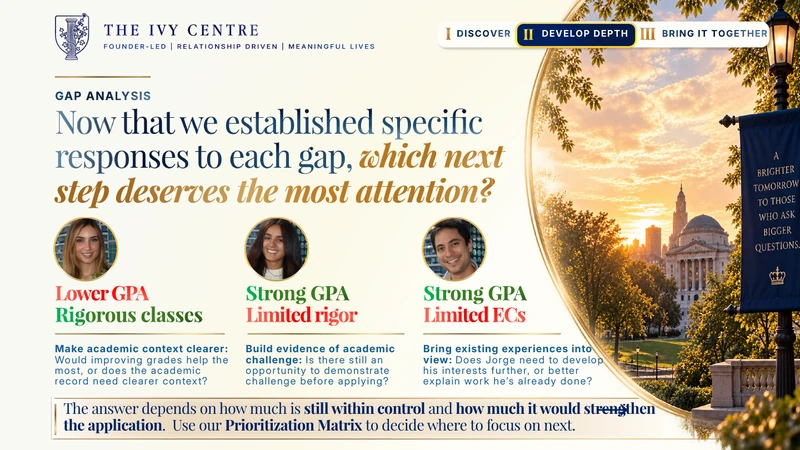 18:5509What can you still change before you apply?
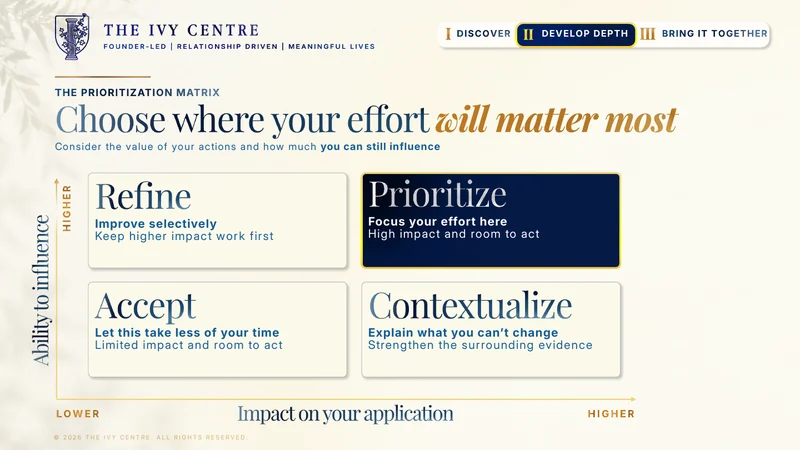 20:2610What deserves your effort, and what can wait?
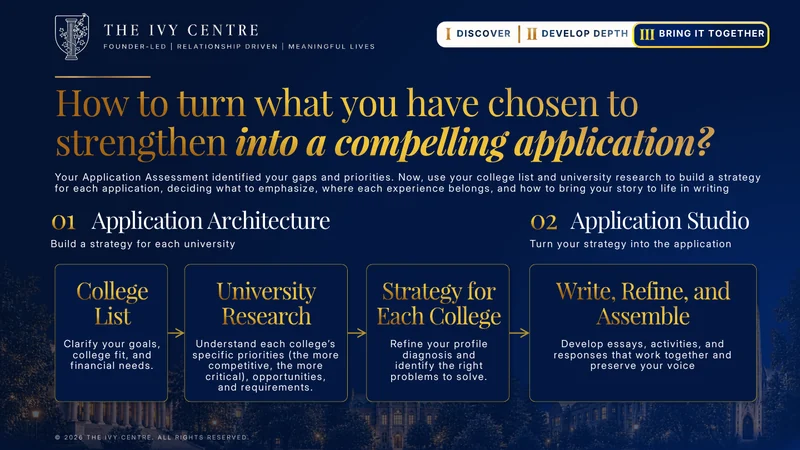 21:3711Why each university needs a different strategy
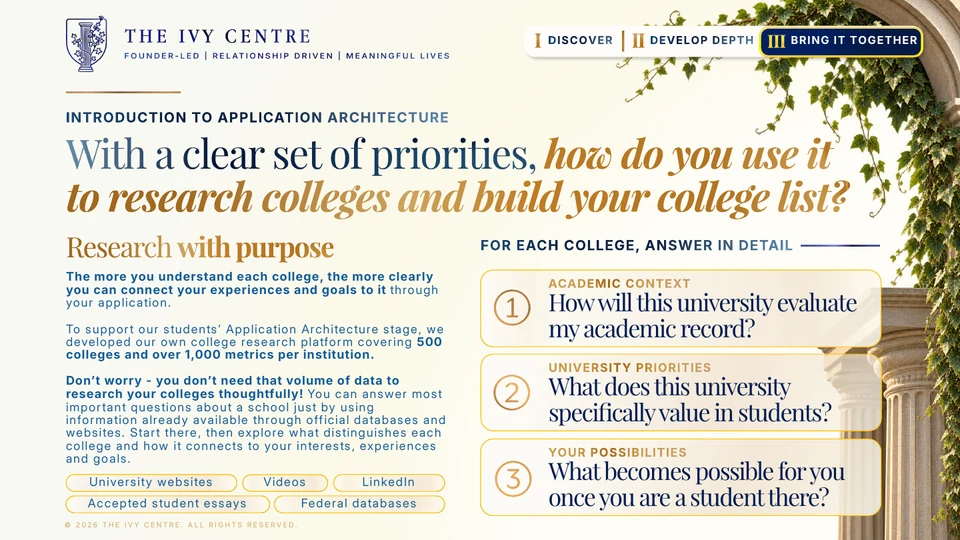 22:3612How to research colleges the right way
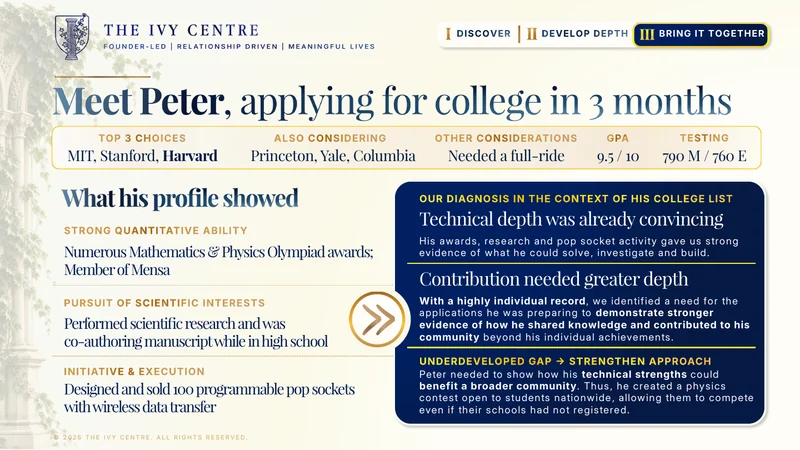 24:4513Peter: Highly technical profile but no differentiator
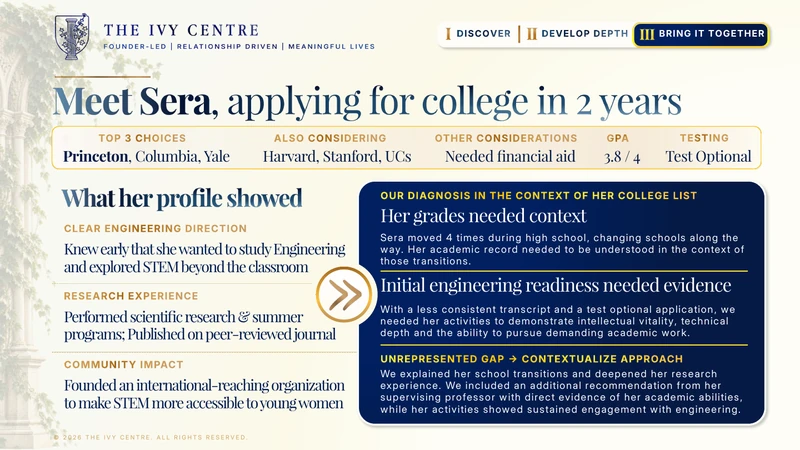 26:3714Sera: Low GPA and SAT, but strong depth in context
 27:5615What should you do next?
Six downloadable resources
Free with masterclass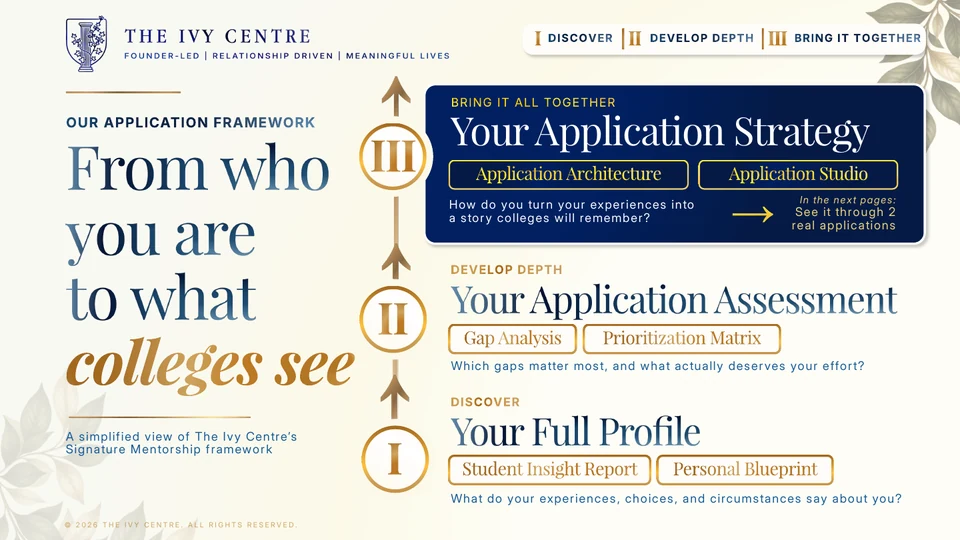 College Application Strategy Map
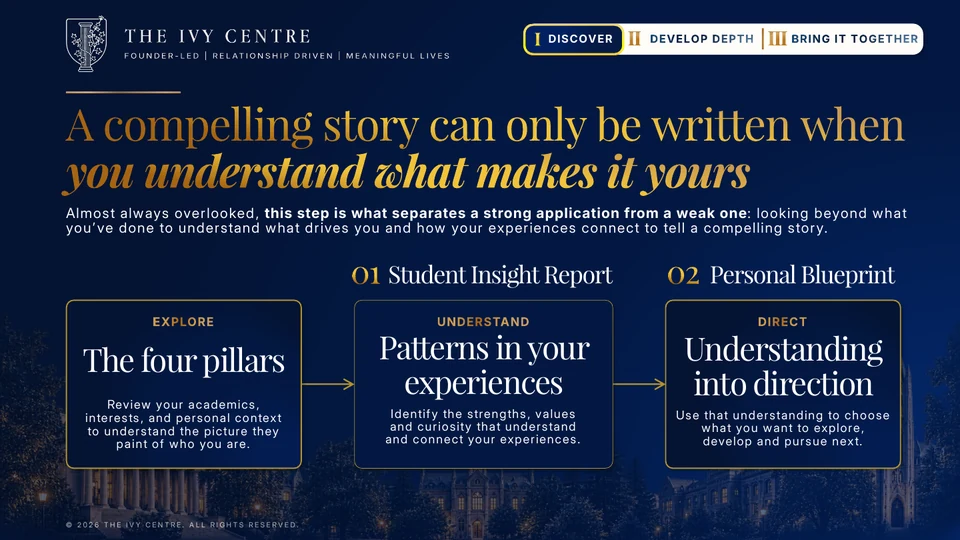 Discover What Sets You Apart
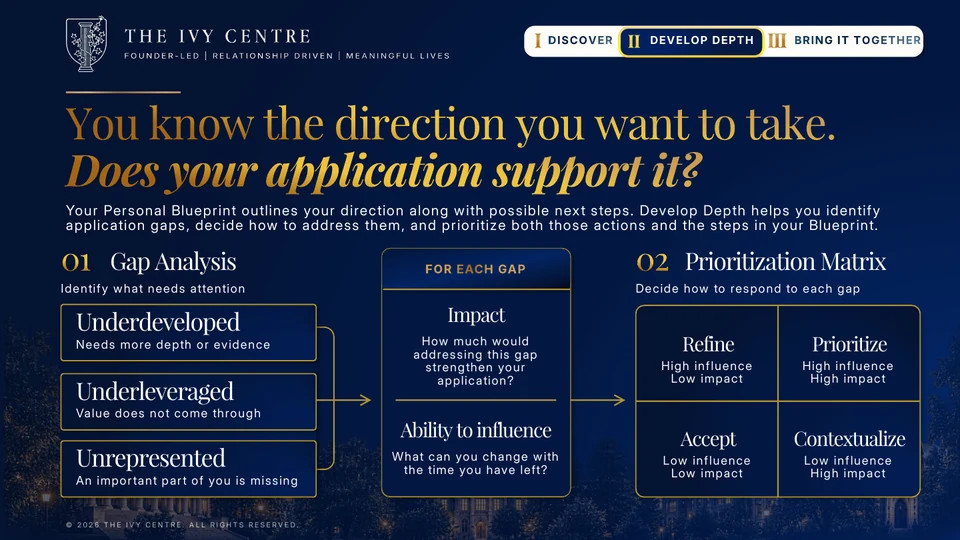 Find and Address Your Specific Application Gaps
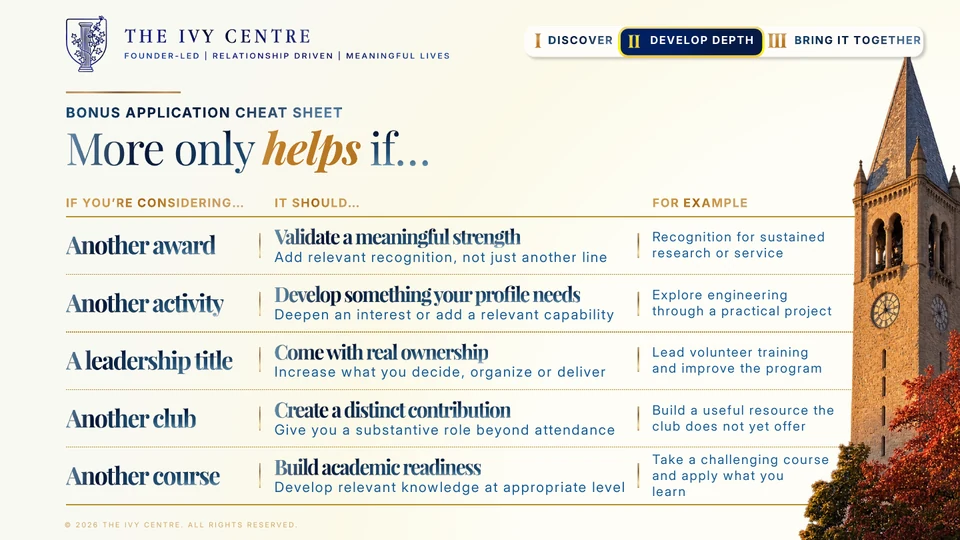 What to Strengthen Next: Your Priorities Cheat Sheet
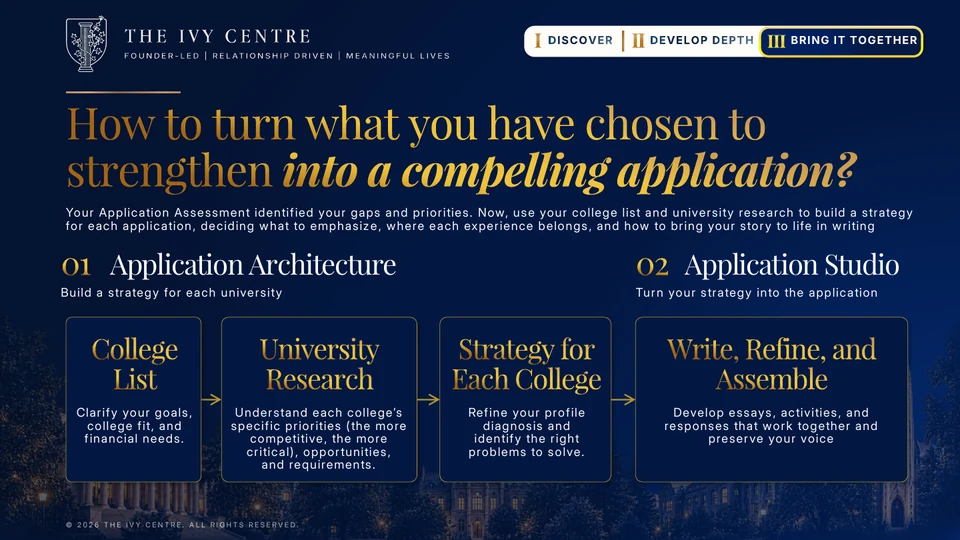 Turn Your Profile into a REALLY Compelling ApplicationHow to Research Colleges and Shape Your Strategy for Each
All 15 chapters and six guides are included with free access and also shared with you over email.
Explore the free masterclassChoose the version for you. Free access, with no commitment to mentorship.
Reviewed by Jorge Dorantes, MD for The Ivy Centre. Our program descriptions draw on our published mentorship framework and masterclass. Linked external sources support the specific comparisons identified in this guide. Illustrative examples are labeled; individual outcomes are not predictions.