Consulting and mentorship describe different kinds of work
Admissions consulting usually refers to advice on preparing and submitting an application. Mentorship can include that work, while also helping a student understand themselves, develop their abilities and make decisions over time. The names alone do not establish quality. A consultant can be a thoughtful mentor, and a service called mentorship can still amount to occasional document feedback.
The useful distinction is what happens between the first conversation and the final application. Who learns the student’s context? Who helps them act on the advice? Who notices when the plan should change? Who remains responsible when academic, personal and application priorities conflict?
This guide compares common delivery models rather than ranking companies. A firm may combine several models, and individual advisers can work differently within the same organization. Use the categories to understand a proposal and ask more precise questions.
Put the guide into practice
Compare how responsibility is organized
Open each model to see the delivery question worth asking before comparing credentials or prices.
01Specialist team
Who connects the work across the college list, activities, testing and essays? Ask how advisers share context and who is responsible for the complete strategy.
02Recent graduate or near peer
What training and supervision support the adviser’s recent student perspective? Ask how they handle circumstances different from their own.
03Independent or boutique one to one
How does the adviser protect continuity and capacity? Ask about backup arrangements, specialist input and who challenges the strategy.
04Former admissions officer
How does the person’s institutional experience relate to the work you need now? Ask about role, recency and developmental support, without assuming access to a future committee.
05The Ivy Centre’s three founders
How will Lara, Marah and Jorge work together within your proposed program? Ask about shared decisions, ongoing involvement and how the student’s context stays connected.
The specialist team model
A specialist team divides responsibilities among people with different areas of expertise. One person may coordinate the college list, another may advise on essays, and others may support testing, projects or interviews. The potential advantage is access to relevant expertise without expecting one adviser to know everything.
The important question is how those perspectives come together. An essay adviser needs to understand the strategy behind the college list and the experiences that matter to the student. A testing recommendation should account for the student’s academic demands and application timeline. If each specialist sees only their own assignment, the family may end up coordinating the strategy themselves.
Ask who owns the whole plan, whether specialists share working notes and how conflicting advice is resolved. Establish whether the lead adviser reads the complete application and whether the same people remain involved throughout. A strong team should be able to explain its handovers and accountability clearly.
This arrangement may suit a student who wants several distinct services and is comfortable building relationships with different advisers. It is less attractive when the student needs continuity but no one is responsible for maintaining it. Size alone does not settle the question: a large team can coordinate well, and a small one can coordinate poorly.
A specialist’s title also needs substance. Who are the people assigned to your student, what training supports their judgment, and who reviews their recommendations? A long list of available specialists is less useful if the family cannot establish which ones will participate or how well they understand the student. The central risk is fragmented responsibility, not the mere fact that more than one person is involved.
The recent graduate or near peer model
A recent graduate can make college feel more understandable and approachable. Students may find it easier to speak candidly with someone who remembers the application process and campus experience closely. This perspective can be valuable for brainstorming, confidence and practical questions about student life.
Their own admission experience, however, is one experience. It does not automatically establish expertise across different school systems, financial circumstances, academic interests or admissions cycles. The relevant question is how the adviser has learned to evaluate students whose circumstances differ from their own.
Ask about training, supervision and experience beyond their personal application. Find out when a more experienced colleague reviews the advice and who handles unfamiliar issues. A student seeking a relatable sounding board may value this model; a complex application strategy may require additional expertise.
Relatability and professional judgment are different strengths. A recent graduate may remember a campus vividly while having limited experience with family disagreements, changing motivation or a student whose opportunities differ substantially from their own. Ask who supports them in those situations and whether the student can draw on a more experienced mentor without purchasing a separate service. Recent personal success should be a starting perspective, not the entire method.
The independent or boutique one to one model
An independent adviser or small boutique often builds continuity through a close relationship with one lead person. The same adviser may see the student’s early thinking, evolving interests and final application. That accumulated understanding can make feedback more specific and reduce the need to repeat context.
The tradeoff is dependence on that individual’s capacity and range of experience. Ask what happens during an illness, a busy deadline period or a disagreement. Does anyone challenge the lead adviser’s assumptions? Is there access to specialist support when needed? A small business should be able to describe its continuity arrangements without disclosing other students’ private information.
This model may fit a student who works best through a stable relationship. Evaluate the person’s availability and ability to earn the student’s trust, as well as their qualifications. A distinguished résumé is useful only if the adviser has the time and interest to bring that experience into the work.
A long career does not eliminate the limits of one perspective. An adviser may have deep experience in one school system or academic field and less in another. Ask how they test their own assumptions and seek relevant expertise. The practical issue is whether this person’s experience helps them understand your student, rather than steer the student toward the path they know best. Continuity is valuable; an independent second perspective can make it stronger.
The former admissions officer model
A former admissions officer may bring valuable experience reading applications and understanding an institutional review process. That perspective can help a student see how evidence is presented, how context is interpreted and how an application reads as a whole.
It does not create control over present admissions decisions. Ask where and when the person worked, what their responsibilities were and how they stay informed about current policies. Experience at one institution should not be presented as privileged access to every university or as a guarantee of knowing a future committee’s priorities.
Also distinguish evaluation from development. Explaining how an application may be read is different from helping a student build the experiences, judgment and habits that give the application substance. Some advisers do both well. The proposal should say which work is included and who performs it.
A useful follow up is: “Can you show us how you turn an evaluation into a development plan?” Recognizing that an essay or profile is unconvincing is not the same as helping a student build the experience, reflection or communication that would make it convincing. Ask for the adviser’s method, the actions it produces and how progress is reviewed. Experience can inform intuition; families should still be able to understand the reasoning.
A simulated admissions committee can provide another reading of a completed application. Its value depends on who participates, what they examine and whether the feedback is actionable. A one time committee review and continuing strategic mentorship serve different purposes. Neither gives access to a university’s actual decision process.
The Ivy Centre’s three founder mentorship model
Our approach brings Lara David, Marah Selim and Jorge Dorantes into a connected mentorship with each student. The founders contribute different professional perspectives while remaining involved in the same student’s development and application strategy. Founder involvement is part of delivery, rather than simply a name attached to the business.
Lara’s background in engineering and management consulting informs how we break down complex decisions, examine evidence and turn a strategy into practical work. Marah’s background in psychology and human development helps us understand motivation, pressure and how a student follows through. Jorge’s experience across medicine, research and the humanities adds another perspective on intellectual depth, communication and possible futures.
All three founders are Ivy League alumni with scientific or technical backgrounds and substantial experience beyond their own undergraduate applications. Lara holds a master’s degree in Earth and Environmental Engineering and worked in management consulting at Boston Consulting Group. Marah is a Counseling Psychology PhD candidate. Jorge is a physician and resident surgeon. Their work also reaches into education, writing, music, philosophy and the humanities. Scientific reasoning and clear communication belong together in our mentorship.
We want students to know people who have navigated demanding academic and professional environments, can discuss the realities of those paths and have chosen to invest their time in education. Role models should make possibilities more understandable, not make a student feel they must copy someone else’s résumé. Our founders’ different experiences create room for a student to question, explore and find their own direction.
Every student benefits from a weekly founder discussion
Lara, Marah and Jorge meet every week to discuss each student. We review development, completed work, parent conversations, barriers, emerging interests and opportunities worth exploring. A changed priority is considered in the context of the whole student, rather than passed between unrelated assignments.
For example, an unfinished project might initially look like a time management problem. A conversation could reveal that the student no longer finds the question interesting, lacks a particular skill, or has taken on too much. The founders can consider those explanations together and decide what to investigate next. The purpose of the meeting is a useful response, not three opinions for the student to reconcile alone.
This continuing review differs from bringing a committee together only after the application is written. We also review final applications through Triple Quality Control, but our collaboration begins earlier, while the student’s experiences and decisions are still developing.
How the work stays connected
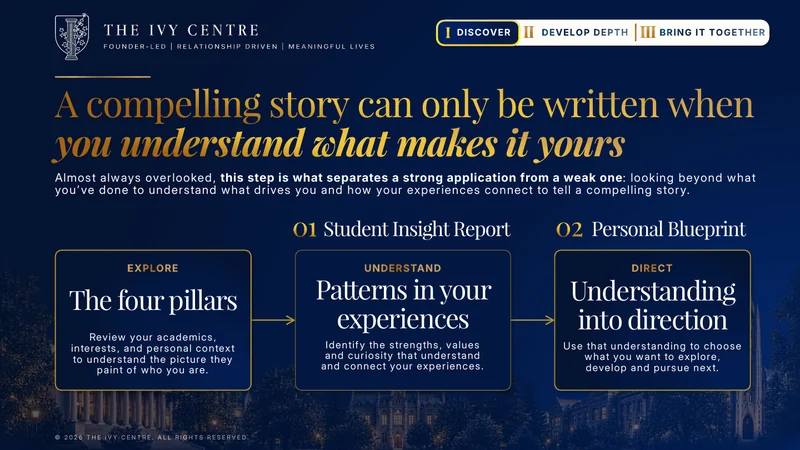
The Student Insight Report brings together the student’s strengths, values, interests and development needs. The Personal Program Blueprint turns those findings into a plan. As the student gains experience, the founders revisit the plan rather than treating an early assessment as a permanent identity.
Our connected student environment preserves the context of meetings, assignments, projects and decisions. That matters when a concern raised in one conversation should change another part of the strategy. A missed deadline may reveal an unrealistic workload. A project may uncover an academic interest that should change the college list. The system helps people see those connections; the founders interpret them with the student.
Before applications are written, Application Architecture gives each component a purpose. Triple Quality Control brings all three founders into the review of the complete application. The aim is a coherent account of the student, with accurate evidence and an authentic voice, rather than a collection of individually polished but disconnected pieces.
Explore our connected student environment
Compare who knows the student and who owns the strategy
| Model | Potential strength | What the family should verify |
|---|---|---|
| Specialist team | Different kinds of expertise available within one organization | Who integrates the work, manages handovers and makes the final strategic call |
| Recent graduate or near peer | Relatable guidance and recent student experience | Training, supervision and experience beyond the adviser’s own application |
| Independent or boutique one to one | Continuity and detailed knowledge of the student | Capacity, backup arrangements and access to another perspective |
| Former admissions officer | Experience evaluating applications in an institutional setting | Relevant role, recency, current knowledge and ability to support development |
| The Ivy Centre’s three founder model | Three Ivy League alumni with professional and graduate experience, weekly student discussions and a connected student environment | How the proposed program combines founder involvement, development, application work and the student’s priorities |
Do not treat these categories as a ladder with one universally correct answer. A family needing a single application review may value speed and a clearly defined deliverable. A student seeking broader development may value continuity, reflection and experienced mentors who can challenge their thinking over time.
| What The Ivy Centre brings | How it affects the student’s experience |
|---|---|
| The three founders remain involved | The people responsible for the mentorship know the student’s context and discuss it together every week. |
| Scientific, professional and humanities perspectives | A decision can be examined for evidence, feasibility, motivation and communication, rather than through one professional lens. |
| A connected student environment | Meetings, priorities and projects retain context across the founders’ work. Automation supports coordination; founders make the judgments. |
| Development alongside application strategy | Executive functioning, academic direction, SAT preparation and communication are considered within the agreed program and timeline. |
| Undergraduate and graduate admissions support | Applicants can seek guidance for college, master’s degrees, STEM PhD programs, medical school and MBAs, with the appropriate scope for each stage. |
| Education access built into the model | One paying student supports one scholarship student. Our wider education mission also includes ProDuca. |
The model is deliberately personal and limited in scale. We are accountable for the quality of each relationship and for the business we are building. We want families to meet us, understand the work and decide whether our approach is the right fit.
What the differences look like in practice
Consider a student who says they want to study medicine because they enjoy biology and want to help people. They have strong grades but little experience of the daily realities of healthcare. This is an illustrative example, not an identifiable student story.
A focused application service might help the student communicate their existing experiences accurately. A specialist team might connect them with relevant academic and application support. A developmental mentorship would also question the assumption behind the stated goal: what does the student understand about medicine, what experiences would test that interest and what other paths might satisfy the same values?
In our model, that conversation can draw on Jorge’s medical perspective, Marah’s understanding of motivation and Lara’s approach to evaluating alternatives. The next step might be an appropriate opportunity to learn more about healthcare, a different exploration or a revised timeline. It would not be inventing a clinical story to make an essay more persuasive.
The distinction is the work undertaken before the writing begins. A student can leave the process with better questions and a more informed direction, even when their original plan changes.
Beyond the undergraduate application
The Ivy Centre’s mentorship can address executive functioning, academic direction, SAT preparation, communication and personal development, with scope determined by the program. We also offer graduate school support, especially for master’s degree, STEM PhD, medical school and MBA applicants. These pathways require different evidence and different preparation.
A STEM PhD applicant needs to examine research interests, prior work and potential academic fit. A medical school applicant needs to think carefully about preparation, service, professional motivation and the requirements of the relevant system. An MBA applicant needs to connect professional experience, leadership and future goals. An undergraduate college list cannot simply be reused as a graduate strategy.
For families considering a continuing relationship, ask how support can evolve and what would require a new engagement. Community and access to thoughtful mentors may remain valuable beyond an admissions cycle, but the service agreement should clearly define the work being purchased now.
Explore the journey beyond admissions
A master’s degree applicant may need to compare research and taught programs, confirm prerequisites and explain why the proposed study advances an academic or professional goal. That requires its own research and strategy. Graduate guidance should start with the purpose and expectations of the particular degree.
What does a data driven mentorship actually do?
“Data driven” is useful only when a firm can explain the data, the decision and the limitations. Ask what information it collects, how it checks that information and how it changes a recommendation. A list of acceptance rates or an automated university ranking is not, by itself, a strategy for an individual student.
Our founders’ STEM and analytical backgrounds inform how we examine evidence and uncertainty. We combine the student’s context with research about programs and opportunities, then discuss what those findings mean for the next decision. We do not turn a small set of private student outcomes into a precise admissions probability.
Similarly, a claim such as “500 years of combined experience” says little about the person assigned to your child. It may describe many people across many roles. Ask instead about the assigned mentors’ relevant experience, their current availability and how their knowledge is kept current. The same questions should be asked of us.

From The Ivy Journal
The Research University Trap: Why a Famous Lab Is Not College Strategy
Read the articleIn our work, a useful evidence trail connects an observation to a decision. What did the student do? What did we learn from it? Which university requirement or opportunity is relevant? What remains uncertain? What should the student do next, and when will we revisit it? Lara’s engineering and management consulting experience, Marah’s research training and Jorge’s medical training reinforce that discipline.
We automate coordination, not care or judgment. The student environment helps us preserve information and follow through. The founders still question assumptions, interpret findings and communicate the reasons for a recommendation. Being comfortable with technology is useful because it gives us more capacity for this work, not because an algorithm can promise admission.
Price, ethics and accountability belong in the comparison
Collaborative Mentorship at The Ivy Centre starts at $15,000. It reflects a continuing relationship and the founder time required by that model. A lower priced service may be entirely appropriate for a narrower need. Compare what is included, who performs it, how much work occurs between meetings and what happens when the student’s needs change.
Across every model, the application must remain the student’s own work. Advisers should help students think, plan and communicate; they should not invent experiences, write a false personal story or promise influence over an admissions office. Ask how the firm handles authorship, outside tools, confidentiality and disagreements with the family.
Our commitment extends to students whose circumstances would otherwise limit access: one paying student supports one scholarship student. Alongside ProDuca, this is part of our wider ambition to improve education and help young people find work and opportunities that matter to them. We are building for meaningful impact, not for the largest possible enrollment.
Within the selected program, attention follows the student’s priorities. If testing is already strong, the work may focus more deeply on research, communication or a college decision. If planning and follow through need attention, we work on those foundations. The student receives the same commitment, directed where it can be most useful. Different program levels still have different amounts of founder time and involvement.
Make the decision with the student
Meet the people who would actually advise the student. Bring a real question and listen to how they investigate it. Do they ask for context before giving an answer? Can they explain a tradeoff without dismissing your concerns? Does the student feel able to disagree or admit uncertainty?
Then compare written proposals against the same priorities. The best fit is the relationship and delivery model that can help this student do the work ahead, within a scope and budget the family understands. A recognizable title, a large team and an impressive admissions statistic each tell only part of that story.
Use our consultant selection guide
See the strategy in practice
See three perspectives become a practical strategy.
The masterclass shows how our founders examine a profile and decide what to strengthen, highlight and explain.
Full masterclass included with free and immediate access
Explore the 15 chapters
Free with masterclass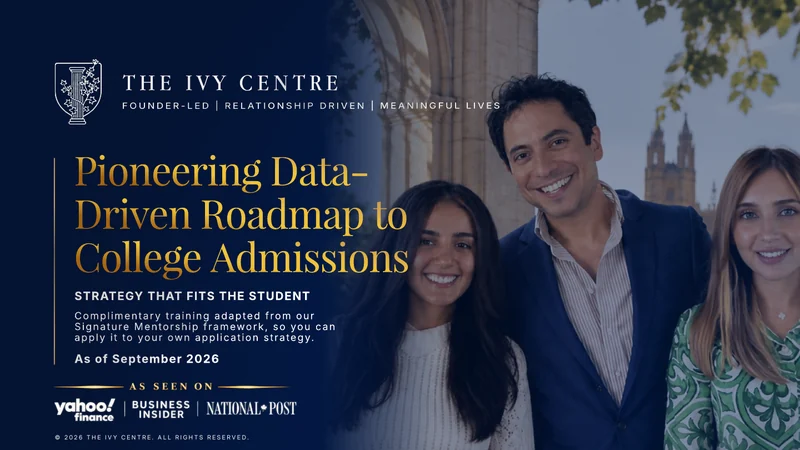 00:0001What does a strong application actually need?
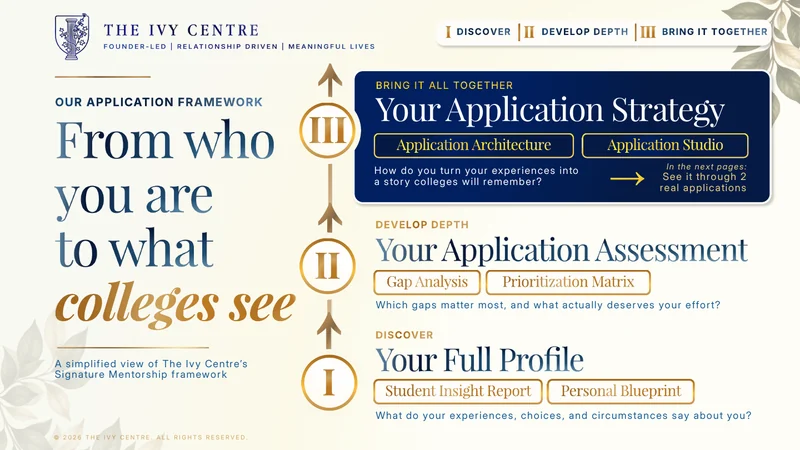 06:3502The five stages of every strong application strategy
 09:2003What makes you memorable to admissions officers?
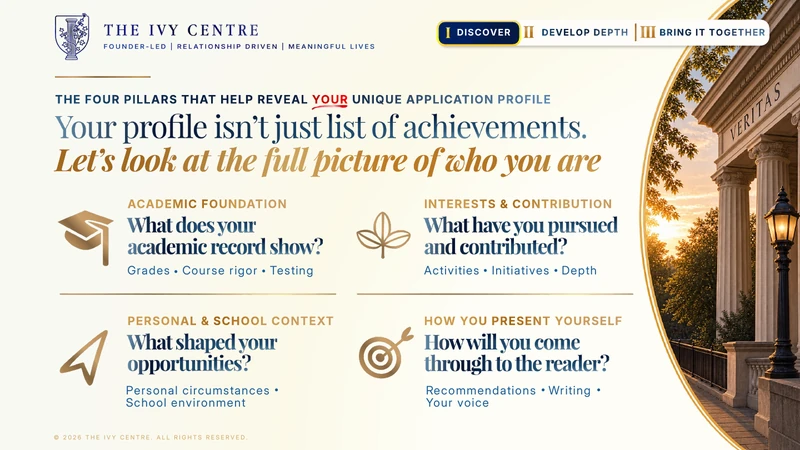 10:4504The four pillars behind every student profile
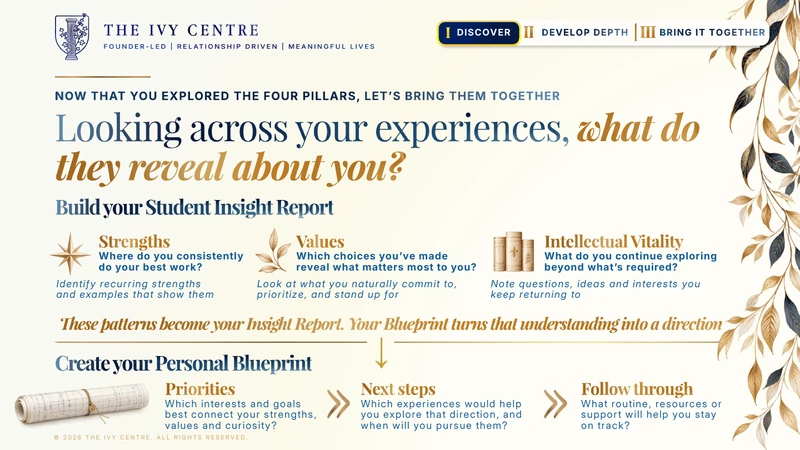 12:2705Turn your strengths, values, and curiosity into direction
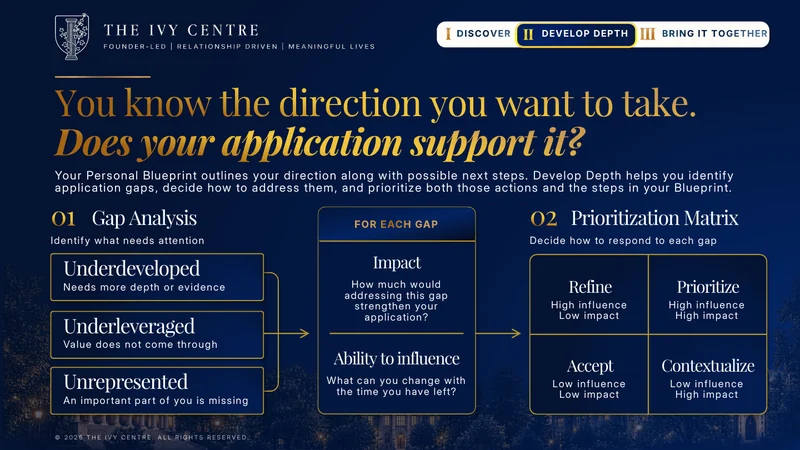 13:5306What is your application actually missing?
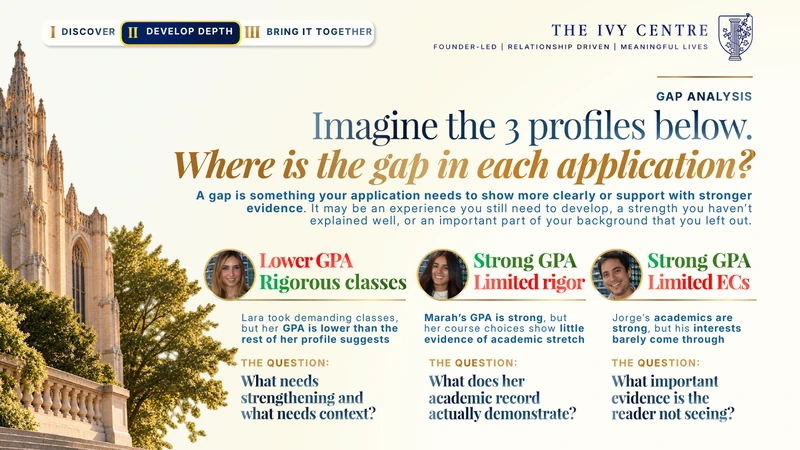 15:2607How to spot weaknesses in your college application
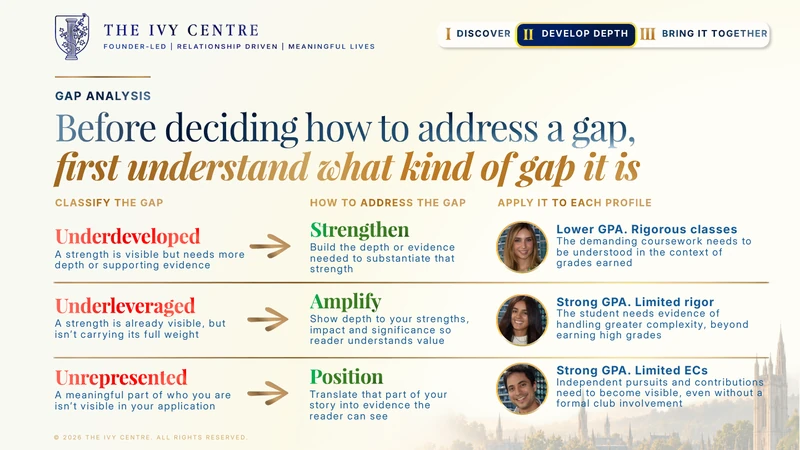 17:0108There's only 3 types of gaps. Each with a different way forward.
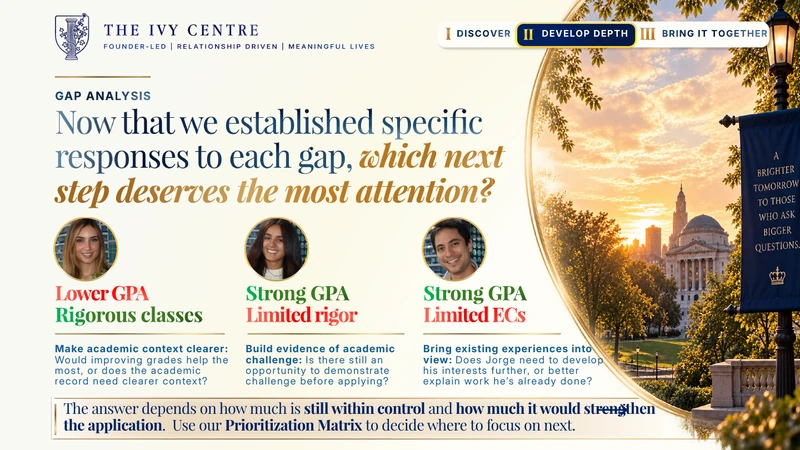 18:5509What can you still change before you apply?
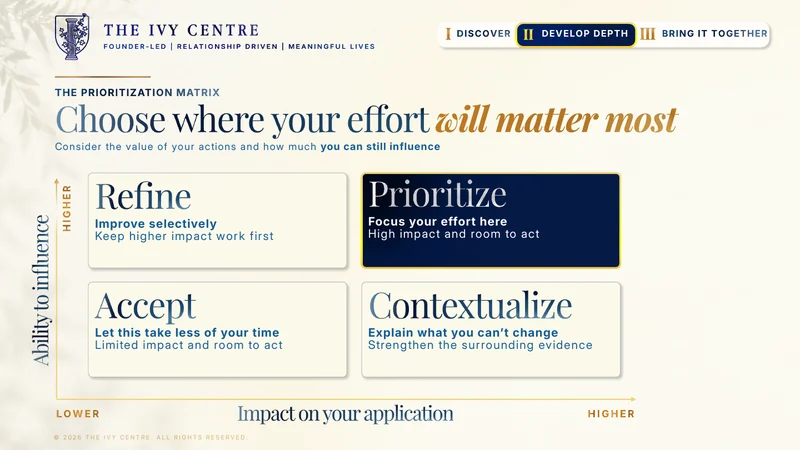 20:2610What deserves your effort, and what can wait?
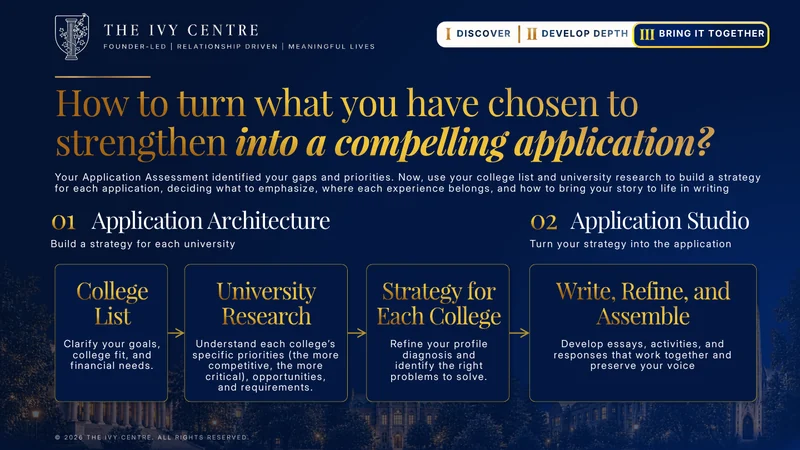 21:3711Why each university needs a different strategy
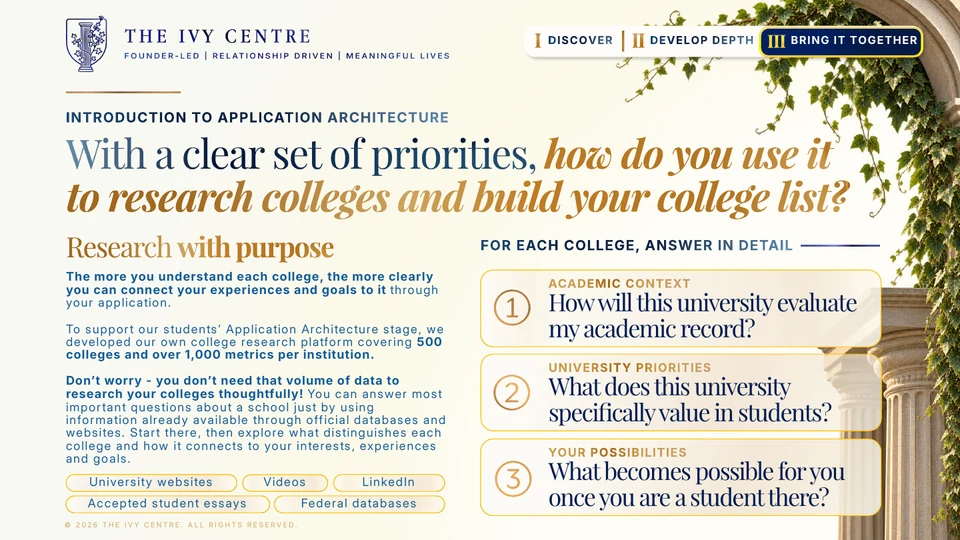 22:3612How to research colleges the right way
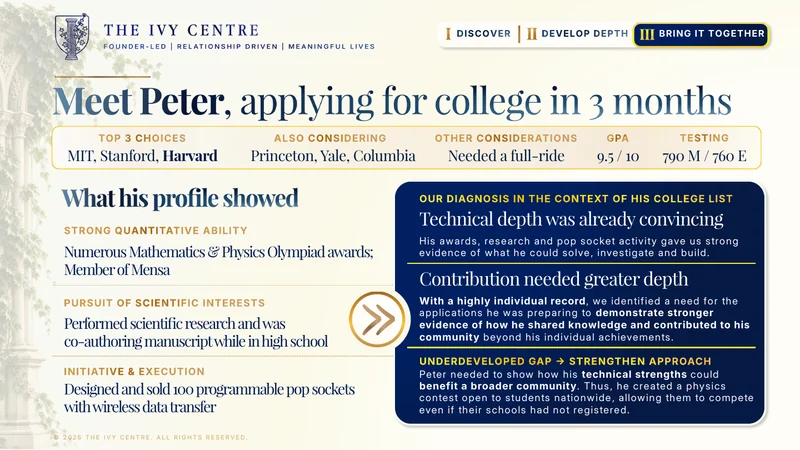 24:4513Peter: Highly technical profile but no differentiator
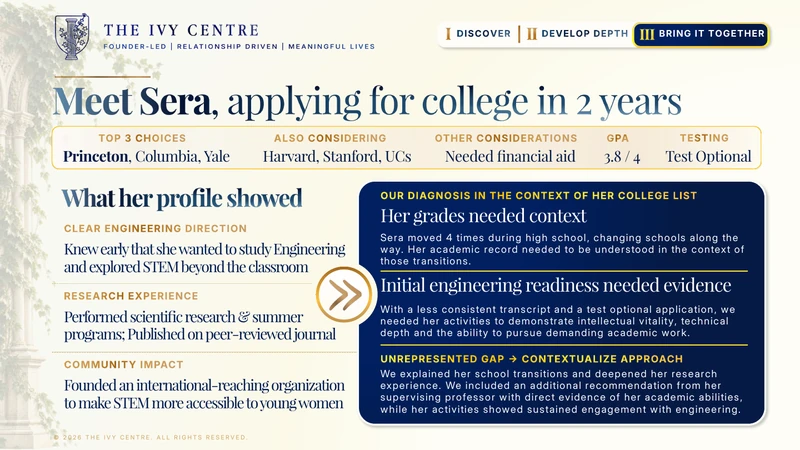 26:3714Sera: Low GPA and SAT, but strong depth in context
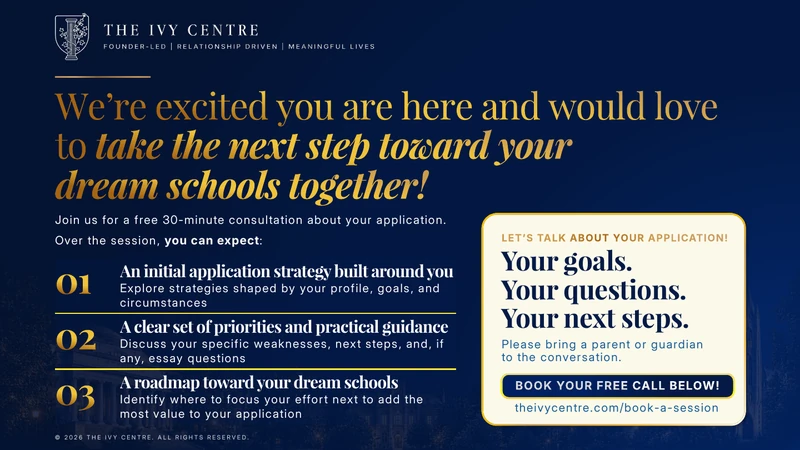 27:5615What should you do next?
Six downloadable resources
Free with masterclass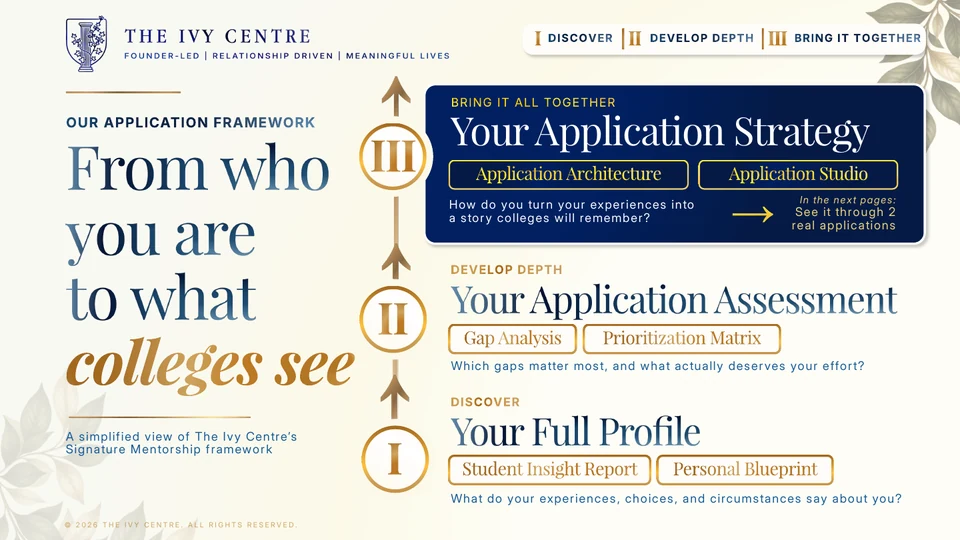 College Application Strategy Map
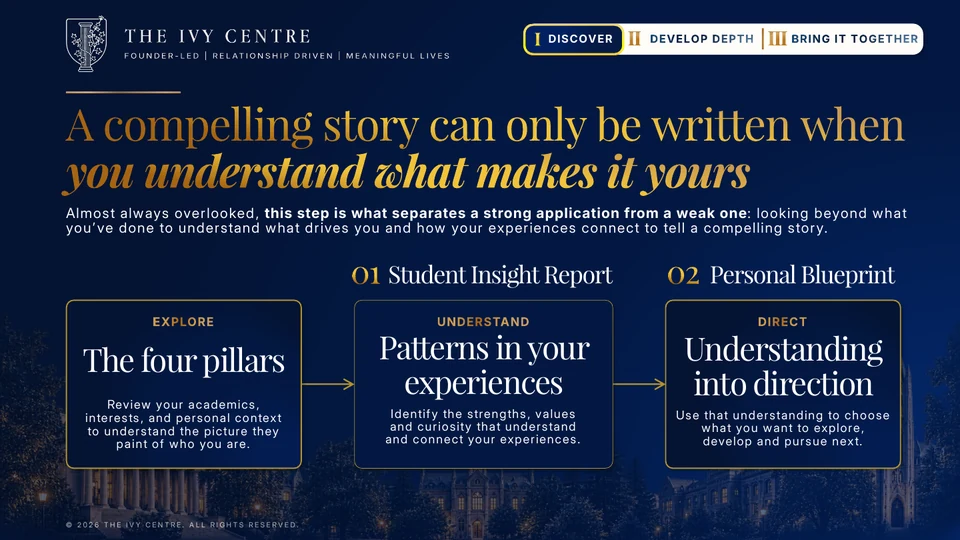 Discover What Sets You Apart
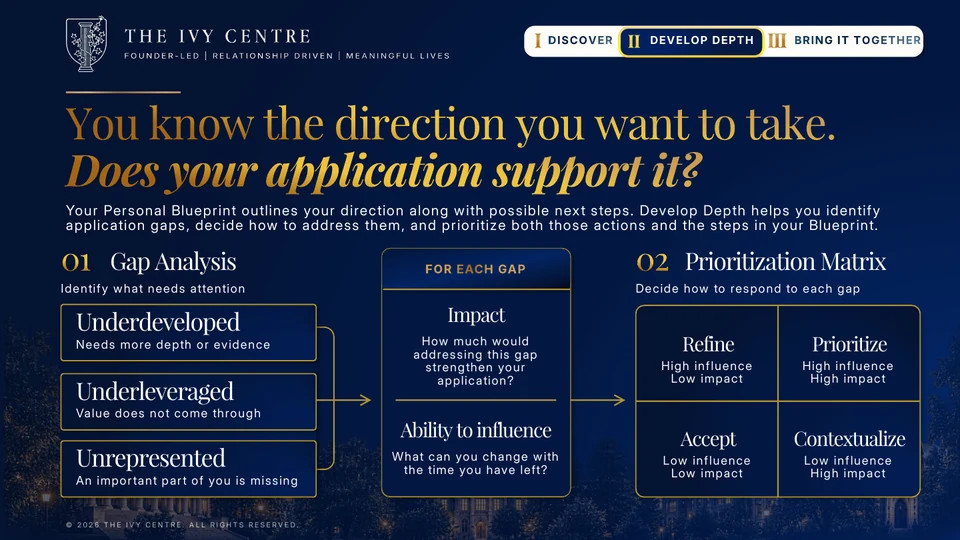 Find and Address Your Specific Application Gaps
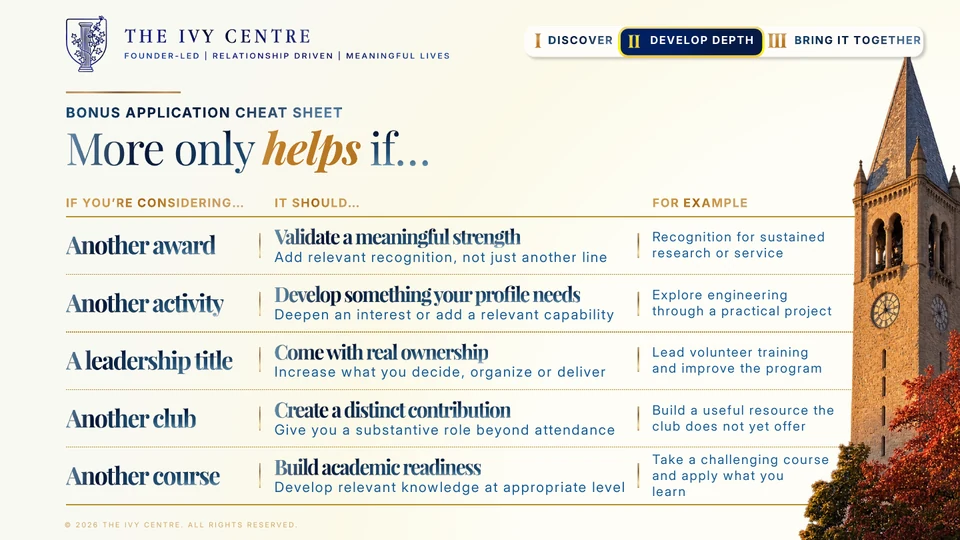 What to Strengthen Next: Your Priorities Cheat Sheet
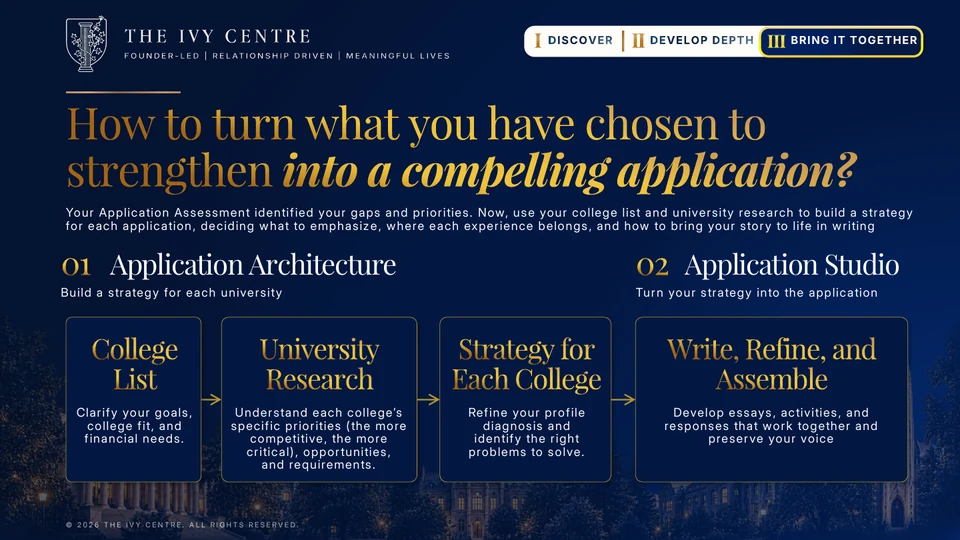 Turn Your Profile into a REALLY Compelling ApplicationHow to Research Colleges and Shape Your Strategy for Each
All 15 chapters and six guides are included with free access and also shared with you over email.
Explore the free masterclassChoose the version for you. Free access, with no commitment to mentorship.
Reviewed by Lara David for The Ivy Centre. Our program descriptions draw on our published mentorship framework and masterclass. Linked external sources support the specific comparisons identified in this guide. Illustrative examples are labeled; individual outcomes are not predictions.