Mentorship begins before there is an application to polish
Ivy League admissions mentorship is a continuing relationship that helps a student develop the experiences, judgment and ability to communicate that a thoughtful application requires. It can include college strategy and essay feedback, but the work begins with the student’s interests, strengths, context and capacity to grow.
The phrase should not imply a secret route into a particular university. A mentor cannot promise an offer or determine how a future committee will decide. The useful promise is a clear process: understand the student, make informed choices, help them act on those choices and revisit the plan as evidence develops.
This approach can be relevant beyond the Ivy League. A student’s best environment may be a different university, a particular program or a path they had not initially considered. Mentorship should make those possibilities clearer rather than narrow every conversation to a list of prestigious names.
What families mean by mentorship, and what a contract may actually offer
A parent or student may hear “Ivy League mentorship” and imagine both a strong admission outcome and a close relationship with someone who knows the student. A contract may instead cover a fixed set of meetings, application tasks and a final review. Neither description should be left to assumption. Ask whether you are buying feedback on an application, continuing student development, or both.
An application service can fulfill its purpose when submissions are complete. A developmental relationship has a wider purpose: helping the student understand their interests, make choices, follow through and prepare for what comes after admission. Some firms combine the two. In a model with separate specialists, ask who maintains that personal understanding across assignments and whether the relationship continues when the original deliverables are finished.
At The Ivy Centre, the same three founders remain involved in the student’s context. We are deliberately building a continuing mentorship, with application strategy as an important part of that journey. We want students to leave with stronger judgment and a clearer direction as well as a thoughtful application. The written program still defines its duration and scope; a sense of community should never replace that clarity.
Compare how the different mentoring models work
What makes the relationship developmental?
A developmental mentor asks why the student is making a choice, not only whether the choice looks impressive. They help the student examine assumptions, learn from experience and take increasing responsibility. Advice becomes something the student learns to use, rather than a sequence of instructions to obey.
Consider a student who wants to start a nonprofit. A useful first conversation would explore the need they have noticed, whom they have listened to and what existing organizations already do. Joining an established effort may offer more meaningful work than creating a new title. The quality of the decision matters more than the appearance of entrepreneurship.
The same principle applies to research, competitions and leadership. A mentor can help identify an appropriate next challenge, but the student needs to engage with the work itself. An activity selected only for its expected admissions value can become difficult to sustain and difficult to discuss with conviction.
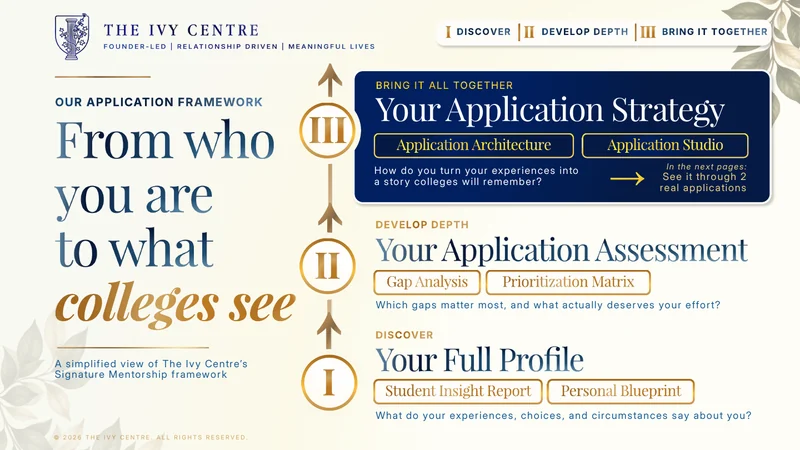
The five stages need to connect
At The Ivy Centre, the stages form a continuing journey rather than separate products. What we learn about a student should influence what they explore. What they learn through experience should influence their university strategy. Their eventual choice should inform the preparation for arriving and thriving there.
Explore the complete five stage journey
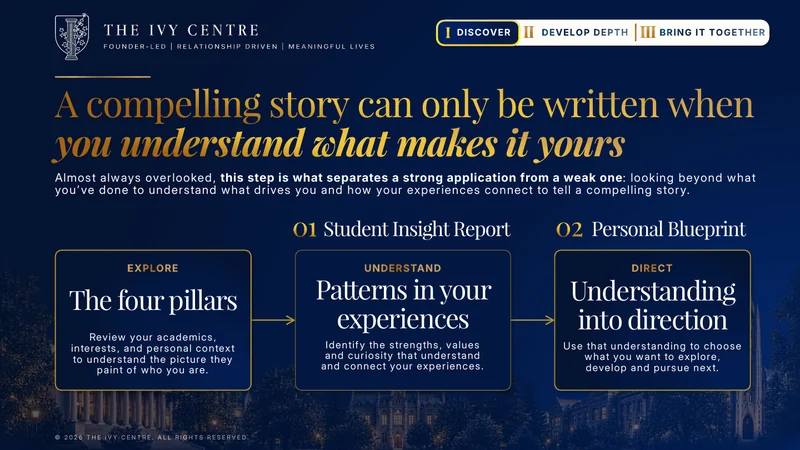
Discovery should produce useful insight
Discovery involves more than asking for a favorite subject or a preferred career. We examine strengths, values, curiosity, patterns of motivation and the circumstances in which the student does their best work. We also look for differences between what the student says they want and what their experiences suggest they enjoy.
The Student Insight Report brings those observations together. It is a working understanding of the student, not a permanent label. A teenager is allowed to change direction. The report is useful when it helps the student make a better next decision and gives the founders a shared basis for discussing it.
An uncertain student does not need to invent a lifelong passion. They may need a thoughtful experiment: read more deeply about a question, try a practical task, speak with someone in a field or contribute to an existing project. Reflection afterward is what turns activity into insight.
Development should build evidence and independence
The Personal Program Blueprint translates understanding into priorities. Those priorities may involve academic choices, deeper experience, communication or habits that make the plan achievable. A good plan includes what the student will stop doing as well as what they will begin.
For a student who repeatedly misses deadlines, another reminder may solve today’s problem without changing the pattern. Developmental support examines how tasks are broken down, how time is estimated and when the student asks for help. The aim is increasing independence, not a permanent dependence on adults to manage every step.
Our work can include executive functioning, focused workshops, the Ivy Lab and SAT support within the agreed program. Each should serve the student’s actual priorities. More services are not automatically better if they create a schedule the student cannot sustain.
Application strategy should follow the person
When applications approach, the task is to connect the student’s evidence with each university’s questions and opportunities. Application Architecture considers what each component needs to communicate before the student starts writing. The personal statement, supplements, activities and additional information should contribute distinct, accurate parts of the picture.
This is different from choosing an attractive theme and forcing every experience into it. A student can have several interests. Coherence comes from helping the reader understand the person’s choices and development, not from making every activity sound identical.
Triple Quality Control brings all three founders into reviewing the complete application. The student remains the author. Feedback should improve clarity and thoughtfulness while preserving the student’s own perspective, rather than replacing it with a professionally manufactured voice.

From The Ivy Journal
Can You Use AI For Your College Essays?
Read the articleThree founders, one student’s context
The Ivy Centre’s model connects Lara David’s engineering and management consulting perspective, Marah Selim’s psychology and human development background, and Jorge Dorantes’ experience across medicine, research and the humanities. The founders remain involved in the same student’s journey.
The benefit is not simply three sets of comments. It is the opportunity to question an assumption from different directions while maintaining one shared plan. An apparent motivation issue may require a different response from a lack of subject knowledge. A compelling idea may need a more realistic execution plan. The founders bring those observations together.
Our connected student environment helps preserve the context behind the work. Meetings, projects and decisions should inform one another. Technology supports that continuity; the relationship and professional judgment remain human.
See how our connected environment supports the work
Every week, the three founders discuss each student together. We review progress, parent conversations, barriers, new insights and possible next steps. This means a concern about motivation, a promising project or a changed academic interest can affect the whole plan, rather than remain isolated in one person’s notes.
That regular discussion complements Triple Quality Control at application time. A final review checks the work that has been produced; continuing founder discussions also shape the choices and development that create it. Our role is to help students think and act with greater independence, not to make every decision for them.
What happens after offers arrive?
An admission creates another decision. Students need to compare programs, costs, opportunities, support and the kind of environment in which they are likely to thrive. A higher ranking does not resolve every tradeoff. Mentorship can help the student examine the actual options and explain their choice.
Preparation for university can then address how to seek support, build relationships, manage new independence and make use of opportunities. Those skills matter after the application itself has ceased to be important. The community and perspective developed through mentorship can remain useful as the student’s goals evolve.
The Ivy Centre also offers support for graduate study, especially master’s degree, STEM PhD, medical school and MBA pathways. That work requires attention to research, professional experience and the specific expectations of the next stage. Families should discuss the scope and timing of any continuing engagement rather than assume every future application is automatically included.
Explore life beyond the application
How to tell whether a mentorship is substantive
Ask a prospective mentor to explain what happens when a student changes their mind, loses momentum or disagrees with a recommendation. Ask how they distinguish a genuine interest from an activity pursued only for appearance. Find out how the student will learn to make decisions rather than simply receive them.
Also ask what you will be able to observe: a clearer plan, thoughtful reflection, meaningful work, more independent follow through and an authentic application. These signs can help you evaluate the relationship before admissions decisions arrive.
Compare mentorship with other consulting models
See the strategy in practice
Watch the framework become a student’s next step.
Our free masterclass shows how discovery, development and application strategy connect in practice.
Full masterclass included with free and immediate access
Explore the 15 chapters
Free with masterclass 00:0001What does a strong application actually need?
 06:3502The five stages of every strong application strategy
 09:2003What makes you memorable to admissions officers?
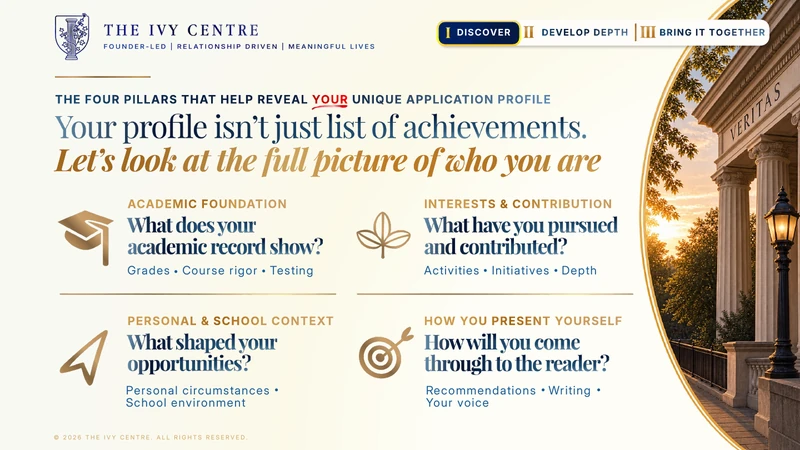 10:4504The four pillars behind every student profile
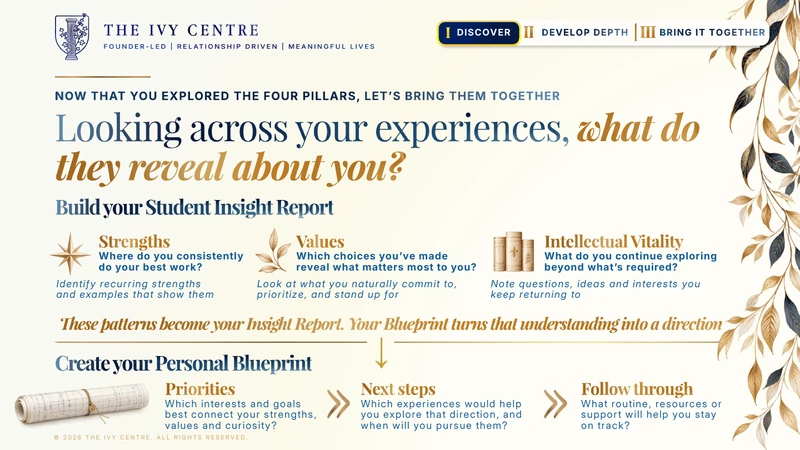 12:2705Turn your strengths, values, and curiosity into direction
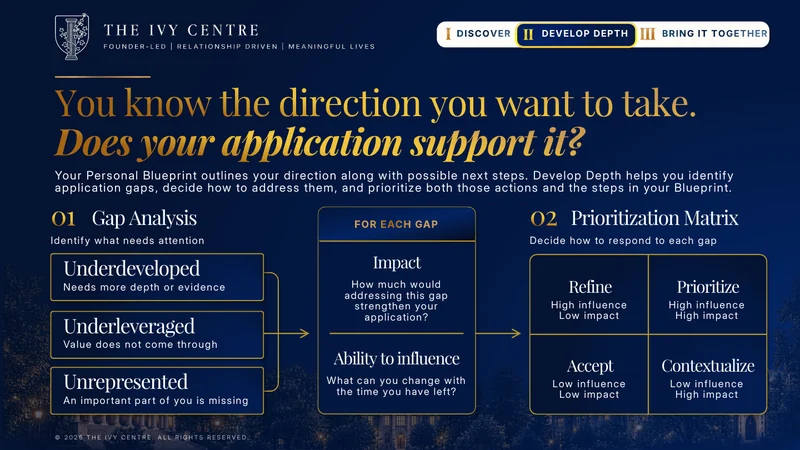 13:5306What is your application actually missing?
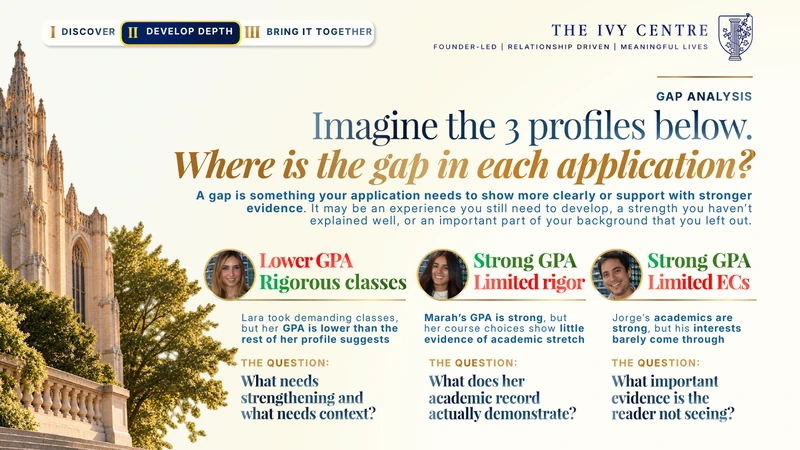 15:2607How to spot weaknesses in your college application
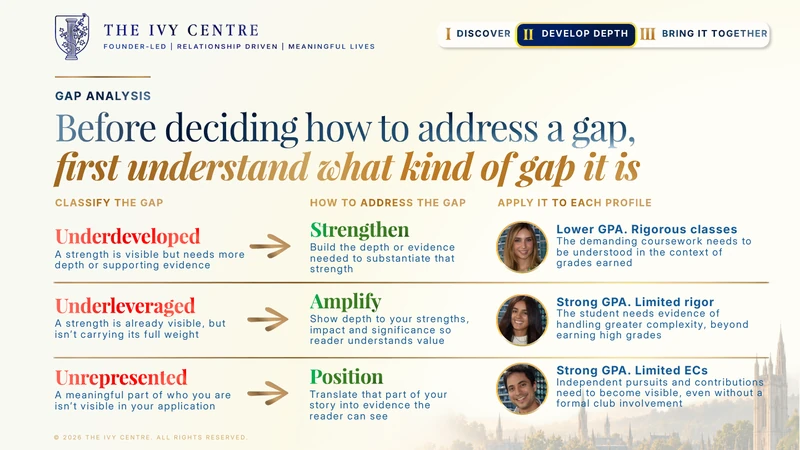 17:0108There's only 3 types of gaps. Each with a different way forward.
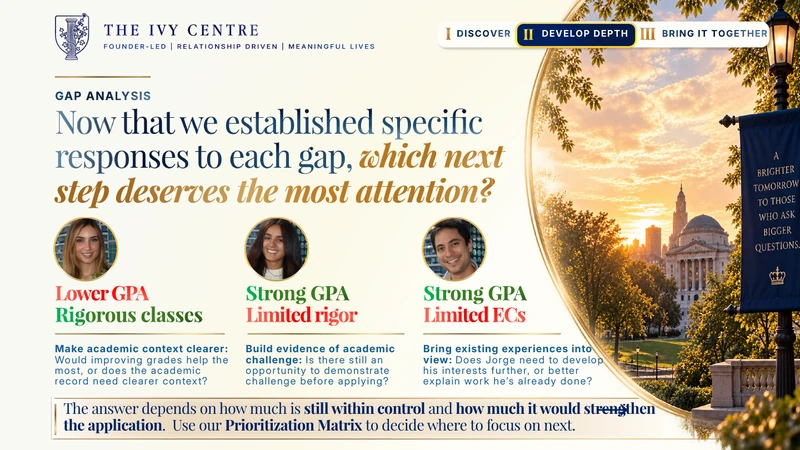 18:5509What can you still change before you apply?
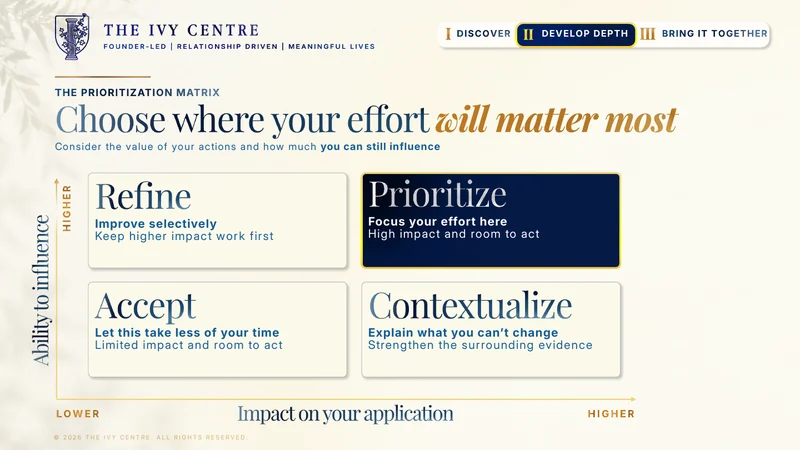 20:2610What deserves your effort, and what can wait?
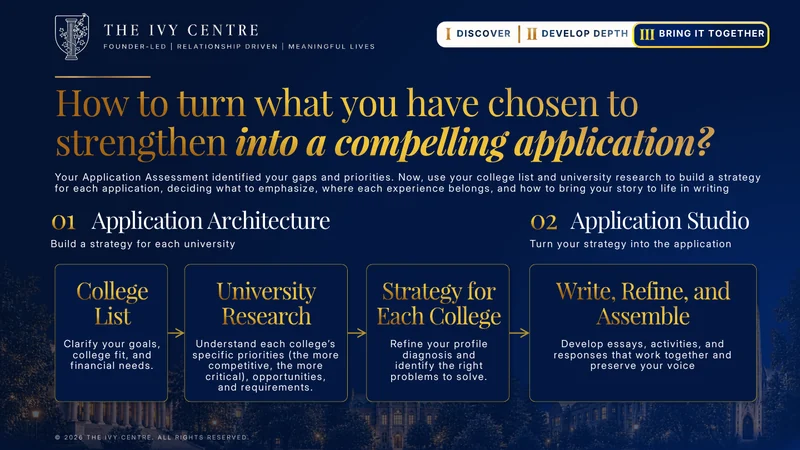 21:3711Why each university needs a different strategy
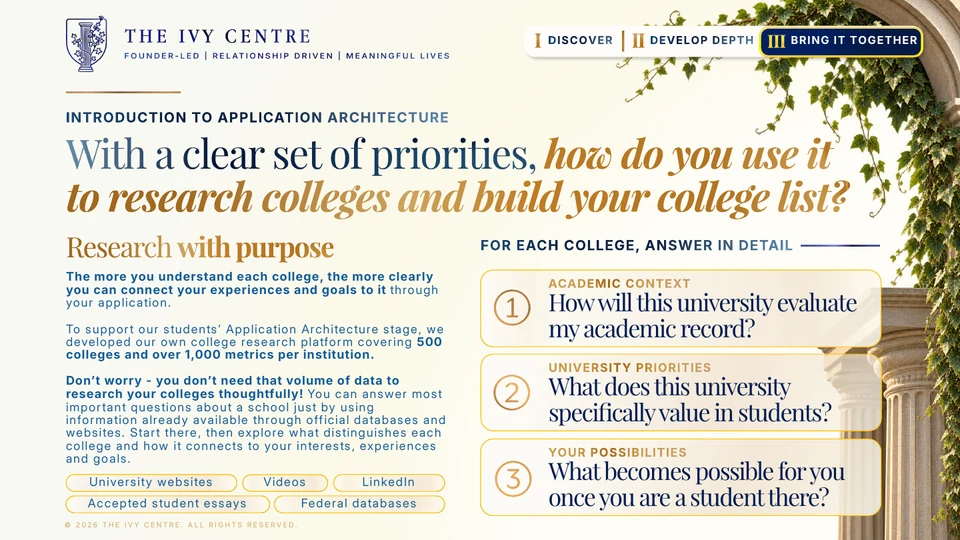 22:3612How to research colleges the right way
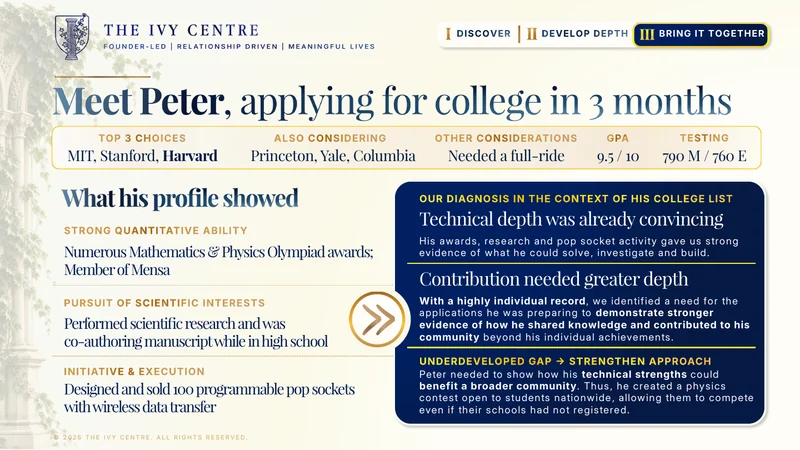 24:4513Peter: Highly technical profile but no differentiator
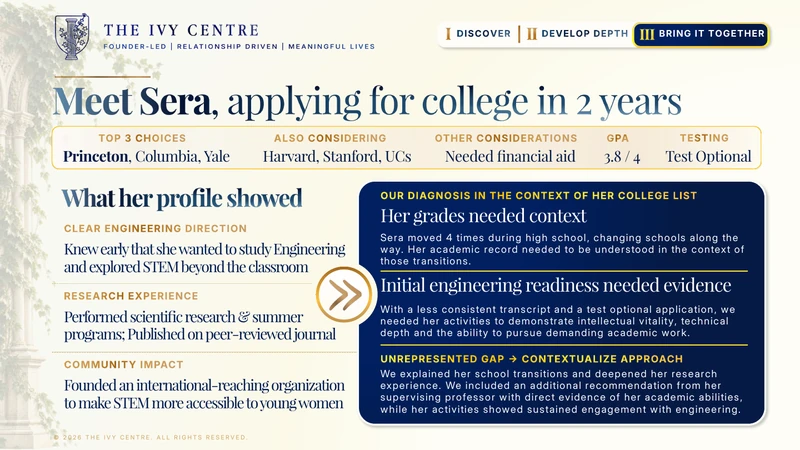 26:3714Sera: Low GPA and SAT, but strong depth in context
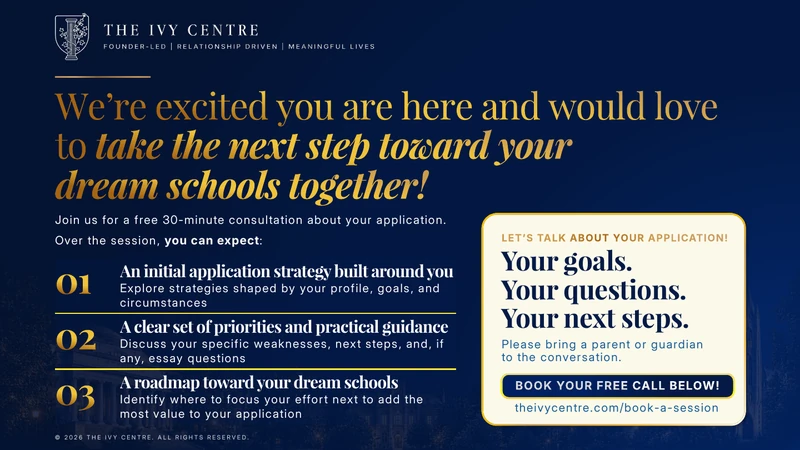 27:5615What should you do next?
Six downloadable resources
Free with masterclass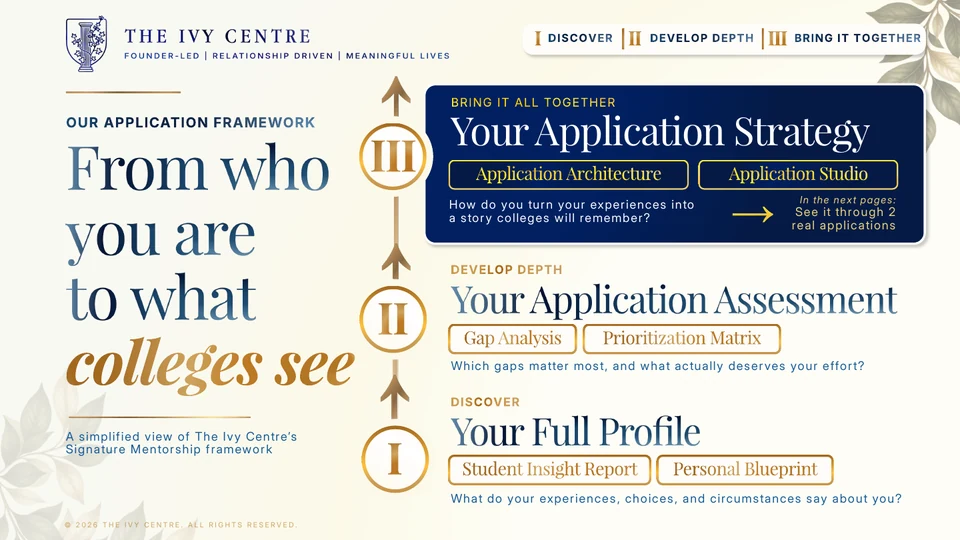 College Application Strategy Map
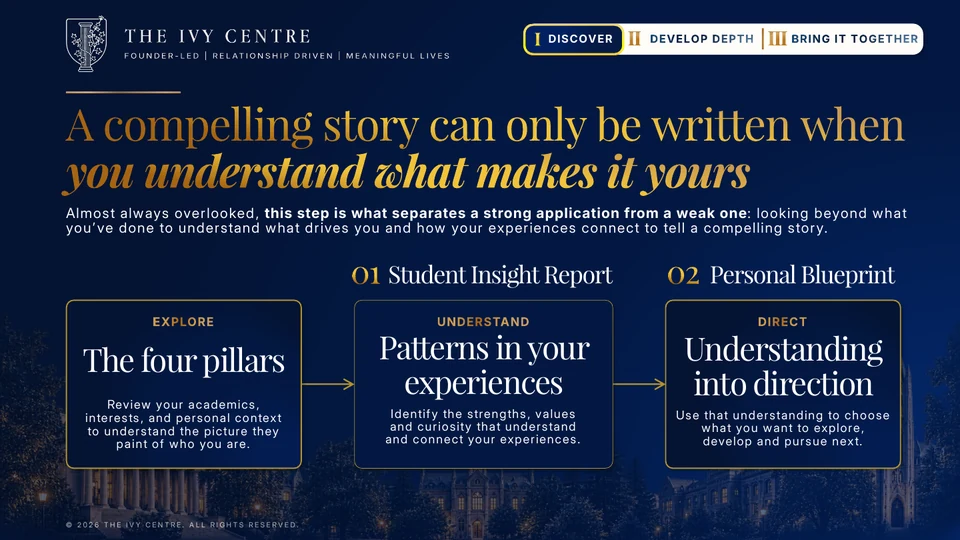 Discover What Sets You Apart
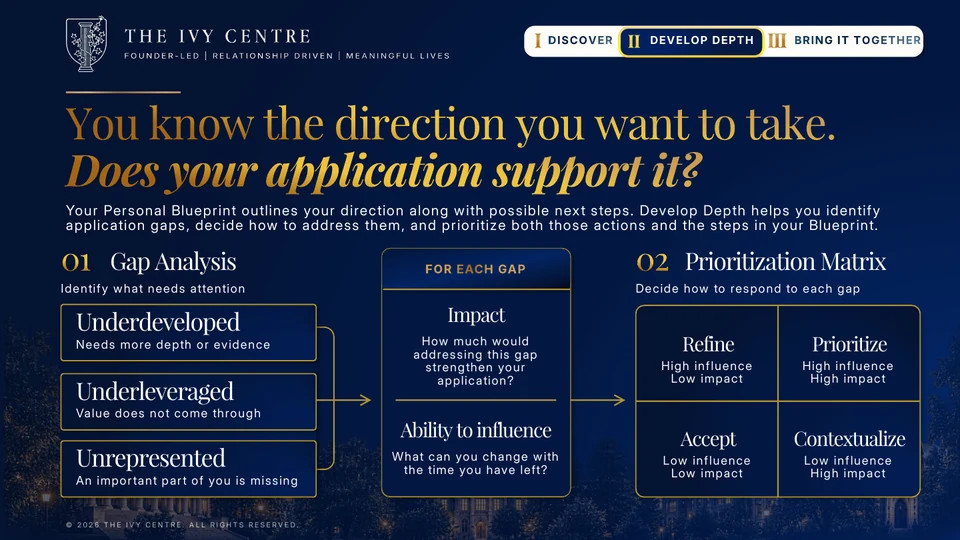 Find and Address Your Specific Application Gaps
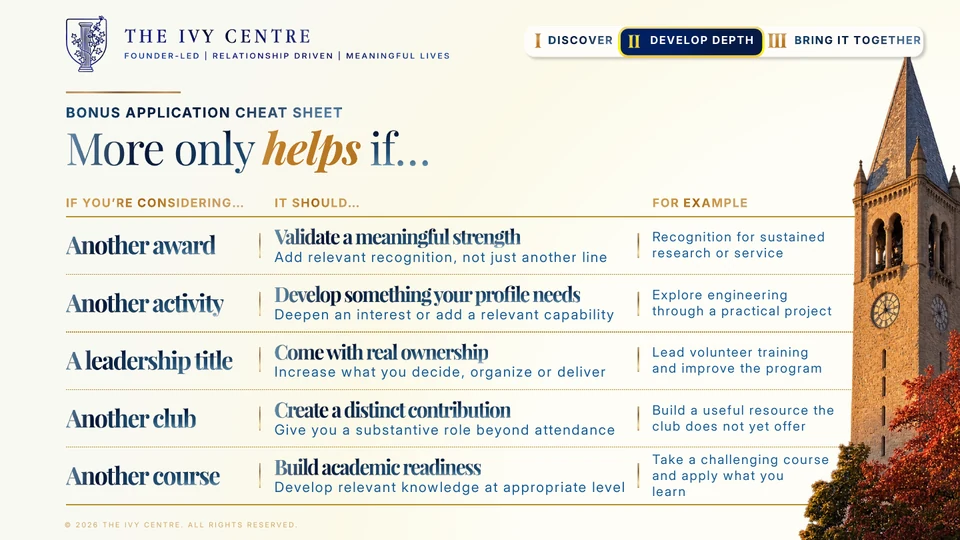 What to Strengthen Next: Your Priorities Cheat Sheet
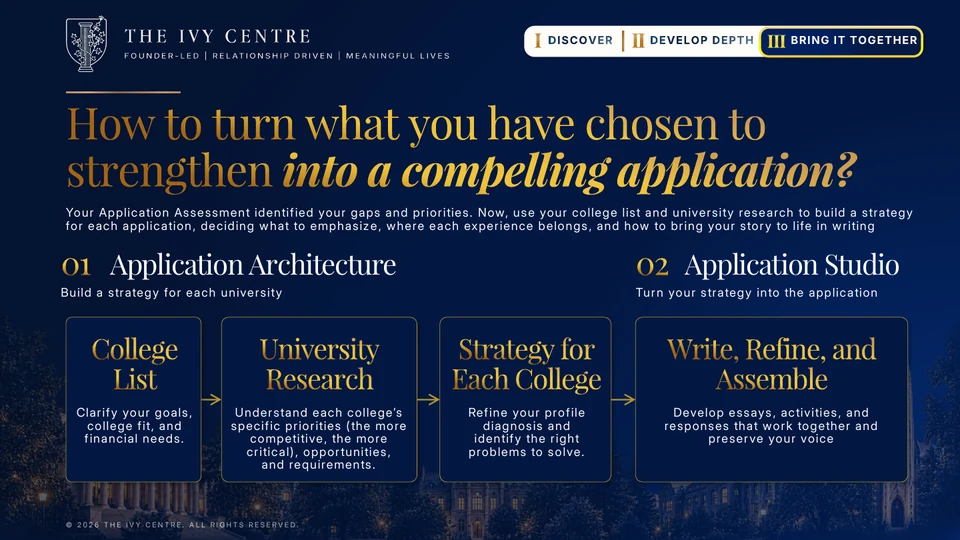 Turn Your Profile into a REALLY Compelling ApplicationHow to Research Colleges and Shape Your Strategy for Each
All 15 chapters and six guides are included with free access and also shared with you over email.
Explore the free masterclassChoose the version for you. Free access, with no commitment to mentorship.
Reviewed by Marah Selim for The Ivy Centre. Our program descriptions draw on our published mentorship framework and masterclass. Linked external sources support the specific comparisons identified in this guide. Illustrative examples are labeled; individual outcomes are not predictions.