What work does an admissions consultant actually do?
An admissions consultant can help a student assess their situation, choose universities, plan applications, develop ideas, revise writing and manage deadlines. Some services focus on one of those tasks. Others include longer term development, testing support or ongoing mentorship. The title alone does not establish the scope.
The most useful way to understand the role is to ask what decisions the adviser will help with, what work the student will produce and how feedback will lead to the next step. A calendar full of meetings is not the same as a clear process.
Assessment: understand the starting point
A thoughtful assessment considers academics, experiences, interests, responsibilities, available opportunities and the student’s own goals. It also examines how the student works. Difficulty following through may require a different response from a lack of information about universities.
The adviser should distinguish an observation from an assumption. A student who has not participated in formal research may still show intellectual curiosity through independent reading, practical work or questions pursued in another setting. A polished résumé may conceal uncertainty about why any of the activities matter to the student.
At The Ivy Centre, the Student Insight Report helps bring these dimensions together. The purpose is to support decisions, not assign a permanent identity or a numerical admissions score.
Planning: decide what deserves attention
After assessment, the work is to choose priorities that fit the student’s time and stage. A useful plan identifies the next actions, the reasons behind them and how progress will be reviewed. It should also make clear which appealing opportunities will wait or be declined.
For a younger student, the plan might emphasize exploring an interest and building reliable study habits. For an applicant close to deadlines, it may emphasize a manageable college list, missing evidence and the structure of the essays. An adviser should explain why the recommendation fits the student now.
See how we turn insight into a plan
University research: connect facts to the student
An adviser can help the student move beyond rankings to examine programs, teaching, academic flexibility, access to opportunities, costs and the environment. The student should learn how to investigate these questions rather than simply receive a list of university names.
For example, the existence of a famous laboratory does not establish that an undergraduate can participate in its work. A useful research process asks how students gain access, what preparation is needed and whether the opportunity fits the applicant’s interests. The resulting information can inform both the college list and a specific university essay or interview.

From The Ivy Journal
The Research University Trap: Why a Famous Lab Is Not College Strategy
Read the articlePlan what each part of the application should communicate
Before writing begins, the adviser can help inventory the student’s evidence and consider where it belongs. A personal statement, an activity description and a university supplement should not all repeat the same claim. Together, they should help a reader understand the student accurately and with appropriate context.
At The Ivy Centre, all three founders contribute to Application Architecture. We consider the strategy for each university and the role of each component. This helps the student see the application as a complete account, rather than a series of unrelated writing assignments.
The architecture remains a guide, not a script. As the student writes, an idea may become clearer or prove less useful than expected. The plan should adapt to the student’s real thinking and evidence.
Writing support: improve the work without replacing the writer
An adviser can ask questions that reveal a more specific idea, identify a confusing passage and explain why an example does not yet support a claim. They can help the student revise structure, precision and clarity. The student must remain the author of the experiences, ideas and final submission.
Useful feedback teaches. “This is too generic” becomes more actionable when the adviser identifies the missing observation and asks the student to explain what they actually noticed, chose or learned. Simply rewriting the passage into an adult voice may produce smoother prose without helping the student communicate honestly.
Families should also ask about AI and outside tools. The relevant boundary is not only whether a tool was used, but whether the application remains accurate and authentically the student’s work, consistent with the institution’s rules.

From The Ivy Journal
Can You Use AI For Your College Essays?
Read the articleCoordination: make the plan achievable
Applications involve dependencies. A draft may need feedback before a revision can begin. A recommendation request needs time. University research may change the emphasis of an essay. Good coordination makes those relationships visible and prevents avoidable last minute confusion.
Our connected student environment keeps projects, meetings and decisions in context across the founders. It supports continuity when one conversation affects another part of the plan. The system should help people exercise better judgment, rather than become another place where the student receives tasks without understanding their purpose.
Executive functioning support can address planning, task initiation, prioritization and follow through. It should build the student’s capacity to manage work over time. Admissions mentorship is not a substitute for clinical care or school accommodations when those are needed.
Explore our planning and coordination approach
Review: check the complete application
Final review should examine accuracy, coherence, completeness and the relationship between components. Are dates and descriptions consistent? Is an important part of the student’s context missing? Does each essay answer the actual question? Are claims supported by the student’s experience?
The Ivy Centre’s Triple Quality Control brings all three founders into this complete review. It is intended to bring different perspectives to the work and reduce missed opportunities or inconsistencies. It does not transfer responsibility for truthful information away from the student or guarantee an admissions outcome.
A practical map of responsibilities
| Work | Adviser’s contribution | Student’s responsibility |
|---|---|---|
| Understanding the profile | Ask questions, identify patterns and test assumptions | Share accurate context and reflect honestly |
| Choosing priorities | Explain options, tradeoffs and a workable plan | Make informed choices and carry out the agreed work |
| Researching universities | Guide the questions and evaluate relevance | Investigate opportunities and articulate personal reasons |
| Writing applications | Provide feedback and strategic context | Develop the ideas, write and revise authentically |
| Submitting | Help review requirements and completeness | Confirm accuracy and complete the institution’s submission process |
Parents also have a role, particularly in discussing finances, practical constraints and support. The relationship works best when the student’s ownership is clear and parent communication does not become a parallel set of instructions that the student cannot see.
Beyond college applications
The Ivy Centre’s broader mentorship can include SAT support, personal development, executive functioning and preparation for the transition to university. We also offer support for master’s degree, STEM PhD, medical school and MBA applications. These services require different expertise and should be scoped according to the student’s stage and goals.
For a graduate applicant, the work may involve clarifying research direction, understanding professional motivation or connecting leadership experience to a future plan. It should not be a generic repackaging of an undergraduate admissions process.
For a master’s degree applicant, the work can include comparing taught and research programs, checking prerequisites and connecting academic preparation to a clear reason for the degree. Undergraduate and graduate support share a commitment to careful thinking, but they do not use an identical application strategy.
What to ask before buying the service
Ask which of these activities are included, who performs them, how often you will meet and what work happens between sessions. Clarify limits on schools, revisions, testing, additional applications and the duration of support. Request an explanation of how the plan changes when the student’s needs change.
Questions for your first consultation
See the strategy in practice
Watch the work behind an application strategy.
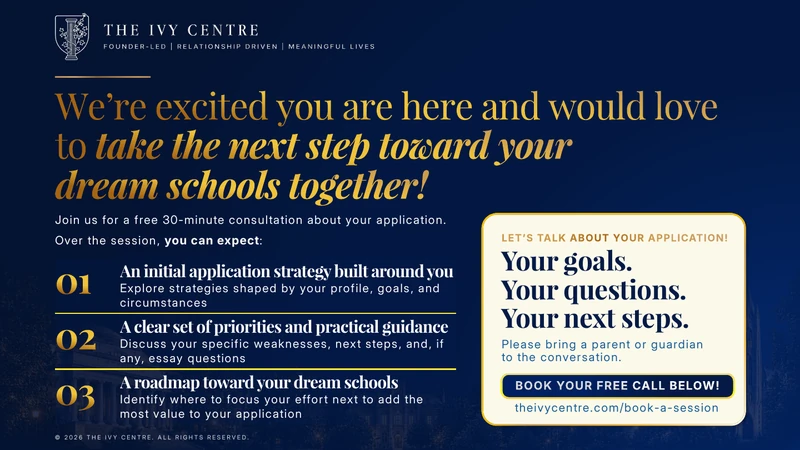
The masterclass shows how our founders move from understanding a profile to choosing practical next steps.
Full masterclass included with free and immediate access
Explore the 15 chapters
Free with masterclass 00:0001What does a strong application actually need?
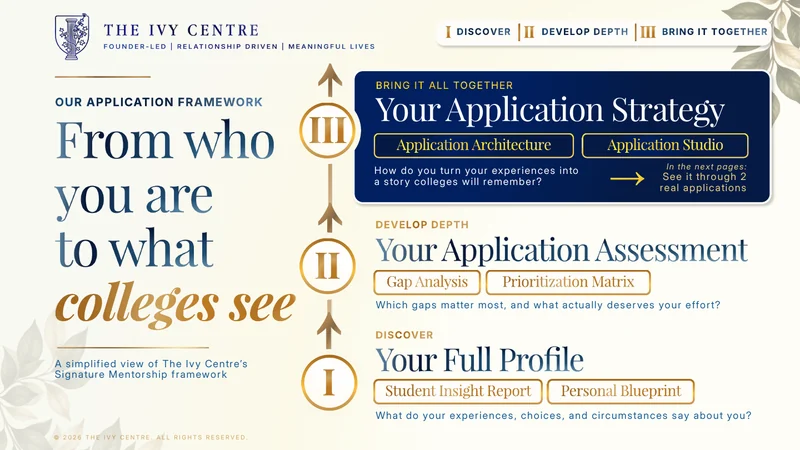 06:3502The five stages of every strong application strategy
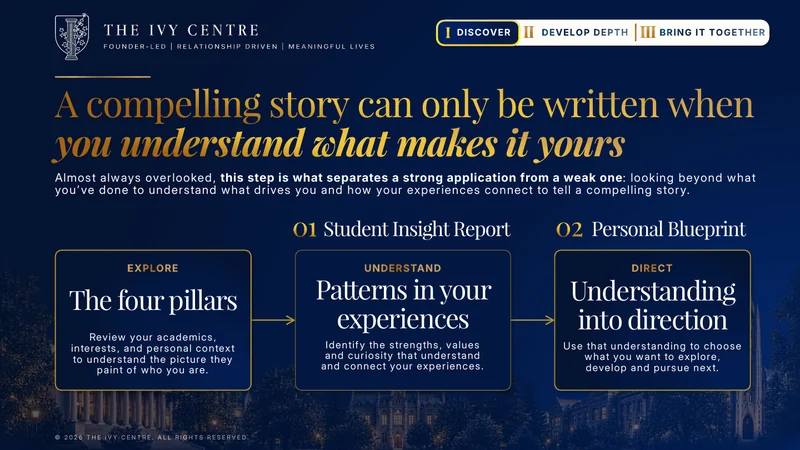 09:2003What makes you memorable to admissions officers?
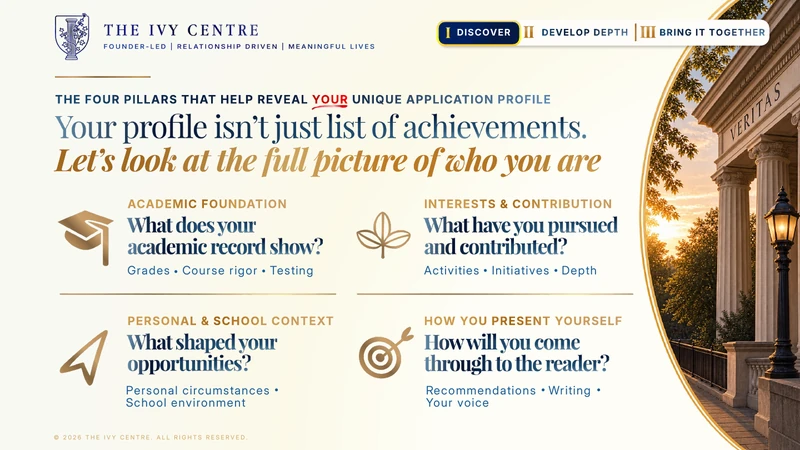 10:4504The four pillars behind every student profile
 12:2705Turn your strengths, values, and curiosity into direction
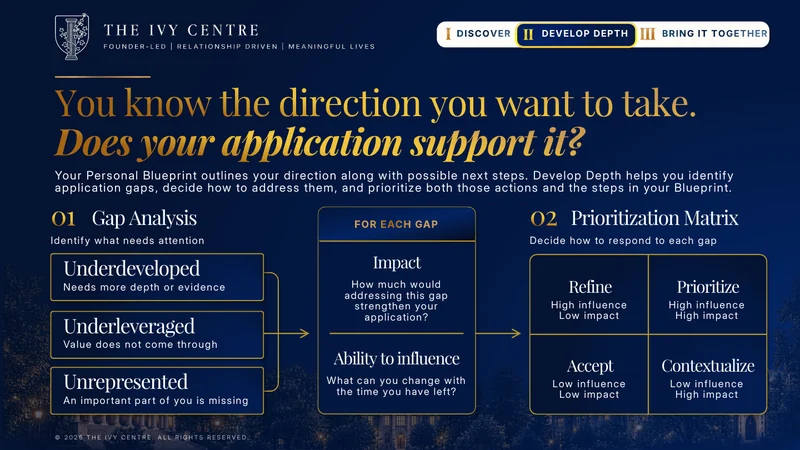 13:5306What is your application actually missing?
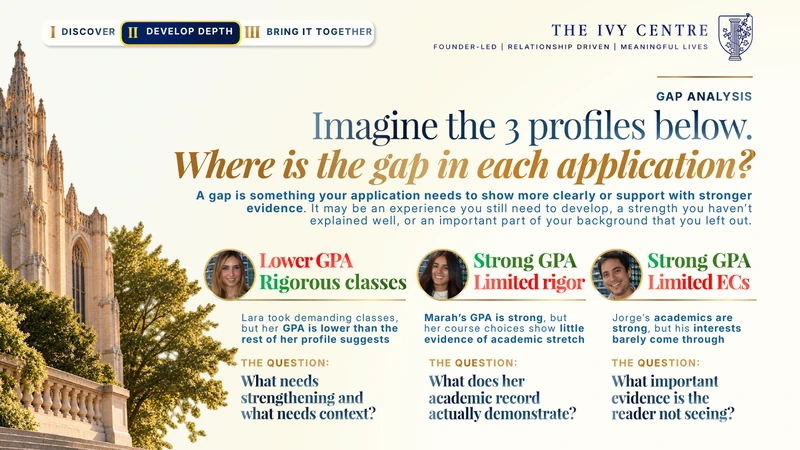 15:2607How to spot weaknesses in your college application
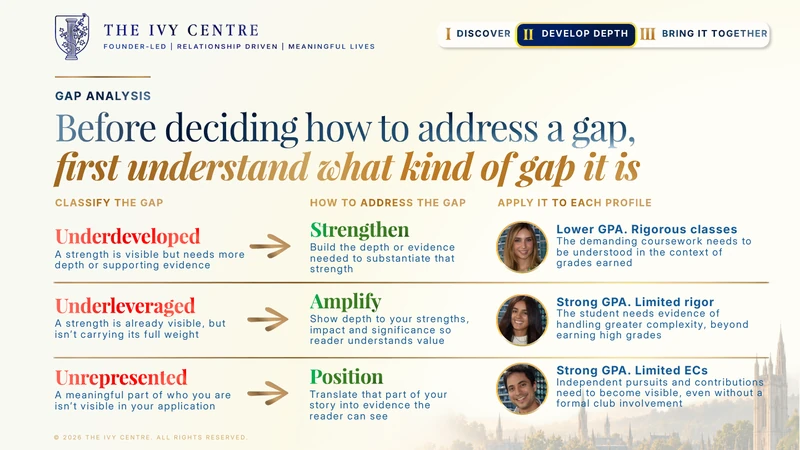 17:0108There's only 3 types of gaps. Each with a different way forward.
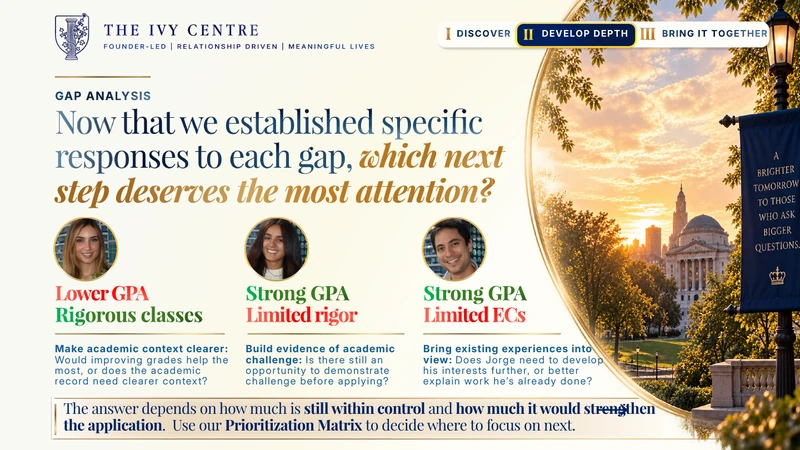 18:5509What can you still change before you apply?
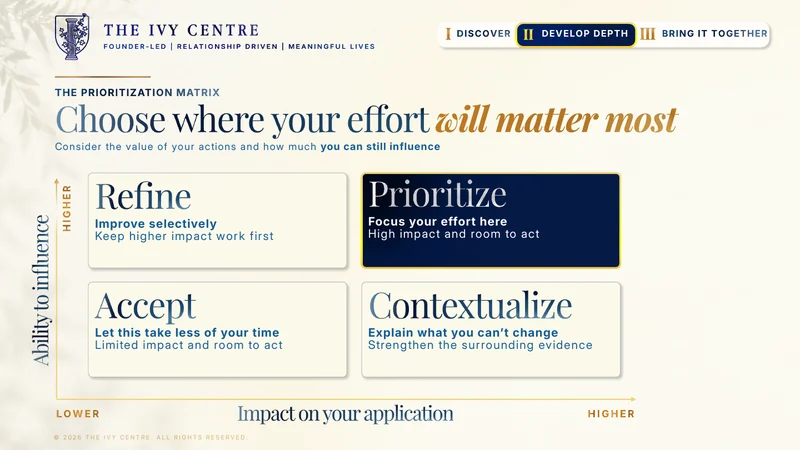 20:2610What deserves your effort, and what can wait?
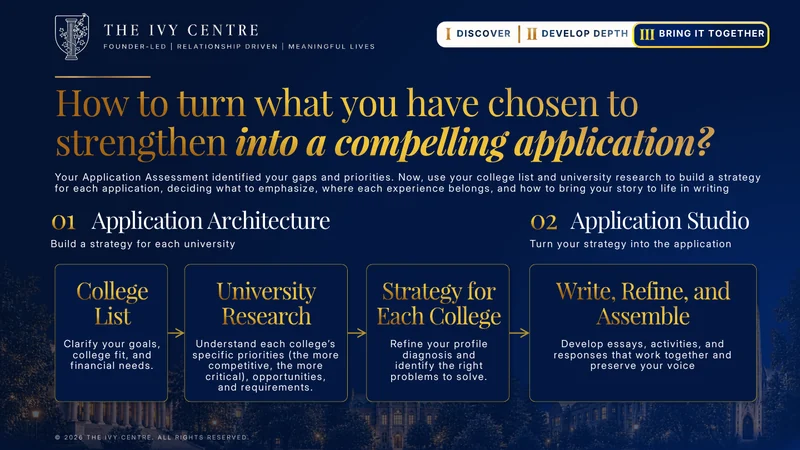 21:3711Why each university needs a different strategy
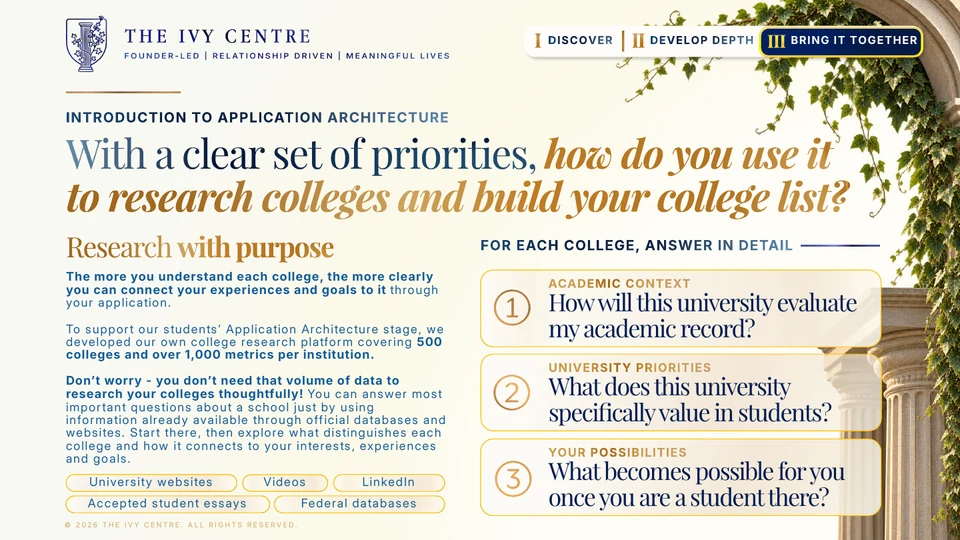 22:3612How to research colleges the right way
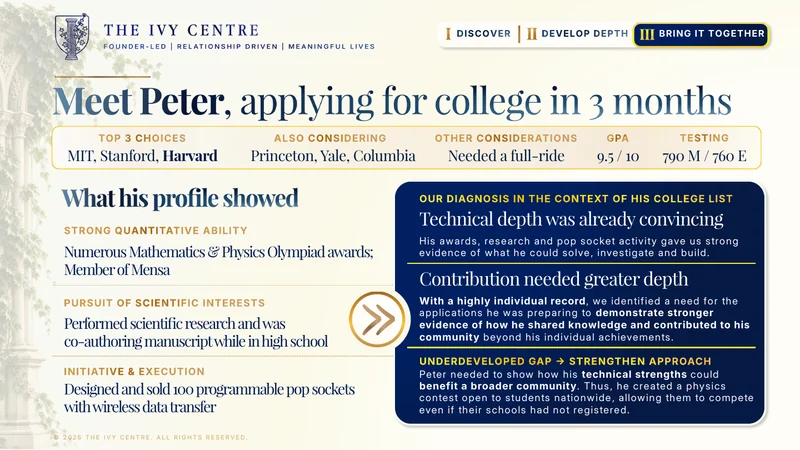 24:4513Peter: Highly technical profile but no differentiator
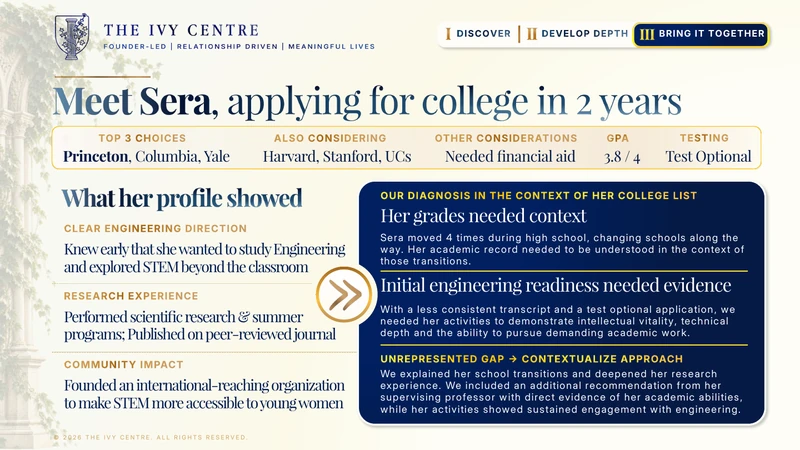 26:3714Sera: Low GPA and SAT, but strong depth in context
 27:5615What should you do next?
Six downloadable resources
Free with masterclass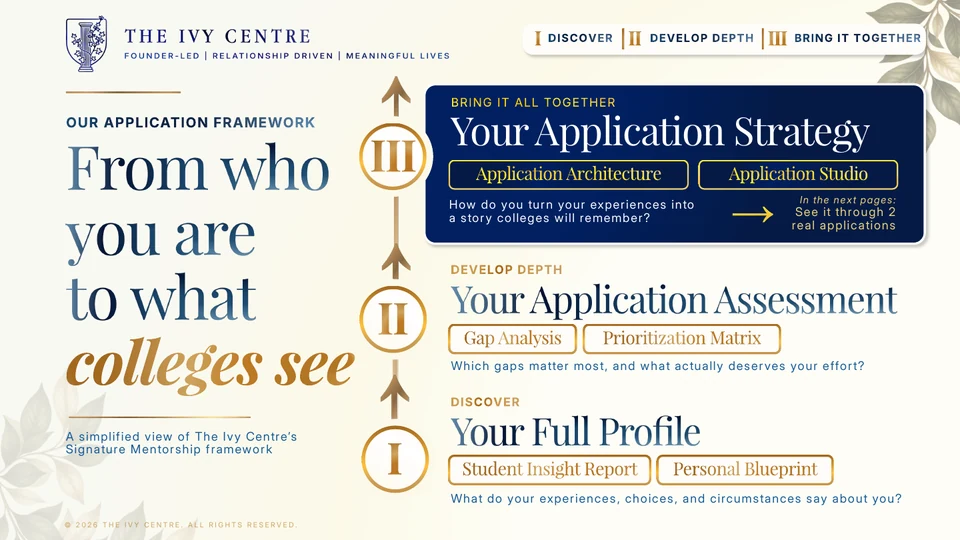 College Application Strategy Map
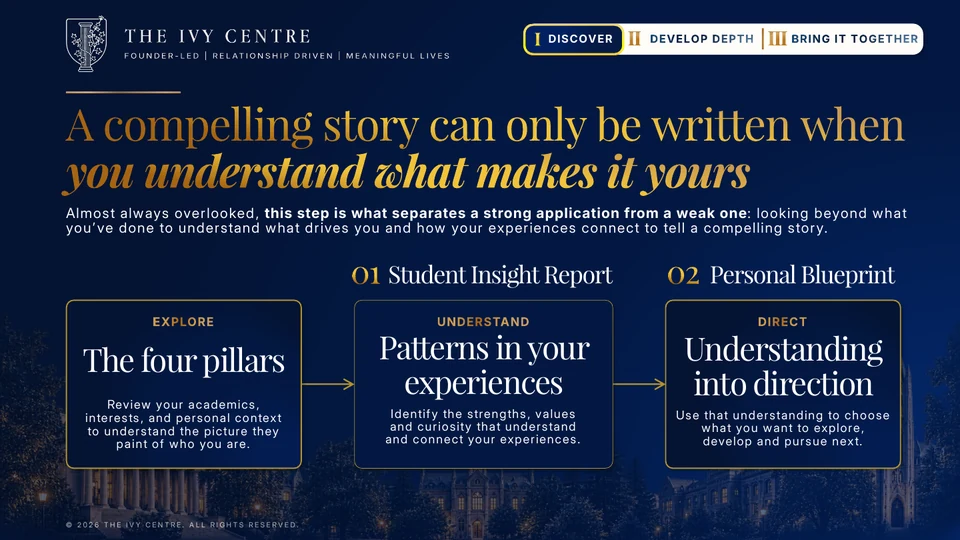 Discover What Sets You Apart
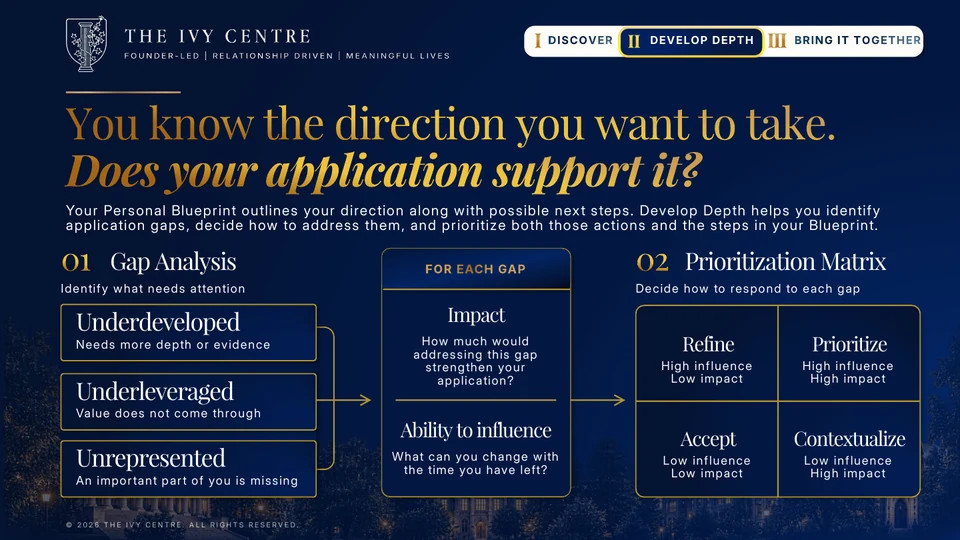 Find and Address Your Specific Application Gaps
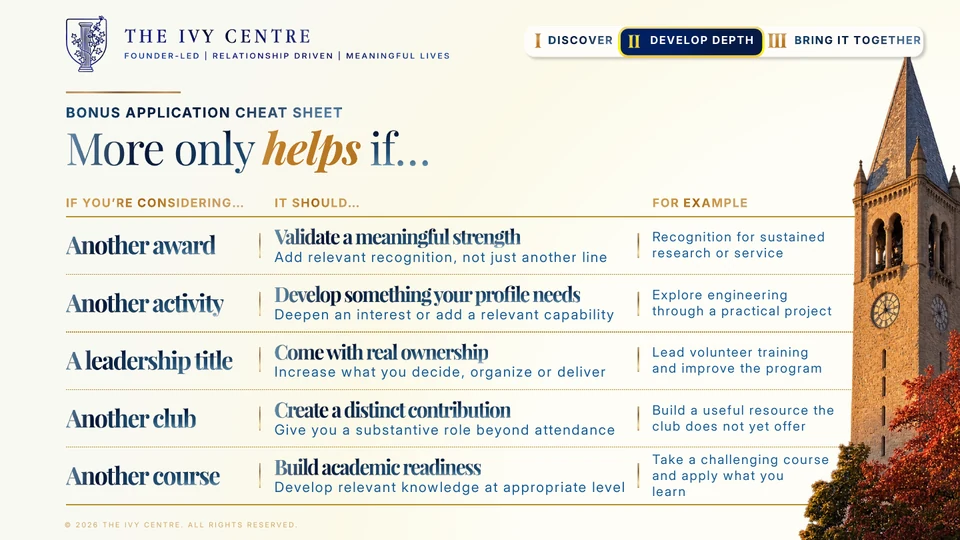 What to Strengthen Next: Your Priorities Cheat Sheet
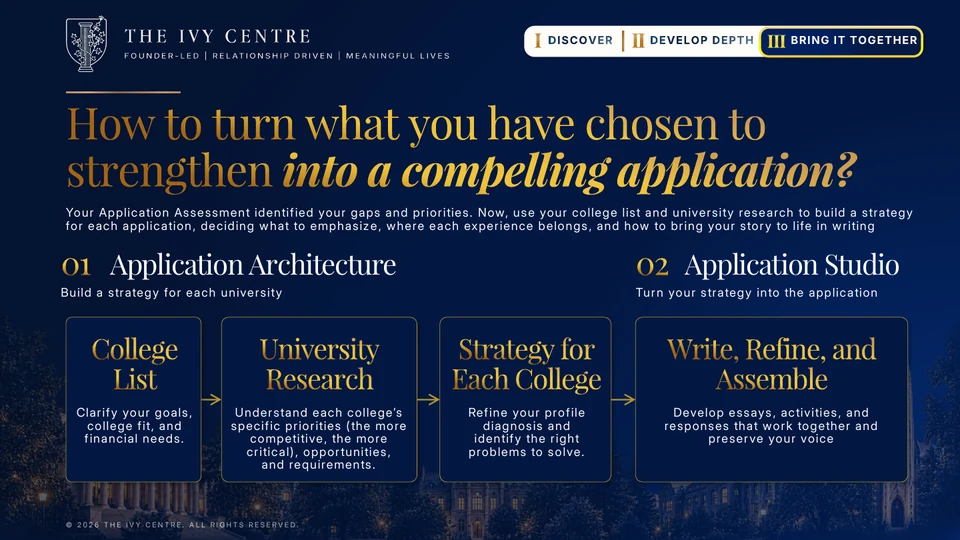 Turn Your Profile into a REALLY Compelling ApplicationHow to Research Colleges and Shape Your Strategy for Each
All 15 chapters and six guides are included with free access and also shared with you over email.
Explore the free masterclassChoose the version for you. Free access, with no commitment to mentorship.
Reviewed by Jorge Dorantes, MD for The Ivy Centre. Our program descriptions draw on our published mentorship framework and masterclass. Linked external sources support the specific comparisons identified in this guide. Illustrative examples are labeled; individual outcomes are not predictions.