How do you choose the right admissions consultant?
Choosing a college admissions consultant begins with understanding the student’s needs, then finding people whose experience, availability and way of working fit those needs. A strong proposal explains what will happen, who will do it and how the student will participate. A recognizable brand or an impressive acceptance rate cannot answer those questions for you.
Start with a short family conversation before speaking to firms. What does the student want help with? Where do parent and student expectations differ? How much support is already available through school? What budget feels sustainable? These answers help you distinguish a useful service from a persuasive sales conversation.
The student should have a voice in the decision. A mentor may challenge them, but the relationship needs enough trust for the student to say “I do not understand,” “I am overwhelmed” or “I no longer want that.” If the student feels they must perform confidence at every meeting, important information can remain hidden.
Decide which kind of adviser you are looking for
There are several common ways to deliver admissions support. A specialist team divides the work among advisers. A recent graduate offers a perspective close to the student’s own experience. An independent or boutique adviser may provide continuity through one relationship. A former admissions officer may contribute experience evaluating applications. Our model at The Ivy Centre brings three founders into one connected mentorship.
These categories overlap. Ask how the actual engagement works rather than assuming that “boutique” means unlimited availability or that “team” means inconsistent advice. The comparison below is a useful first filter.
| If your priority is… | Ask about… | Listen for… |
|---|---|---|
| Continuity | Who stays with the student from planning through submission? | Named people and a clear approach to changes in staffing |
| Several areas of expertise | Who connects testing, activities, the college list and essays? | A shared strategy and someone accountable for the whole application |
| A relatable relationship | How does the adviser build trust with this age group? | Examples of listening and adapting, not just the adviser’s own college story |
| Understanding how applications are read | What was the adviser’s admissions role, and how is their knowledge kept current? | Specific experience with clear limits on what it can predict |
| Development beyond admission | How are independence, judgment and follow through supported? | Repeated practice, feedback and a plan that changes as the student grows |
Explore the five consulting models
Meet the person who will actually mentor your student
Your first conversation may be with an enrollment representative, a senior adviser or a founder. Ask whether that person will actually mentor your student. If someone else will deliver the service, meet them before enrolling and clarify their responsibilities. Also establish who reviews the complete application and who makes decisions when advisers disagree.
Qualifications matter in relation to the work. Experience reading applications can be useful. So can expertise in education, research, psychology, writing or a relevant professional field. A prestigious degree is not a substitute for mentoring ability, and a career title does not tell you how much time someone can give the student.
At The Ivy Centre, Lara David, Marah Selim and Jorge Dorantes are directly involved in the mentorship. We invite families to understand their different backgrounds and how those perspectives work together. Ask the same practical questions of us: what involvement does the proposed program include, how are meetings arranged and how will the founders stay connected to the student’s progress?
Use a real question to test the quality of the thinking
Bring an actual dilemma to the consultation. For example: “Our student can take another advanced course, but doing so may mean leaving an activity they care about. How would you help them decide?” You do not need a complete free strategy during a first call. You do need to see how the adviser approaches uncertainty.
A careful response should investigate the academic context, the student’s capacity, the significance of the activity and the reason for taking the course. An instant answer based only on what “top colleges love” may overlook the very information that makes the choice personal.
Ask what evidence would change the adviser’s recommendation. This is a useful way to distinguish a repeatable method from a fixed opinion. A strong adviser should be able to explain both a recommendation and its limits without making the student feel that there is one secret formula they must follow.
Establish how the relationship works between meetings
Much of the value of a program lies in preparation, feedback and follow through. Ask who reads work before a session, how tasks are recorded and how decisions are revisited. Find out whether messages reach the assigned mentor, a coordinator or a general inbox, and agree on realistic response expectations.
Capacity matters, but there is no single ideal caseload that applies to every model. A person delivering occasional reviews has a different workload from someone providing continuing development. Ask how the firm protects availability during deadline periods, what happens if a mentor is unavailable and how urgent questions are handled. You can assess the process without requesting other students’ identities or schedules.
At The Ivy Centre, the connected student environment is designed to preserve context across the founders’ work. The relevant benefit is that a conversation, a project update or a changed priority can inform the next decision. Ask to understand that workflow, rather than treating the presence of an app as proof of quality.
See how we keep the work connected
At The Ivy Centre, weekly founder discussions consider every student’s progress, barriers, parent conversations and emerging opportunities. The people responsible for the overall strategy stay connected to the work between sessions. Ask any prospective firm to explain its equivalent process in equally concrete terms.
Ask these questions before signing
Your consultation checklist
Clarify the working relationship
Mark the questions you have answered. These checks stay in this page only and are not submitted or saved.
I know who will work directly with the student.I understand the scope, exclusions and total proposed price.I know how meetings, feedback and messages are handled.I understand how the student retains authorship and responsibility.I know what happens if needs, staffing or the timeline change.I have read the terms, privacy policy and introductory period conditions.For each answer, write down the practical implication. “Unlimited support” needs a definition. “Comprehensive” needs a scope. “Personalized” needs an explanation of what can change. A thoughtful firm should be willing to clarify these points in the written agreement, including any limits on schools, meetings, revisions, testing or additional applications.
Graduate school support deserves its own conversation. The Ivy Centre offers support for master’s degree, STEM PhD, medical school and MBA pathways, but the relevant expertise and preparation differ from undergraduate admissions. If future support matters to you, establish what is included now and what would be discussed as a separate engagement later.
Compare results without turning them into promises
Ask what a published percentage measures: admission to one university, an offer from any university in a category or another outcome entirely. Find out which cycles and application rounds it covers, who is included and whether selection into the program affects the starting profile of its students.
External review can provide useful information about records or calculations, depending on its scope. It does not automatically demonstrate that the service caused the outcomes. Likewise, a testimonial can tell you something about an individual experience without representing every student’s experience.
Our policy at The Ivy Centre is to explain the methodology and limitations of our published figures while keeping student data private, including individual records with identifying details removed. Families should understand that this limits independent reproduction of the figures. We do not ask you to treat a private record as an admissions guarantee; we ask you to assess the people, the method and the proposed work alongside it.
Use the results evaluation guide
Check the boundaries around student ownership
Ask who writes the essays and what happens when a student’s draft is weak. An ethical adviser can ask questions, give feedback, identify unclear reasoning and help the student revise. The student must remain responsible for the ideas, experiences and final work they submit.
Also ask how the firm approaches AI tools, confidentiality and the use of student stories. A student should not have to agree to public promotion as a condition of receiving thoughtful support. If a prospective family is connected with a current or past family, that contact should happen with the family’s permission.
The Ivy Centre does not share student data with outside individuals or organizations, including individual records with identifying details removed. Public student stories are shared with consent. These boundaries are part of the relationship, not an exception made after a family raises a concern.

From The Ivy Journal
Can You Use AI For Your College Essays?
Read the articleCompare the proposal against your priorities
Use the same questions for every proposal. Put the actual mentors, duration, services, feedback arrangements, exclusions and price side by side. Add the student’s reaction after meeting the people. This helps prevent a long list of features from obscuring what your family actually values.
Collaborative Mentorship at The Ivy Centre starts at $15,000. It is designed for a relationship that can include development, strategy and application work. A family looking for a single review may reasonably choose a narrower service. A family seeking continuing guidance should examine how the program will support growth beyond the completion of documents.
Leave the conversation with a clear next step
Before deciding, ask each prospective adviser to summarize the need they believe they heard, the scope they recommend and what they would need to learn first. Compare that summary with your own priorities. If the proposal solves a different problem, resolve the mismatch before committing.
You are choosing a working relationship with people who may influence how a young person sees themselves and their possibilities. Expertise, care, availability and the student’s willingness to engage all matter. The best selection process makes those qualities visible rather than relying on prestige to stand in for them.
See the strategy in practice
Get to know how our founders think.
Watch the free masterclass before deciding whether our approach to student development and application strategy feels right for your family.
Full masterclass included with free and immediate access
Explore the 15 chapters
Free with masterclass 00:0001What does a strong application actually need?
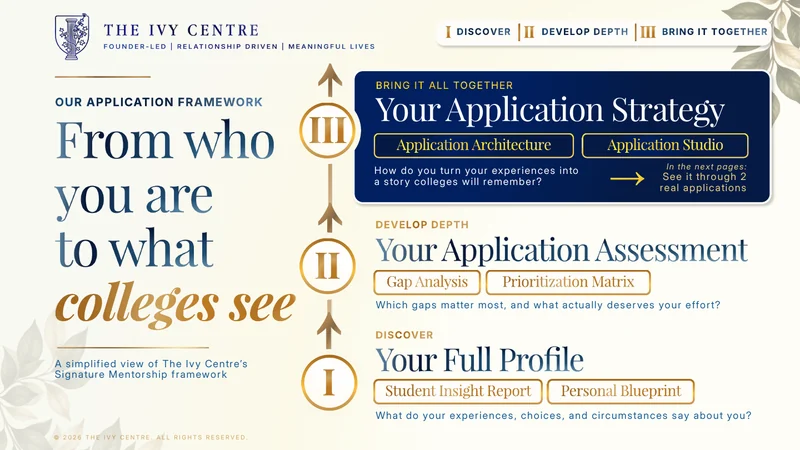 06:3502The five stages of every strong application strategy
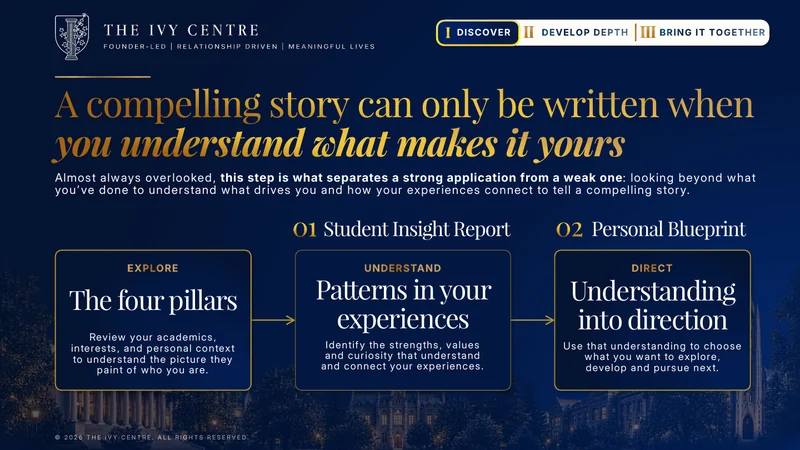 09:2003What makes you memorable to admissions officers?
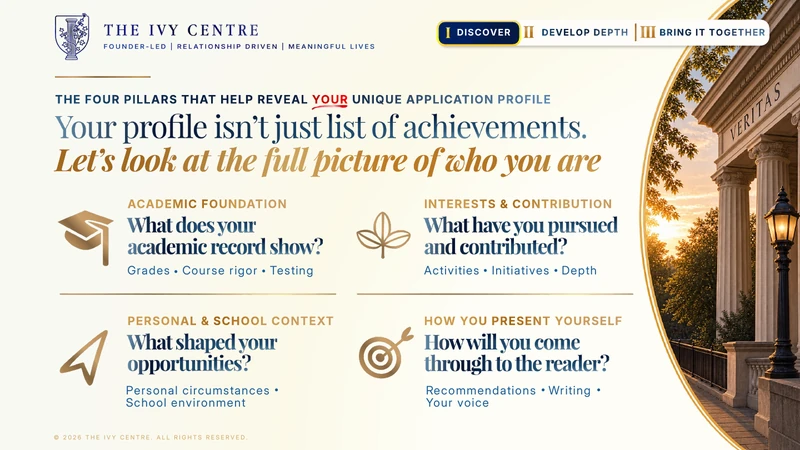 10:4504The four pillars behind every student profile
 12:2705Turn your strengths, values, and curiosity into direction
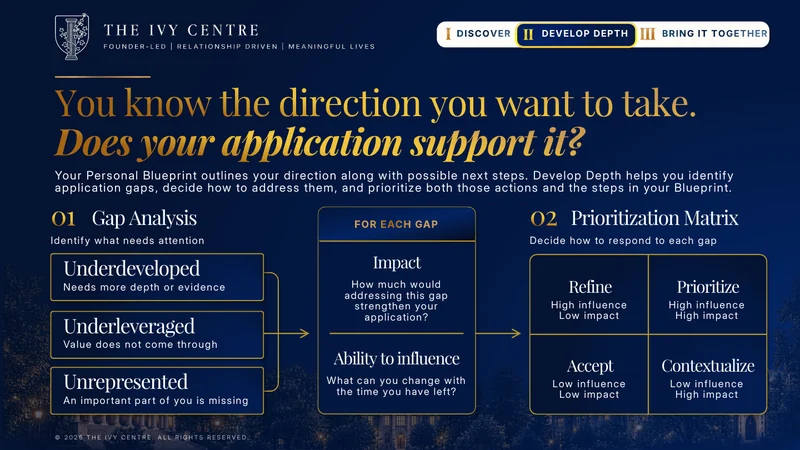 13:5306What is your application actually missing?
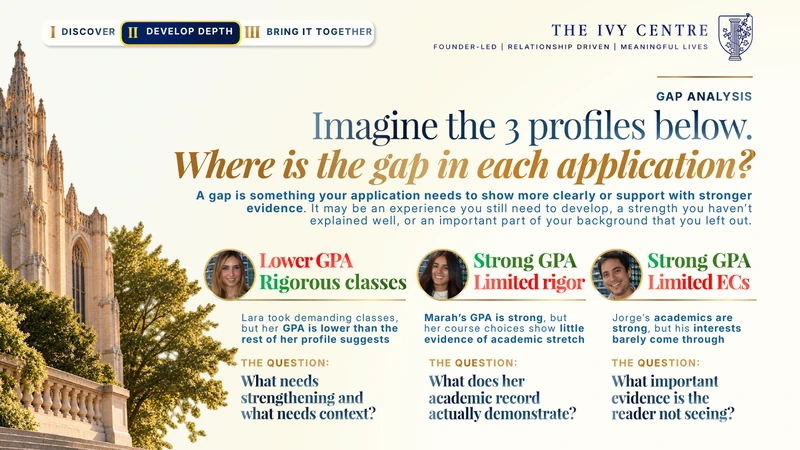 15:2607How to spot weaknesses in your college application
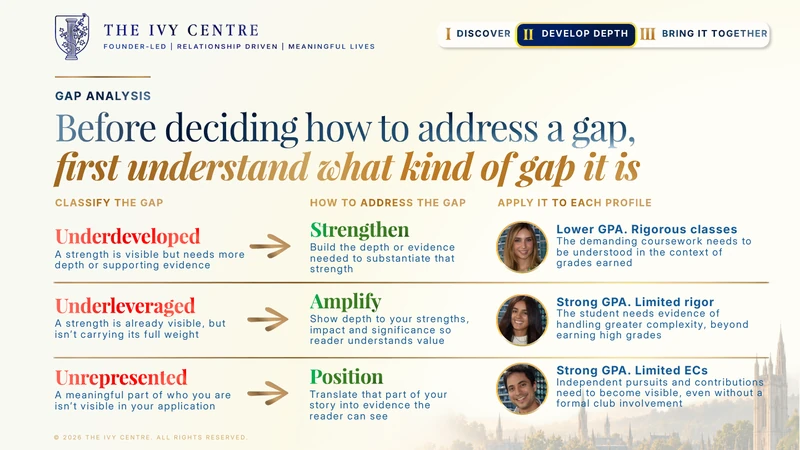 17:0108There's only 3 types of gaps. Each with a different way forward.
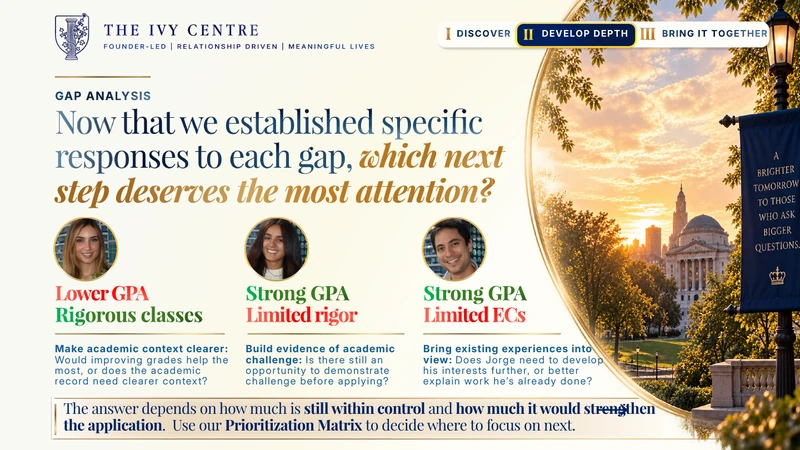 18:5509What can you still change before you apply?
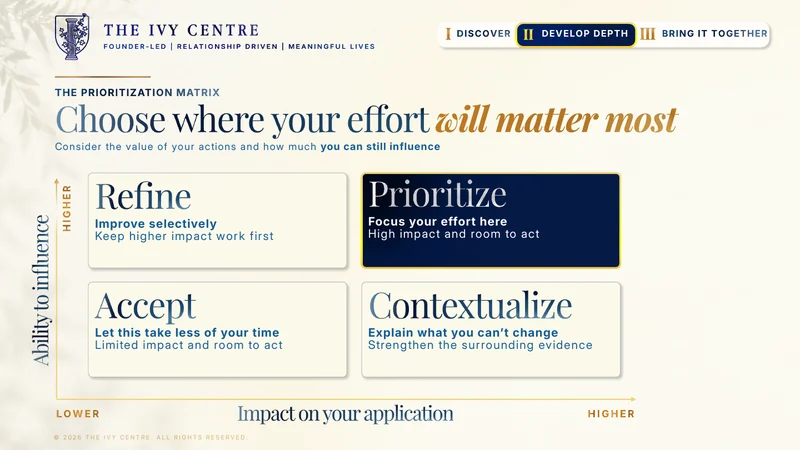 20:2610What deserves your effort, and what can wait?
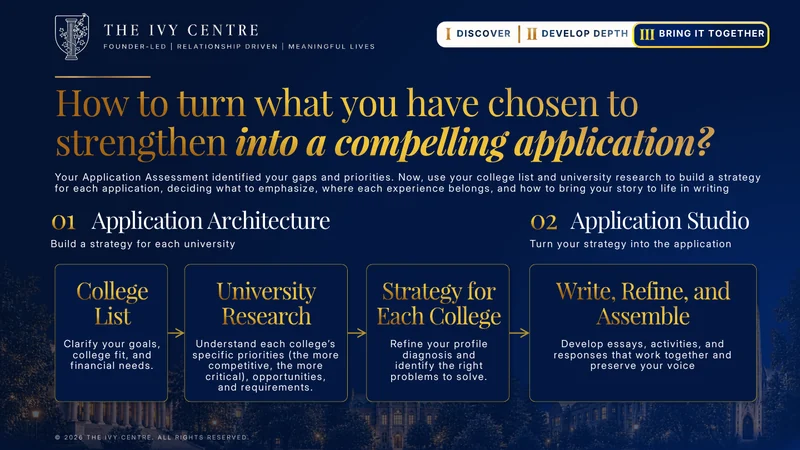 21:3711Why each university needs a different strategy
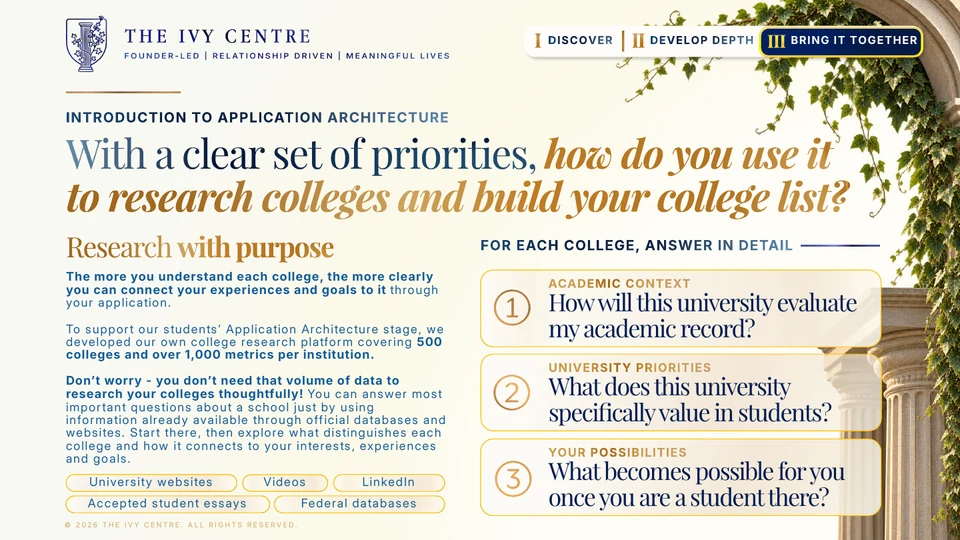 22:3612How to research colleges the right way
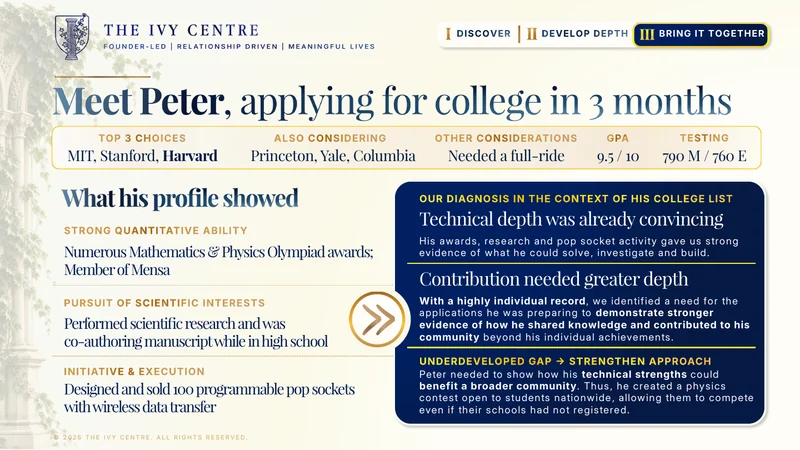 24:4513Peter: Highly technical profile but no differentiator
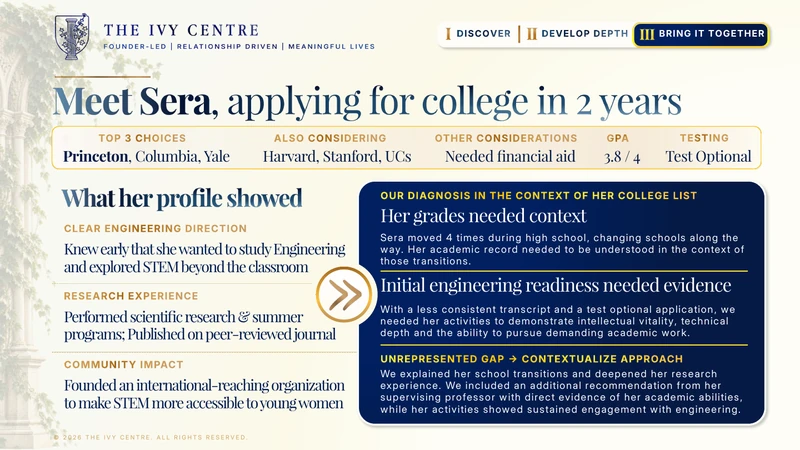 26:3714Sera: Low GPA and SAT, but strong depth in context
 27:5615What should you do next?
Six downloadable resources
Free with masterclass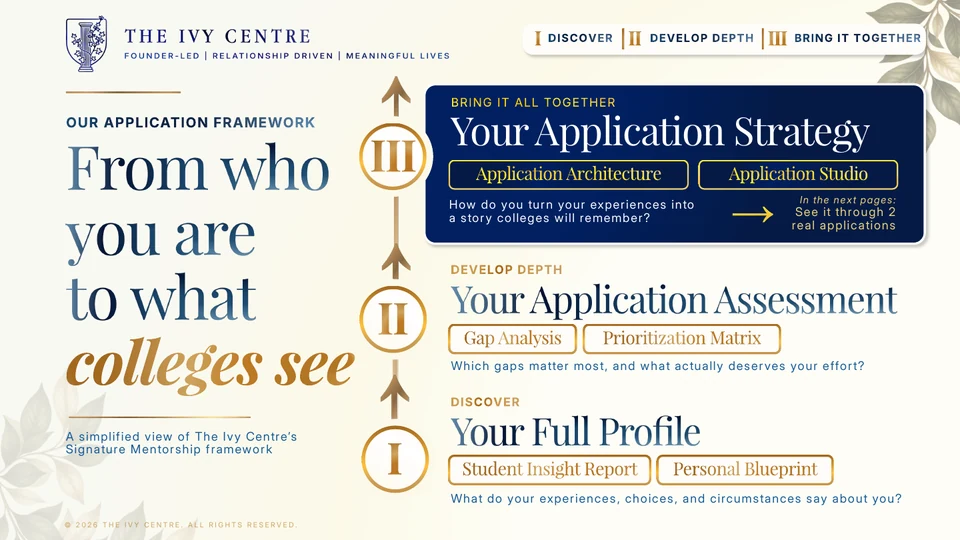 College Application Strategy Map
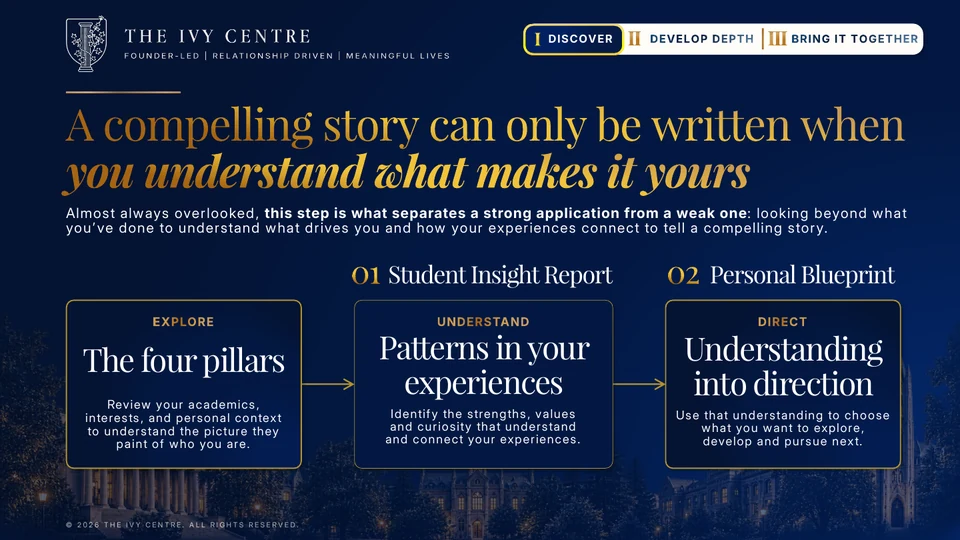 Discover What Sets You Apart
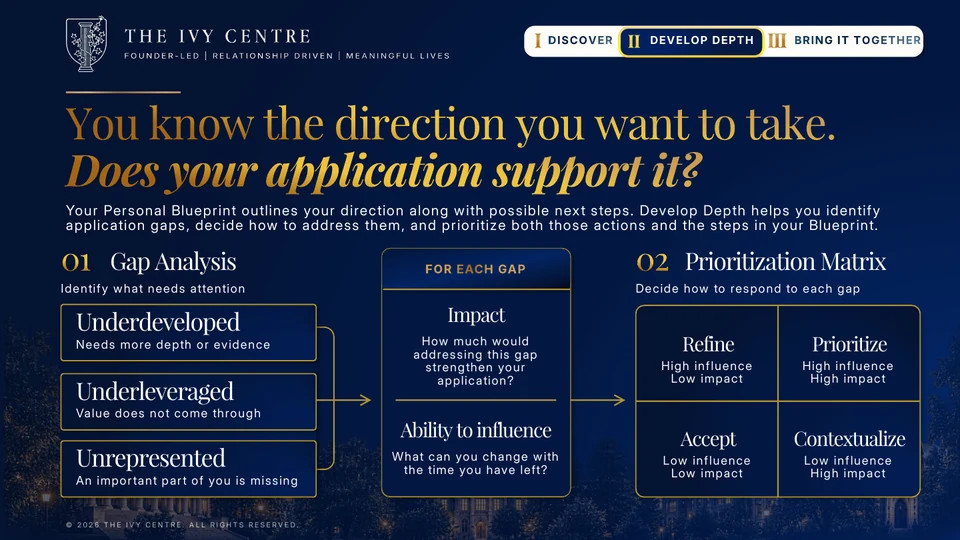 Find and Address Your Specific Application Gaps
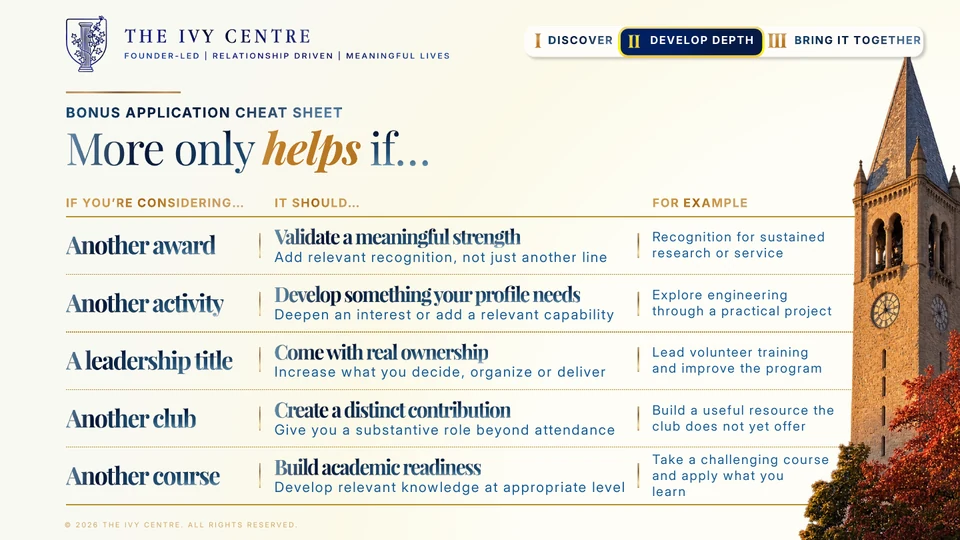 What to Strengthen Next: Your Priorities Cheat Sheet
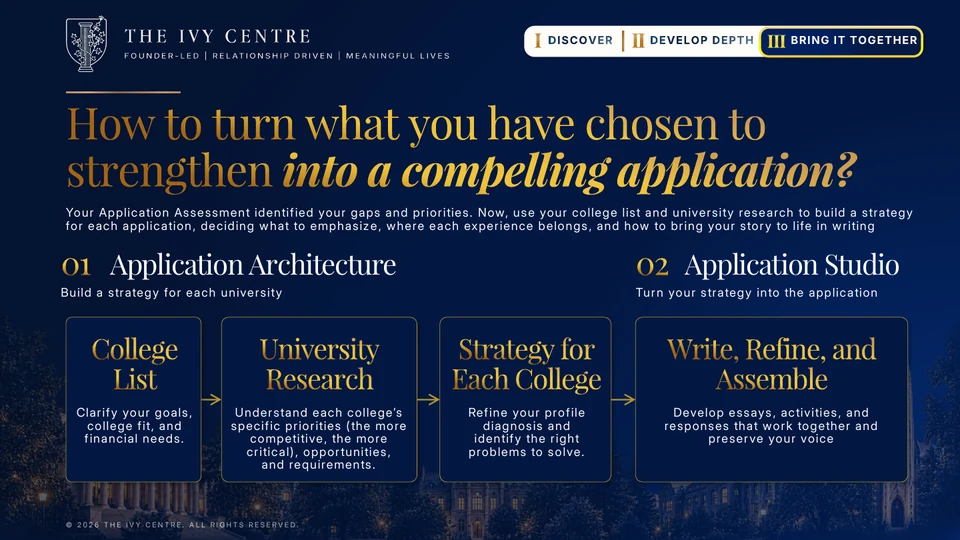 Turn Your Profile into a REALLY Compelling ApplicationHow to Research Colleges and Shape Your Strategy for Each
All 15 chapters and six guides are included with free access and also shared with you over email.
Explore the free masterclassChoose the version for you. Free access, with no commitment to mentorship.
Reviewed by Lara David for The Ivy Centre. Our program descriptions draw on our published mentorship framework and masterclass. Linked external sources support the specific comparisons identified in this guide. Illustrative examples are labeled; individual outcomes are not predictions.