Can consulting improve an application?
Admissions consulting can improve the quality of decisions, preparation and communication that go into an application. It can help a student find a suitable opportunity, address a weakness or explain important context. A firm’s published acceptance rate, however, does not tell you how much the service increased an individual student’s chance of admission.
Those are different claims. To understand the difference, separate the work an adviser can influence from the university decision that follows. The first can be examined through specific actions and evidence. The second also depends on institutional priorities, available places and the applicant pool.
This distinction allows families to be ambitious without treating uncertainty as something a consultant can remove. A useful adviser should help the student use the opportunities still available to them, while explaining what remains outside their control.
Four ways guidance can improve the application process
| Area of influence | What useful support can do | What it cannot establish |
|---|---|---|
| Decisions | Help the student choose realistic priorities and research appropriate universities | That every recommended choice will produce an offer |
| Development | Help the student build knowledge, experience and habits over the time available | A new academic record or a meaningful activity history overnight |
| Communication | Make the student’s evidence, context and motivation clearer | Permission to invent experiences or replace the student’s voice |
| Execution | Coordinate requirements, revisions and deadlines | Control over a university’s review or final decision |
For example, a student may be capable of much stronger work than their current application shows because they are repeating the same experience in every essay. A coherent application strategy can make room for other evidence. That is a concrete improvement you can inspect without assigning it an invented percentage increase in admission chances.
Why acceptance rates cannot measure the benefit for your student
Families who seek consulting are not a random sample of all applicants. They may differ in preparation, resources, school support, goals and willingness to participate. A firm may also select students into a particular program. Those starting differences affect how its outcomes should be interpreted.
There is also no direct observation of what would have happened to the same student, in the same cycle, without the support. An admission after mentorship is an outcome worth celebrating. On its own, it does not measure how much of that outcome was caused by the mentorship.
This is why dividing a firm’s rate by a university’s overall rate can be misleading. The groups, application rounds and definitions may differ. A large multiplier can look precise while leaving the most important comparison unanswered.
Read admissions statistics with the right context
What can still change depends on when the work begins
With substantial time available, guidance can influence course planning, exploration, skills and the development of meaningful experiences. The student can try something, reflect on it and change direction. The work is developmental as well as presentational.
Closer to the deadline, the task changes. A mentor can help assess the evidence already available, identify omissions, research universities and organize a thoughtful submission. They should not promise to manufacture years of depth in a few weeks. The strategy needs to respect the time remaining and the student’s actual record.
Both forms of support can be valuable. A younger student may need help choosing what to pursue. A senior may need help deciding what deserves emphasis and what needs explanation. The right question is what useful change is still possible, rather than whether the student has started at an ideal age.
Choose when to start based on the work ahead
An example of improvement you can evaluate
Imagine a student who has spent several years caring for a younger sibling while maintaining strong school performance. Their activities list emphasizes a short club membership because they assume family responsibilities will not count as meaningful experience. This is an illustrative scenario, not a client record.
A thoughtful adviser would ask about the responsibilities, time commitment, decisions and learning involved. The goal would be to represent the student accurately, with appropriate context, rather than turn a private experience into a dramatic admissions story. The student should decide what they are comfortable sharing.
The improvement is visible: the application now offers a more complete and truthful picture of the person. No adviser can promise how a particular reader will respond. Clearer evidence and sound judgment are still valuable outcomes of the work.
How The Ivy Centre approaches the question
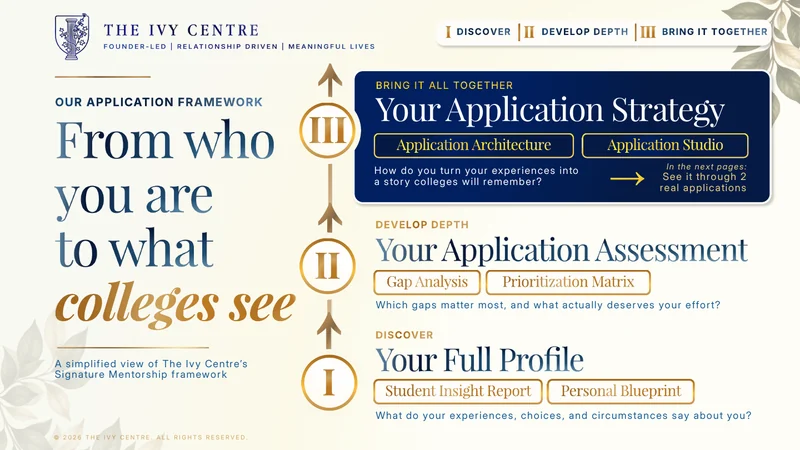
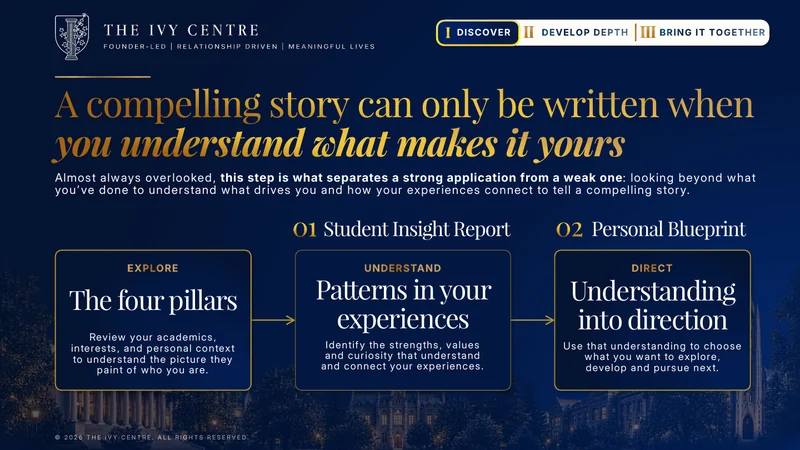
Our three founders examine the student from complementary perspectives. We consider strengths, interests, values and patterns of follow through, then ask what the student’s experiences actually demonstrate. The Student Insight Report and Personal Program Blueprint help translate that understanding into a practical plan.
As applications approach, Application Architecture considers the purpose of each component and the requirements of each university. Triple Quality Control brings all three founders into reviewing the complete application. This is a method for improving coherence, accuracy and thoughtful presentation; it is not a formula for guaranteed admission.
Our broader work can also include executive functioning, SAT preparation and student development, depending on the agreed program. These areas matter because an application is connected to how the student learns and acts. The student remains responsible for participating and doing the work.
Explore our development and application framework
What about graduate admissions?
The Ivy Centre also supports master’s degree, STEM PhD, medical school and MBA applicants. The same distinction between preparation and prediction applies, but the evidence relevant to the application changes. Research interests and experience matter differently from professional progression or preparation for clinical training.
An adviser should explain what expertise is relevant to the pathway and what additional preparation may be necessary. A strong undergraduate record does not automatically answer a graduate program’s questions. Nor does a consultant’s success in one type of application establish expertise in every other type.
Ask how the proposed work will address the specific program, field and stage you are considering. The goal is a well supported decision and an authentic application, not a generic graduate version of a college admissions package.
For a master’s degree, that may mean distinguishing a research program from a professional or taught program, checking academic prerequisites and explaining why this degree is the right next step. The relevant evidence depends on the degree and the applicant’s purpose, not on a generic list of graduate admissions credentials.
How to read our own outcomes
About these results
01 · How we calculate these numbers
Each published percentage above represents the share of The Ivy Centre students who applied to that university and were admitted during the 2021 to 2022 through 2025 to 2026 admissions cycles. All nine university figures cover early application rounds only. Columbia and Penn: binding Early Decision. Stanford, Harvard, Yale and Princeton: Restrictive or Single Choice Early Action. MIT: nonrestrictive, nonbinding Early Action. Chicago: Early Action, Early Decision I and Early Decision II. Caltech: Early Action in the first cycle, then Restrictive Early Action after its fall 2022 policy change. Regular Decision outcomes are not included. Every applicant is counted, with no exclusions.
These figures include all of our paying students, students in our scholarship program, and students mentored before we introduced our current three founder model. Before that model, students followed the same core program under one lead mentor, our founder Lara David.
Our scholarship students are selected from a large pool of highly qualified applicants, so they naturally tend to start with stronger profiles. Even so, outcomes for our scholarship and paying students differ by less than 5 percentage points in every published metric.
Figures are calculated from our internal records and updated every May, once the admissions cycle has closed. Last updated: May 2026. Percentages are always rounded down as a conservative measure, and differences between groups always rounded up, to the nearest 5, so numbers are never overstated. “Students mentored” figure includes every student we have worked with since 2015, across all of our programs.
02 · Why we don’t publish applicant counts
Unlike volume driven college admissions firms, we mentor a deliberately small group of students each year. We protect every family’s privacy, and for the many high profile families we work with, that privacy is essential (if not non negotiable).
Community is also a big part of being an Ivy Centre student. Our students and families know one another, so even simple figures, like the number of students applying to a specific university in a given year, could easily reveal who applied and who was admitted. We know many firms rely on detailed figures like these to build trust, and that not publishing them may raise questions. We have, however, deliberately chosen to limit the figures we publish: protecting our families’ privacy and our relationships will always matter more to us than any statistic we could share.
We do not publish or share student level admissions records, including records with identifying details removed. Our published percentages are aggregate summaries, not individual student files. Every student’s information stays within our secure environment. In the rare cases where we connect a prospective family with a current or past family, we ask that family for permission individually, every time. Any student story we share publicly is shared with that student’s consent.
We also stand behind the mentorship with a full, no questions asked money back guarantee within the applicable two or four week introductory period. The service is paid upfront; the period is confirmed before enrollment.
Our results describe students in the stated group and cycles. They do not establish a causal effect or predict a new student’s outcome. We protect student data, including individual records with identifying details removed, which also limits independent reproduction of our figures. We want families to understand that tradeoff and assess our method directly.
A money back introductory period is also different from an admissions guarantee. It gives a family a defined opportunity to experience the relationship under the program’s terms. It does not make admission conditional on payment or promise a university decision.
Across our published metrics, the outcomes for scholarship and paying students differ by less than five percentage points. Scholarship applicants are selected from a highly qualified pool, so we disclose that starting difference as well. The comparison is useful context about our own students; it is not a controlled experiment or proof that a new student will achieve the same result.
Decide what progress should look like before decisions arrive
Agree on observable signs of progress: a student who can explain their academic interests more clearly, a researched college list with sound reasons, realistic priorities, stronger follow through and an application that communicates distinct evidence across its parts. Review those signs with the mentor as the work develops.
Consulting can be a way to improve preparation and open possibilities. It should not be sold as certainty. The most useful relationship helps a student make better use of what they can influence while remaining honest about what they cannot.
Build a profile with evidence behind it
See the strategy in practice
See how we identify the changes that matter.
The masterclass examines different kinds of gaps and shows why the next step should depend on the student’s actual situation.
Full masterclass included with free and immediate access
Explore the 15 chapters
Free with masterclass 00:0001What does a strong application actually need?
 06:3502The five stages of every strong application strategy
 09:2003What makes you memorable to admissions officers?
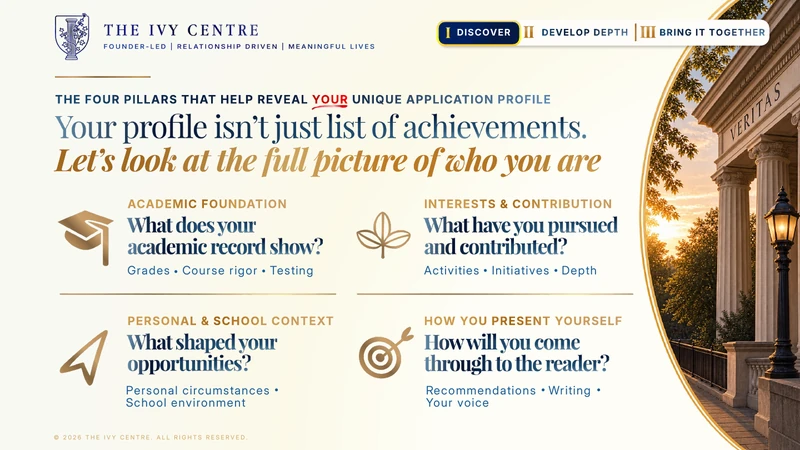 10:4504The four pillars behind every student profile
 12:2705Turn your strengths, values, and curiosity into direction
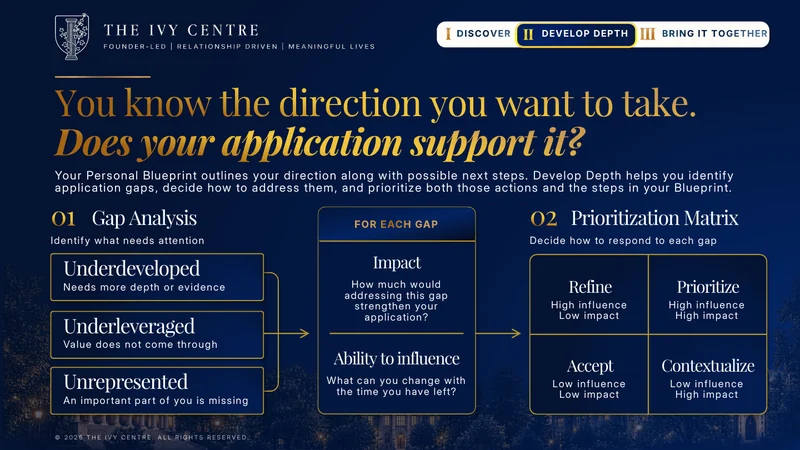 13:5306What is your application actually missing?
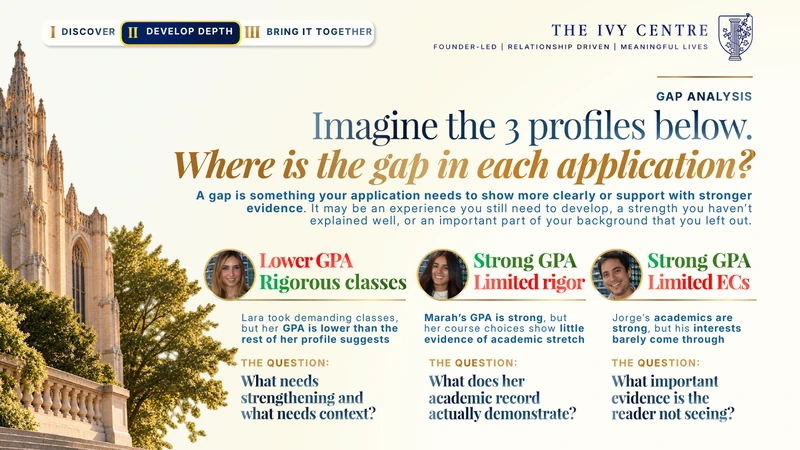 15:2607How to spot weaknesses in your college application
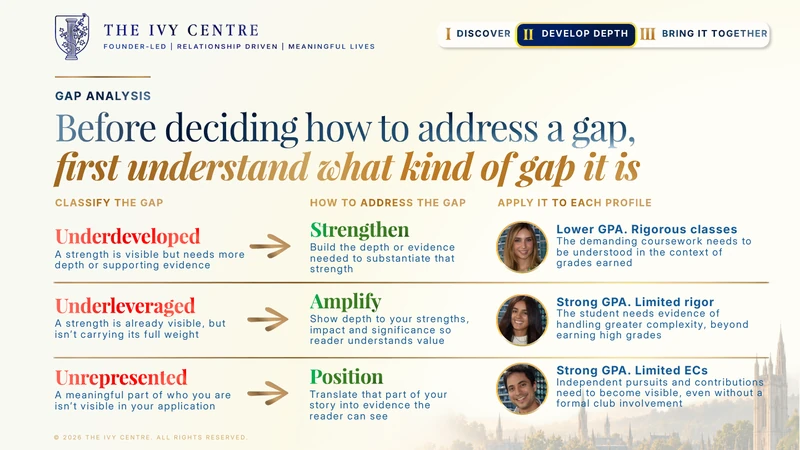 17:0108There's only 3 types of gaps. Each with a different way forward.
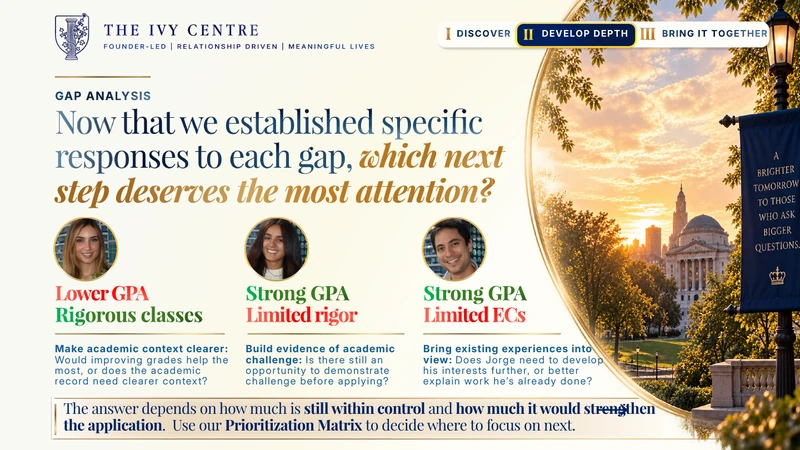 18:5509What can you still change before you apply?
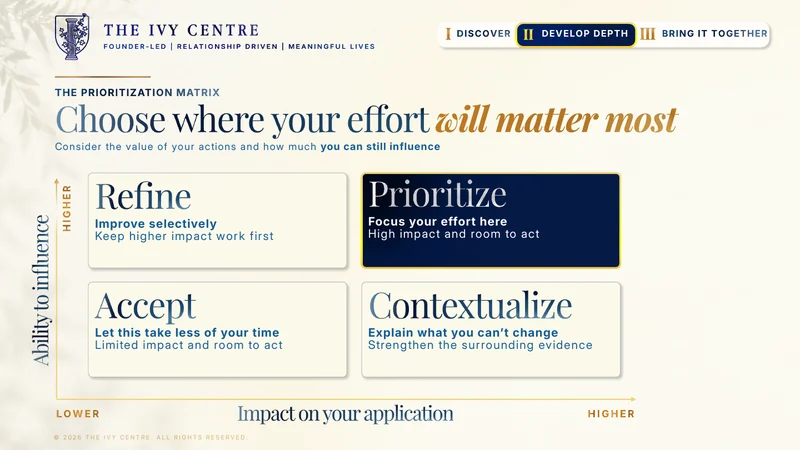 20:2610What deserves your effort, and what can wait?
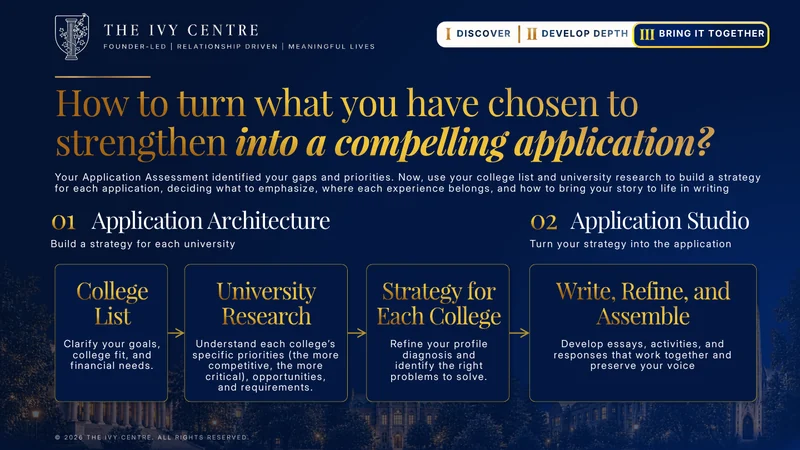 21:3711Why each university needs a different strategy
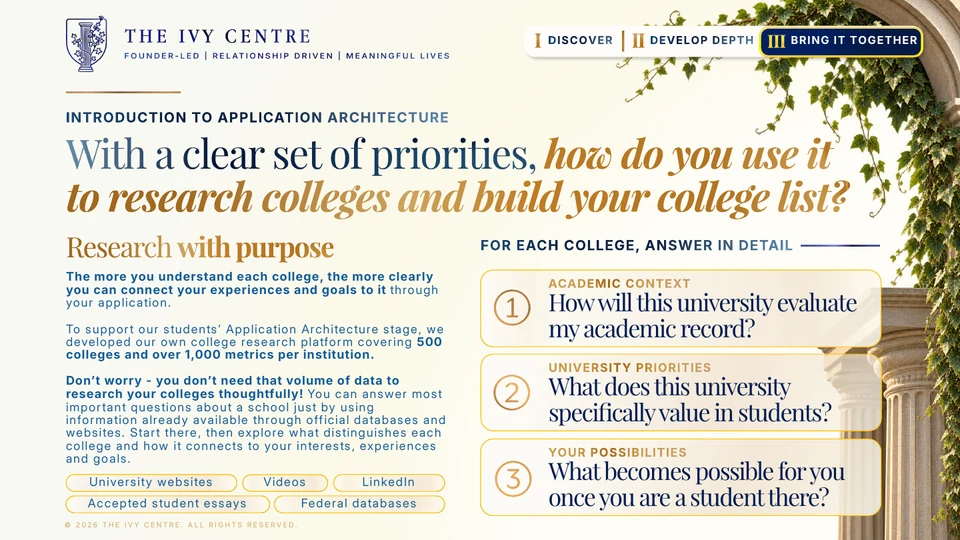 22:3612How to research colleges the right way
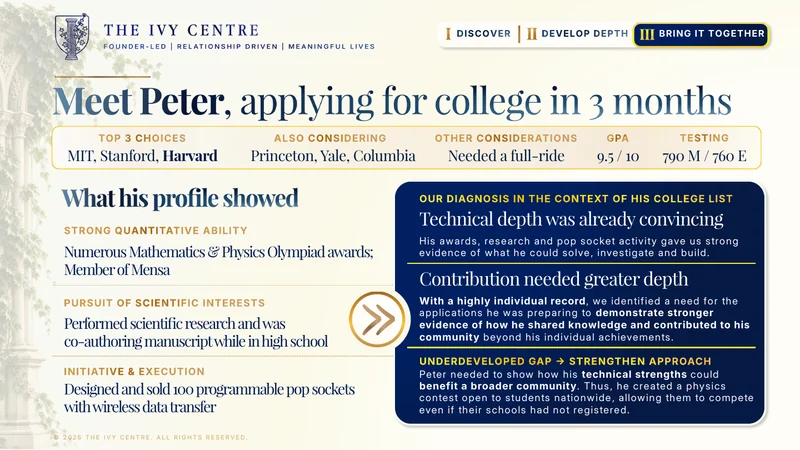 24:4513Peter: Highly technical profile but no differentiator
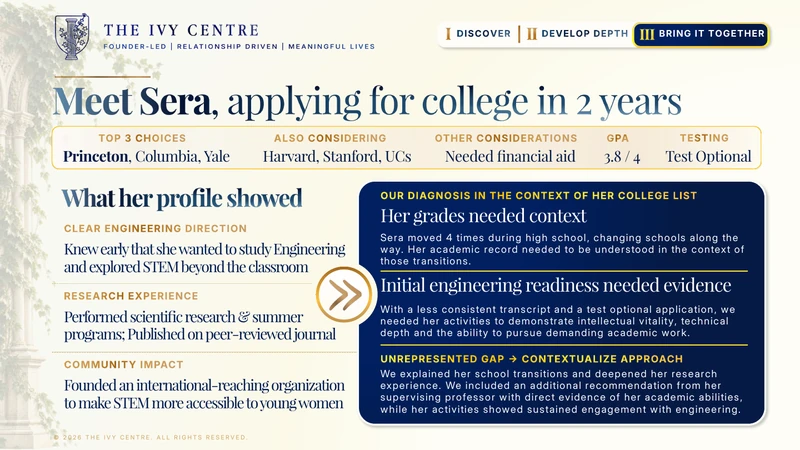 26:3714Sera: Low GPA and SAT, but strong depth in context
 27:5615What should you do next?
Six downloadable resources
Free with masterclass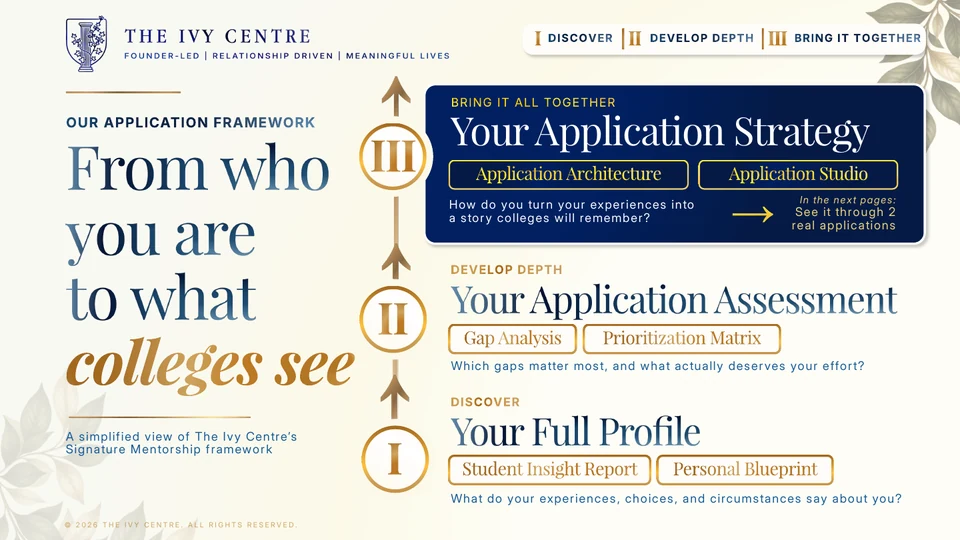 College Application Strategy Map
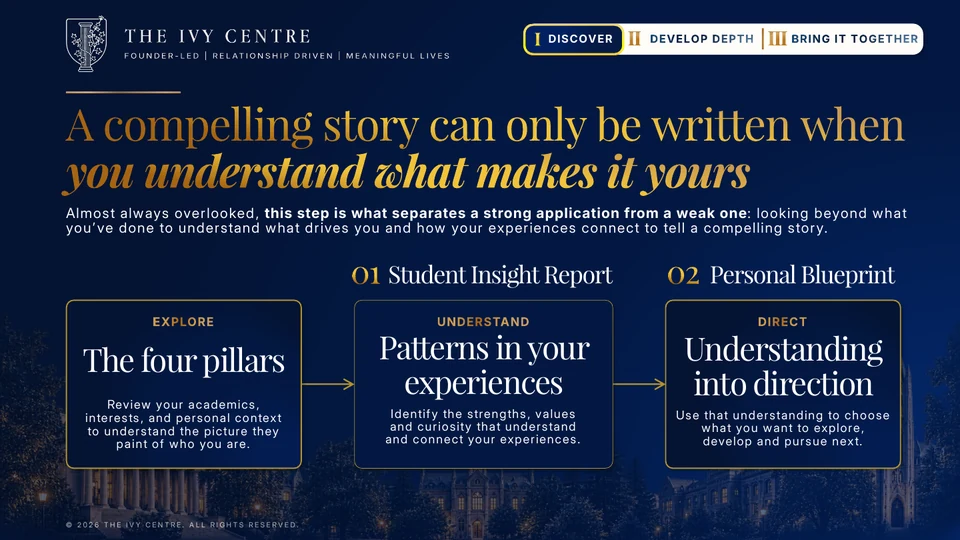 Discover What Sets You Apart
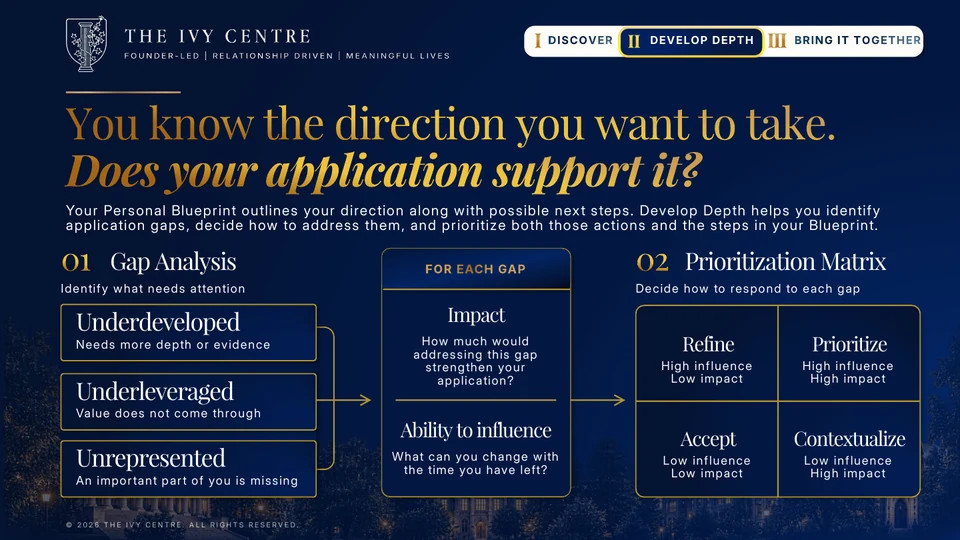 Find and Address Your Specific Application Gaps
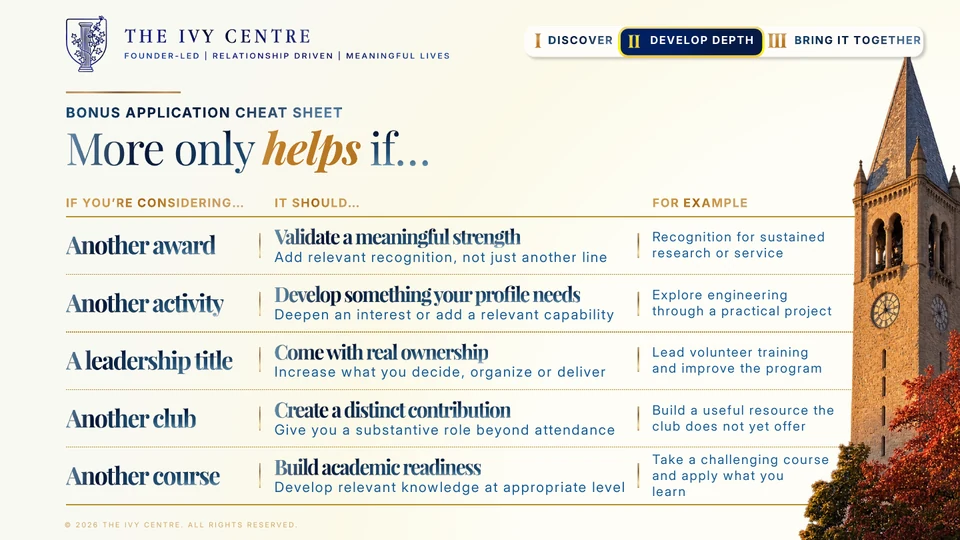 What to Strengthen Next: Your Priorities Cheat Sheet
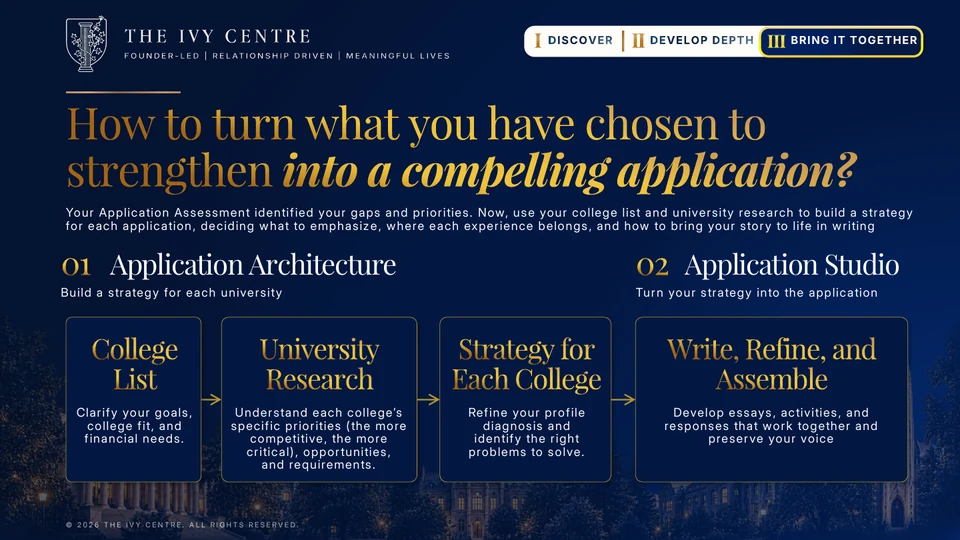 Turn Your Profile into a REALLY Compelling ApplicationHow to Research Colleges and Shape Your Strategy for Each
All 15 chapters and six guides are included with free access and also shared with you over email.
Explore the free masterclassChoose the version for you. Free access, with no commitment to mentorship.
Reviewed by Marah Selim for The Ivy Centre. Our program descriptions draw on our published mentorship framework and masterclass. Linked external sources support the specific comparisons identified in this guide. Illustrative examples are labeled; individual outcomes are not predictions.