What should ninth and tenth graders focus on?
A useful college strategy in ninth and tenth grade helps a student learn well, explore thoughtfully and develop commitments they can sustain. It should leave room for curiosity and change. The objective is not to choose an impressive identity early and spend the next several years defending it.
These years matter because choices accumulate. Courses affect later options. Habits influence how much a student can manage. Experiences reveal interests that may become deeper commitments. A good plan keeps those connections visible while respecting that the student is still growing.
Begin with the student’s actual week. Where are they engaged? Where are they stretched too thin? What do they choose to learn about when nobody assigns it? What responsibilities already take time? Those answers are more useful than starting with a list of activities associated with selective admission.
Protect academic foundations first
Choose a course load that offers appropriate challenge and preserves room to learn deeply. The most demanding possible schedule is not automatically the most productive one. Consider the school’s options, the student’s preparation and how one choice affects the rest of the week.
If a student is struggling, investigate the cause before adding another commitment. Gaps in subject knowledge, weak routines, difficulty asking for help and an unrealistic workload require different responses. The goal is to strengthen the foundation rather than hide the difficulty behind a busier résumé.
Review the plan before future course selection deadlines. Ask which subjects the student wants to understand more deeply, which courses are prerequisites for later choices and what support would help them succeed. Keep the school counselor involved in decisions that depend on the school’s curriculum and requirements.
Explore with a question, an action and a reflection
An exploration becomes more useful when it starts with a question. A student interested in environmental engineering might ask why a local area floods, how water quality is measured or how infrastructure decisions are made. The next action should be appropriate to the student’s knowledge and available resources.
That action could be reading and comparing credible sources, speaking with a local practitioner through an appropriate channel, learning a relevant tool or contributing to an existing supervised project. It does not have to begin with a paid program or a new organization.
Afterward, ask what changed. What did the student enjoy about the actual work? Which assumptions were wrong? What would they investigate next? Reflection helps distinguish an interest in the idea of a field from interest in its day to day questions and methods.
Put the guide into practice
Turn an interest into a useful experiment
Open each step and apply it to one question the student wants to investigate.
01Name the question
Be specific enough that an action is possible. “I want to understand how local water is tested” offers more direction than “I want something impressive in science.”
02Choose a manageable action
Use an accessible, appropriate opportunity. A reading comparison, supervised task or contribution to existing work can be a useful beginning.
03Seek feedback
Identify what you need to learn and who or what can help you evaluate the work. Feedback should inform the next attempt, not simply validate the first idea.
04Reflect and decide
Record what surprised you, what you enjoyed and what you would change. Continue, deepen or redirect based on what you learned.
Choose depth by looking at contribution
An activity becomes meaningful through what the student does, learns and contributes. A title can describe responsibility, but it cannot establish it. Ask what would be different if the student were not involved. The answer may be a completed task, a more reliable process, a useful resource or support provided consistently to other people.
Depth does not require a dramatic public impact. A student may learn a great deal from solving a modest problem carefully, accepting feedback and improving the result. Inflated claims can obscure that genuine learning and create expectations the student cannot explain honestly.
When choosing between commitments, consider interest, access, contribution and sustainability. An activity that fits those conditions may deserve more time. An activity maintained only because the student fears it will look bad to stop may deserve a thoughtful review.
A sample term plan
This is an illustrative planning structure, not a prescription for every student. Adjust it to school demands, family responsibilities and available opportunities.
| Part of the term | Focus | Evidence to review |
|---|---|---|
| Opening weeks | Understand the workload and choose one exploration question | A realistic weekly plan and a question the student can explain |
| Middle of the term | Complete a manageable piece of work and seek feedback | What was attempted, what happened and what feedback revealed |
| Later weeks | Improve the work or make an informed change of direction | A revised result or a clear reason for choosing a different next step |
| End of the term | Review academics, energy and commitments together | What to continue, what to reduce and what to investigate next |
A plan should be small enough that the student can actually use it. Reviewing it regularly is more valuable than creating a beautiful document that nobody revisits.
Develop executive functioning through real work
Planning, task initiation, estimating time and asking for help can be practiced through school and activities. Begin with a concrete task, break it into steps and identify what might interrupt progress. After completion, compare the estimate with what actually happened.
When a task stalls, avoid treating every delay as a lack of motivation. The next step may be unclear, the task may be too large or the student may lack a needed skill. A useful response changes the conditions of the work and helps the student recognize the pattern themselves.
At The Ivy Centre, executive functioning support is connected to the student’s goals rather than delivered as reminders in isolation. The aim is increasing independence. Appropriate school or clinical support may also be needed; mentorship should respect those boundaries.
Let university research broaden the picture
Early research can help a student understand that universities differ in programs, teaching, communities and access to opportunities. It does not need to produce a fixed list in ninth grade. A visit, an official program page or a conversation can generate questions about how the student likes to learn.
Encourage the student to connect a university fact to a personal reason. “There is a well known laboratory” is less useful than understanding what undergraduates can actually do, what preparation is required and why the work interests the student. Those research habits will later support a stronger college list, essays and interviews.
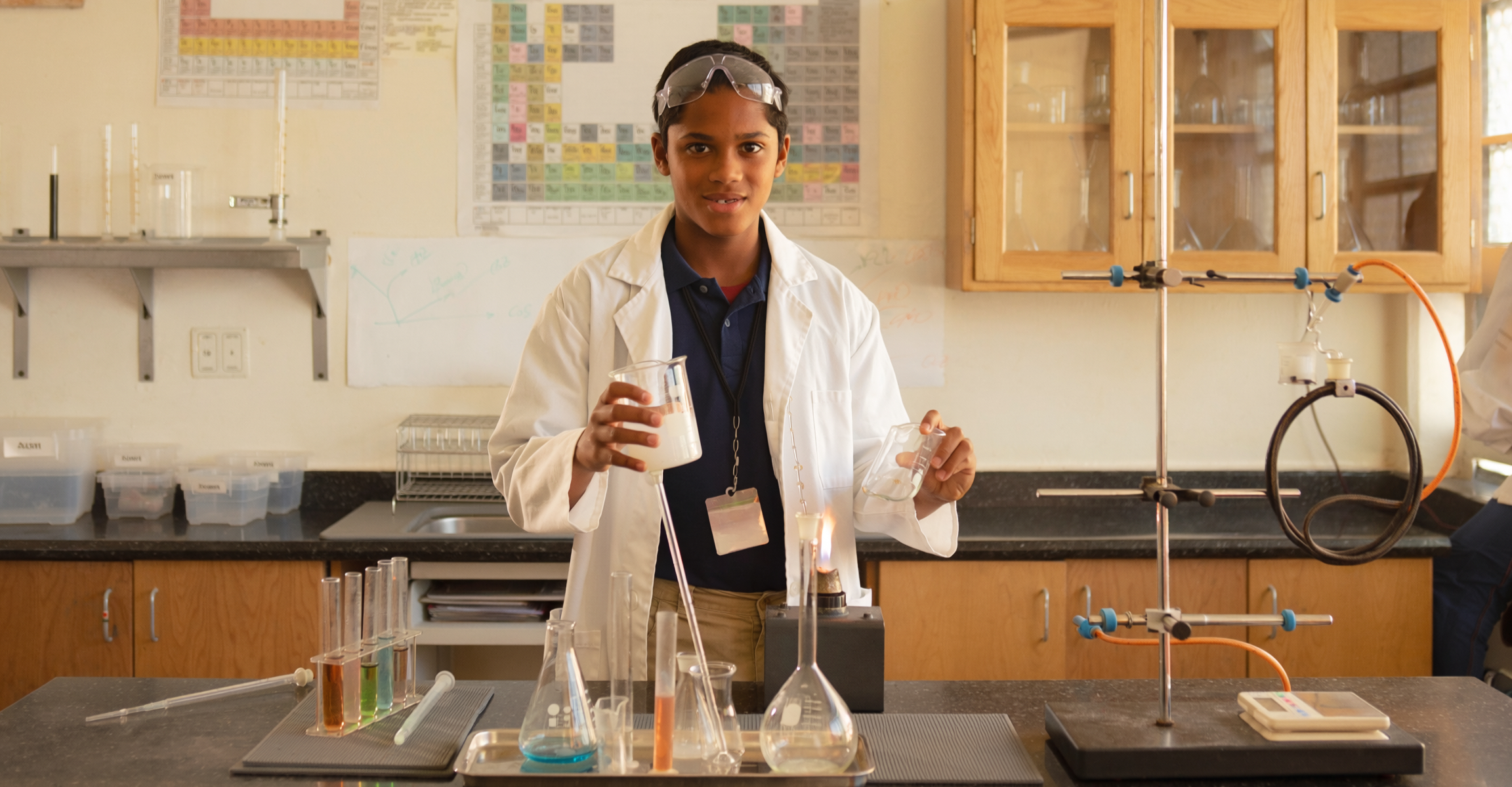
From The Ivy Journal
The Research University Trap: Why a Famous Lab Is Not College Strategy
Read the articleKeep a record without turning everything into a metric
A simple record of projects, responsibilities, feedback and reflections can help the student recognize growth. Capture accurate details while they are fresh: what the student did, what they learned and what they would change. This is useful for future planning as well as eventual applications.
Avoid measuring every experience only by awards, followers or a promised admissions advantage. Those signals can miss the quality of the work and encourage superficial choices. A student should be able to discuss the substance of an experience, including mistakes and revisions, without needing to exaggerate its scale.
How our mentorship supports these years
The Ivy Centre’s three founders bring different perspectives to understanding the student. The Student Insight Report helps identify strengths, values and development needs. The Personal Program Blueprint connects those findings to a manageable plan, which changes as the student learns more about themselves.
Exploration through the Ivy Lab, focused workshops, academic direction and SAT support can be considered within the agreed program. We do not assume every student needs every service at the same time. Founder judgment is useful when it helps decide what matters now and what can wait.
Longer term aspirations may include STEM research, medicine, business or graduate study. Our experience with master’s degree, STEM PhD, medical school and MBA pathways can inform conversations about possible futures, without asking a young student to commit prematurely to one of them.
See how discovery becomes a practical plan
The same attention can take different forms. A student who plans reliably may use more of the mentorship to investigate a question deeply. Another may first need help turning a large goal into manageable actions. We adapt the focus without reducing our commitment to the student. Weekly founder discussions help us notice when that balance needs to change.
What families can do this week
Choose one conversation about the student’s current workload and one question they would like to explore. Agree on a manageable action and a time to reflect on it. Ask what support would help, rather than assuming the student needs a larger schedule.
Good early planning should make the student more thoughtful and capable, not simply more occupied. A strong eventual application grows from the decisions and experiences that happen along the way.
Understand what a competitive profile needs
See the strategy in practice
Learn how to choose what deserves your effort.
The masterclass explains how to identify strengths, recognize gaps and choose a next step appropriate to your stage.
Full masterclass included with free and immediate access
Explore the 15 chapters
Free with masterclass 00:0001What does a strong application actually need?
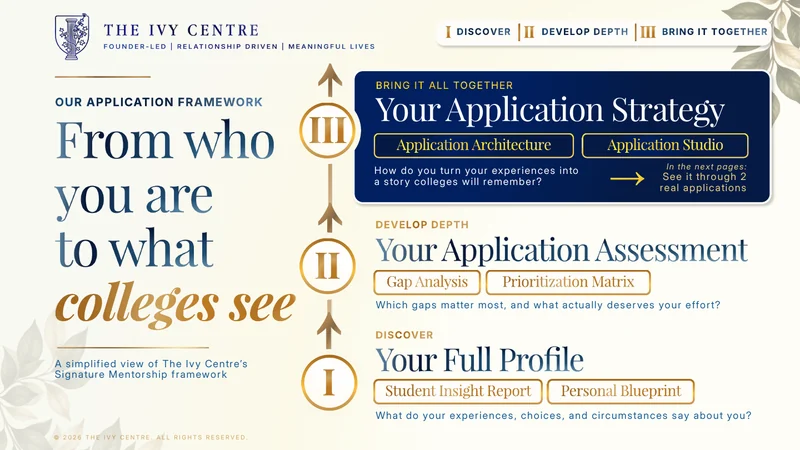 06:3502The five stages of every strong application strategy
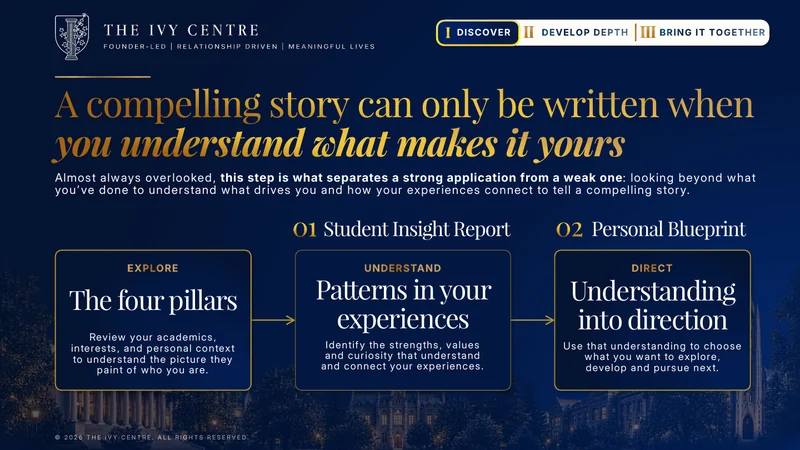 09:2003What makes you memorable to admissions officers?
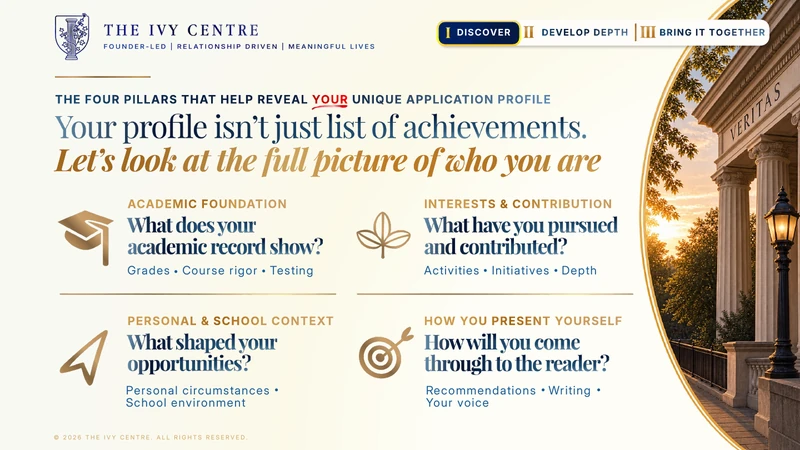 10:4504The four pillars behind every student profile
 12:2705Turn your strengths, values, and curiosity into direction
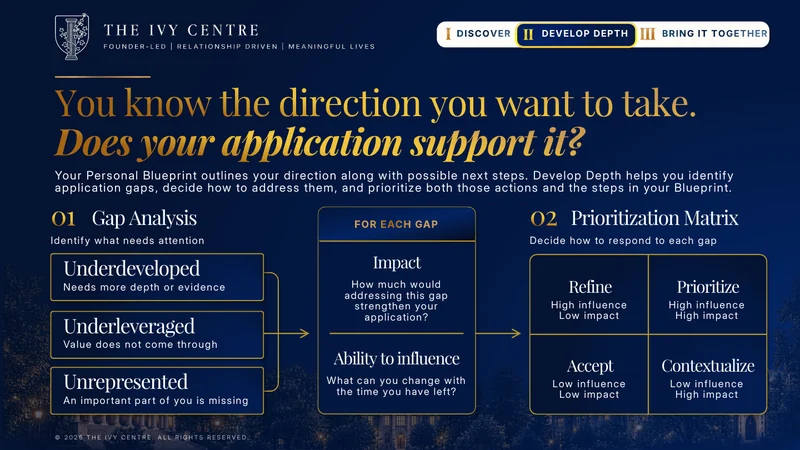 13:5306What is your application actually missing?
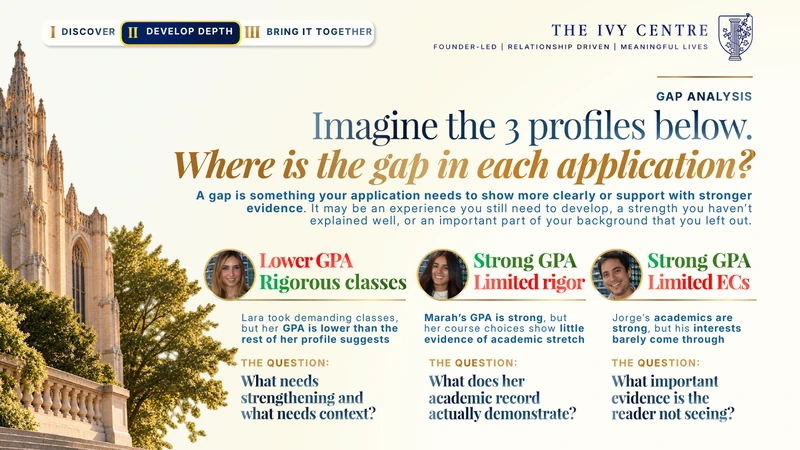 15:2607How to spot weaknesses in your college application
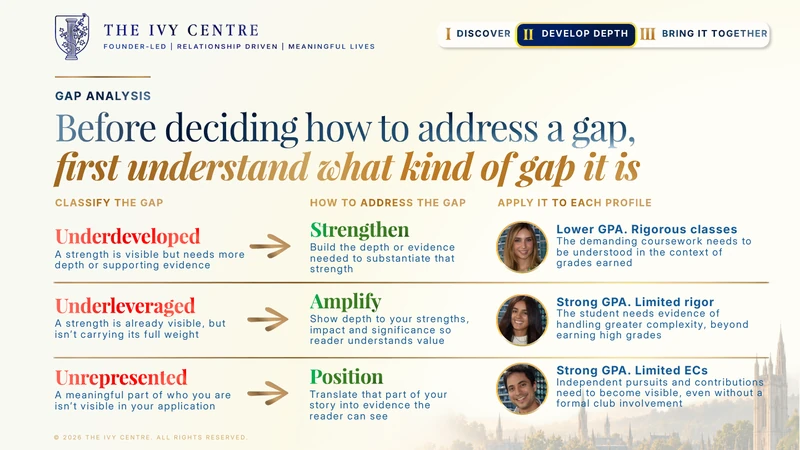 17:0108There's only 3 types of gaps. Each with a different way forward.
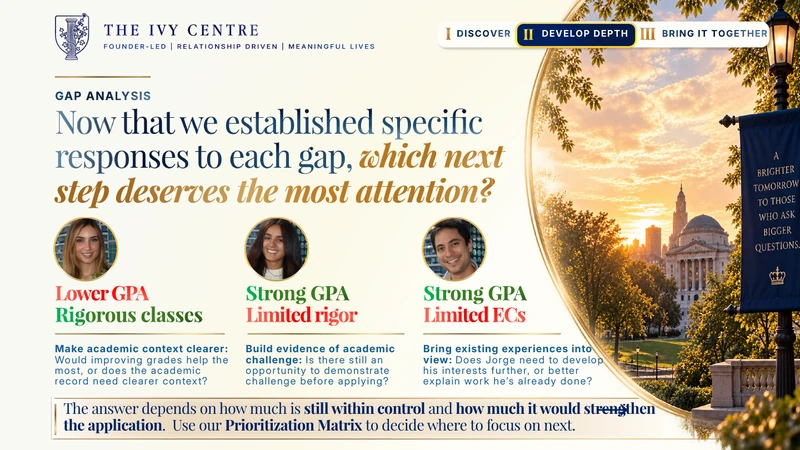 18:5509What can you still change before you apply?
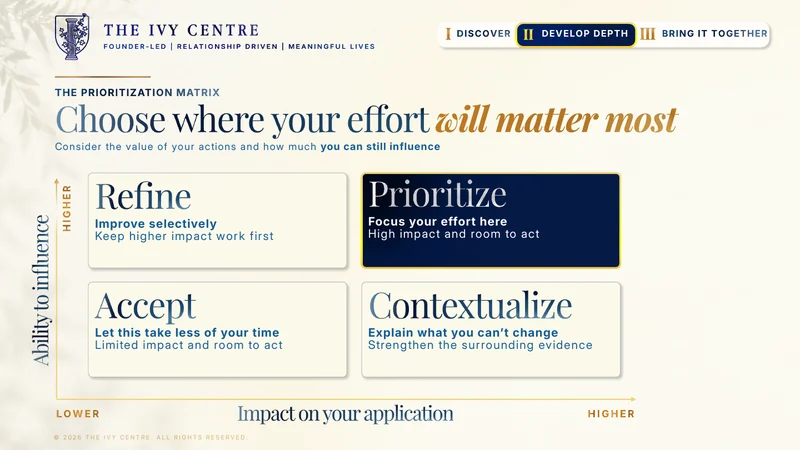 20:2610What deserves your effort, and what can wait?
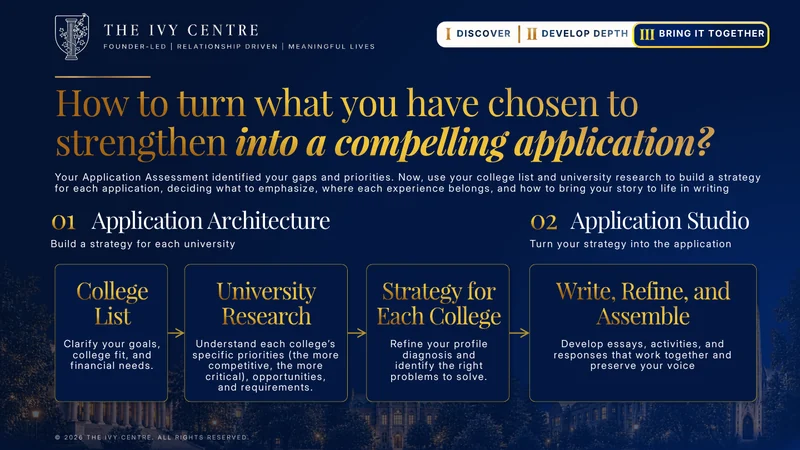 21:3711Why each university needs a different strategy
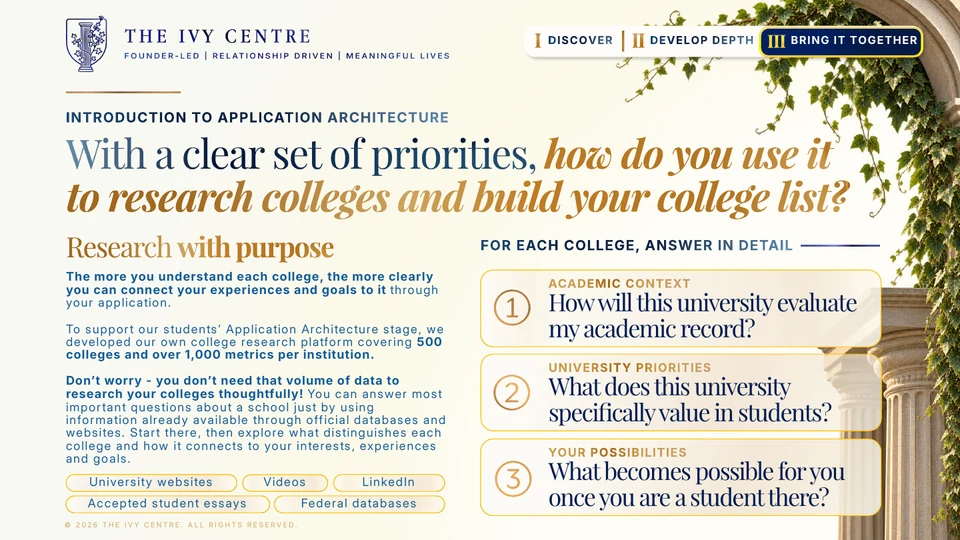 22:3612How to research colleges the right way
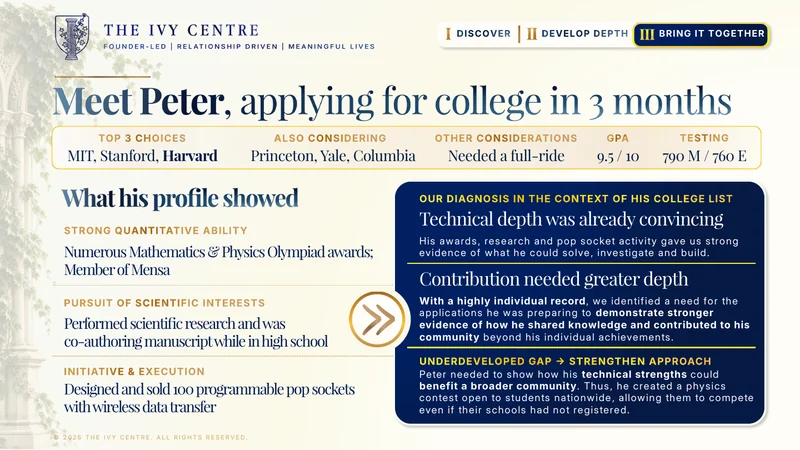 24:4513Peter: Highly technical profile but no differentiator
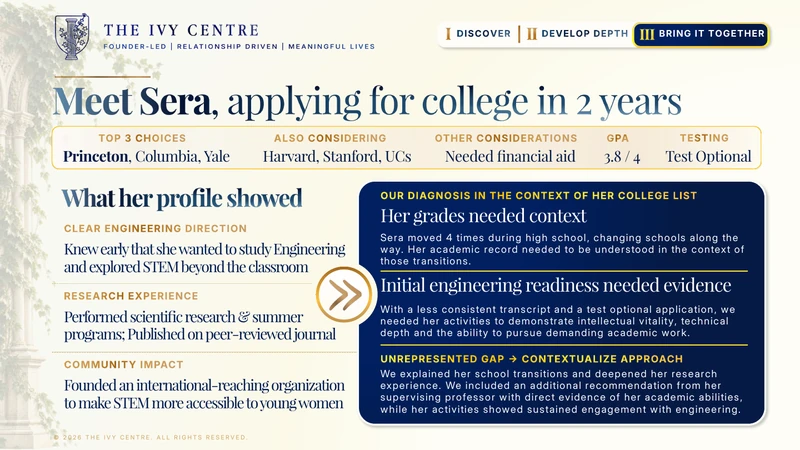 26:3714Sera: Low GPA and SAT, but strong depth in context
 27:5615What should you do next?
Six downloadable resources
Free with masterclass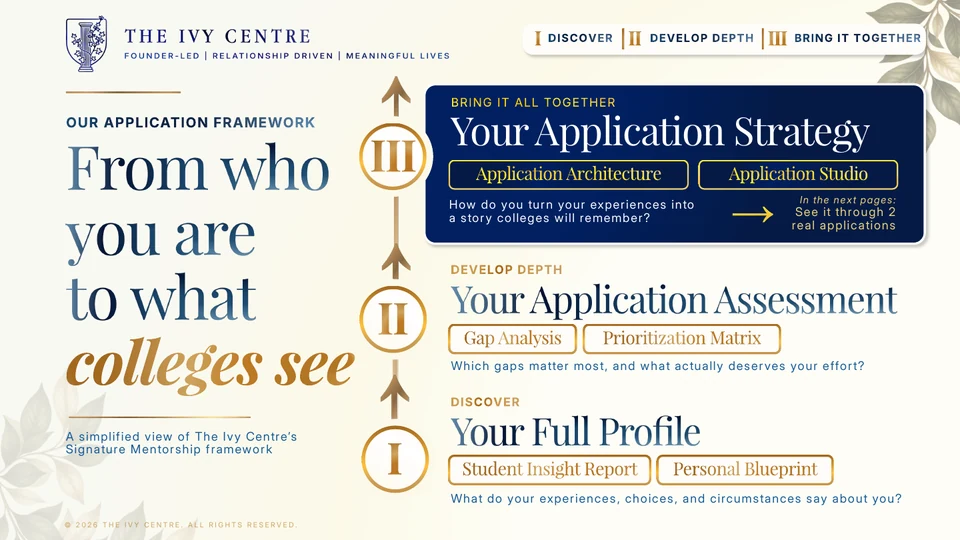 College Application Strategy Map
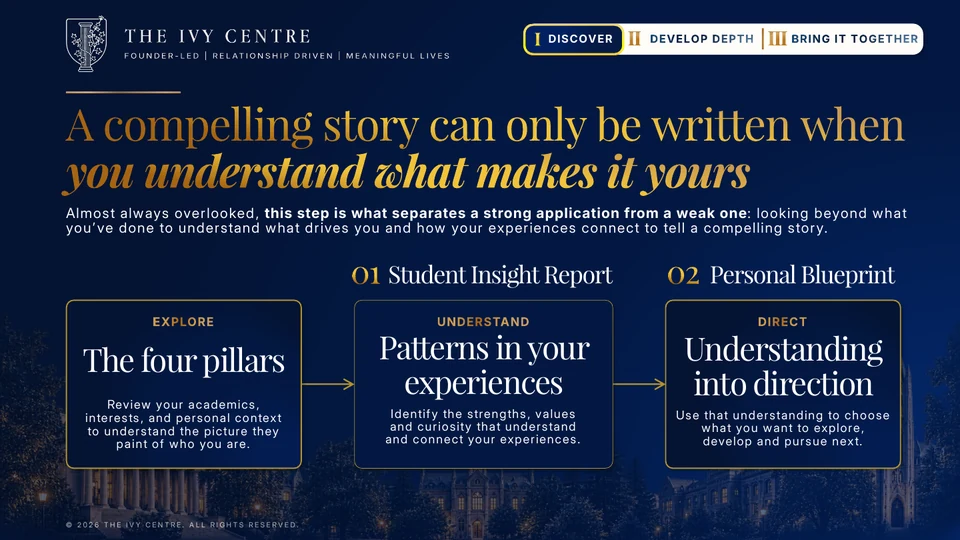 Discover What Sets You Apart
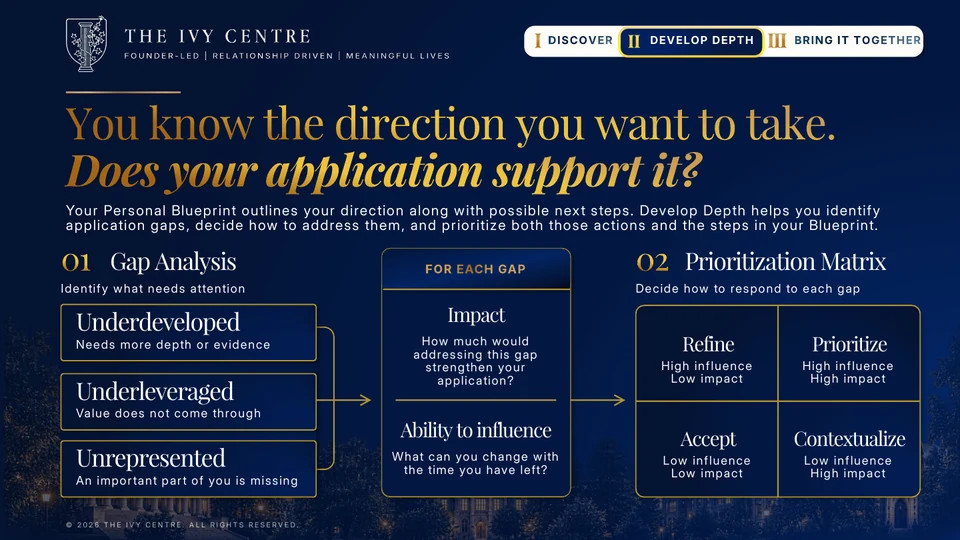 Find and Address Your Specific Application Gaps
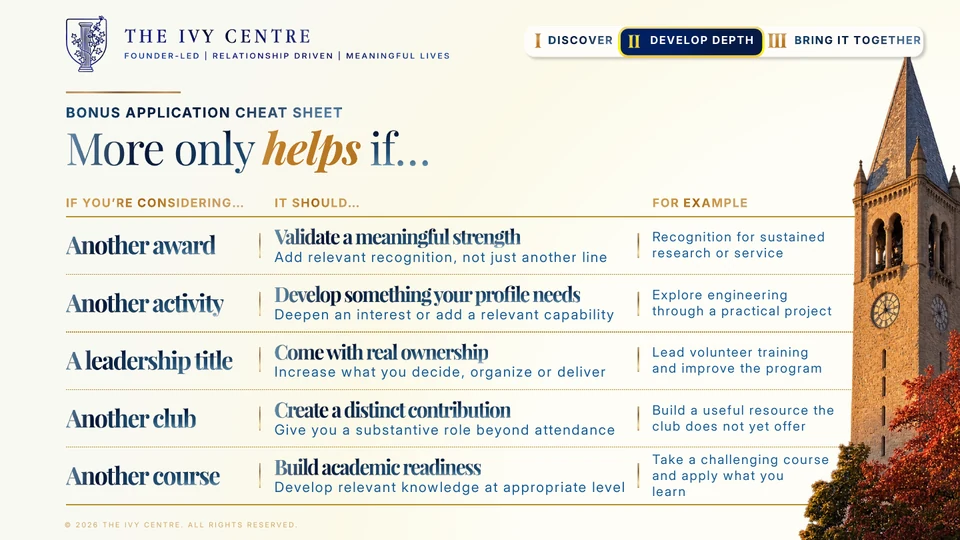 What to Strengthen Next: Your Priorities Cheat Sheet
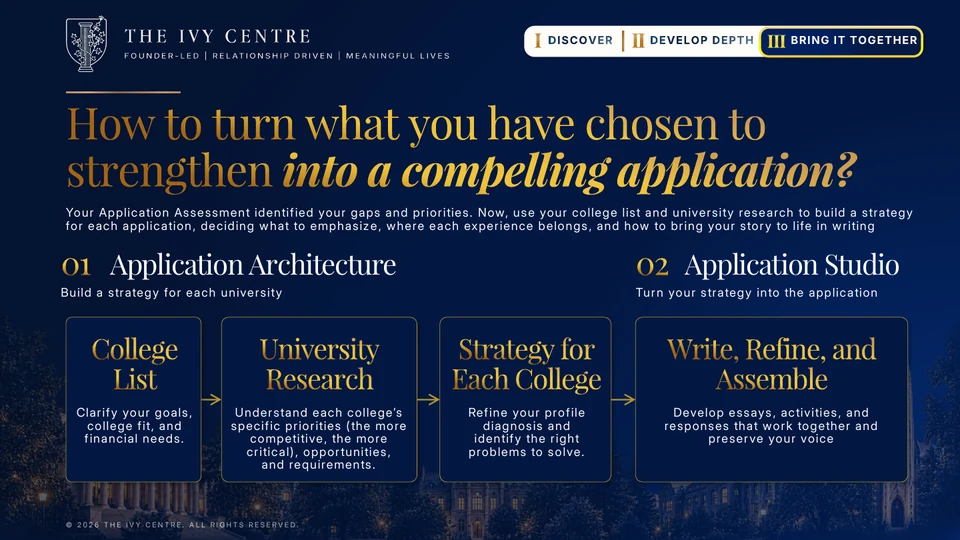 Turn Your Profile into a REALLY Compelling ApplicationHow to Research Colleges and Shape Your Strategy for Each
All 15 chapters and six guides are included with free access and also shared with you over email.
Explore the free masterclassChoose the version for you. Free access, with no commitment to mentorship.
Reviewed by Marah Selim for The Ivy Centre. Our program descriptions draw on our published mentorship framework and masterclass. Linked external sources support the specific comparisons identified in this guide. Illustrative examples are labeled; individual outcomes are not predictions.