Applications & Essays
Writing An Effective Resumé For High School Students Applying To College How to Write and Make the Most of this One Page
By The Ivy Centre — College admissions mentorship
OCT 6, 20267 min read
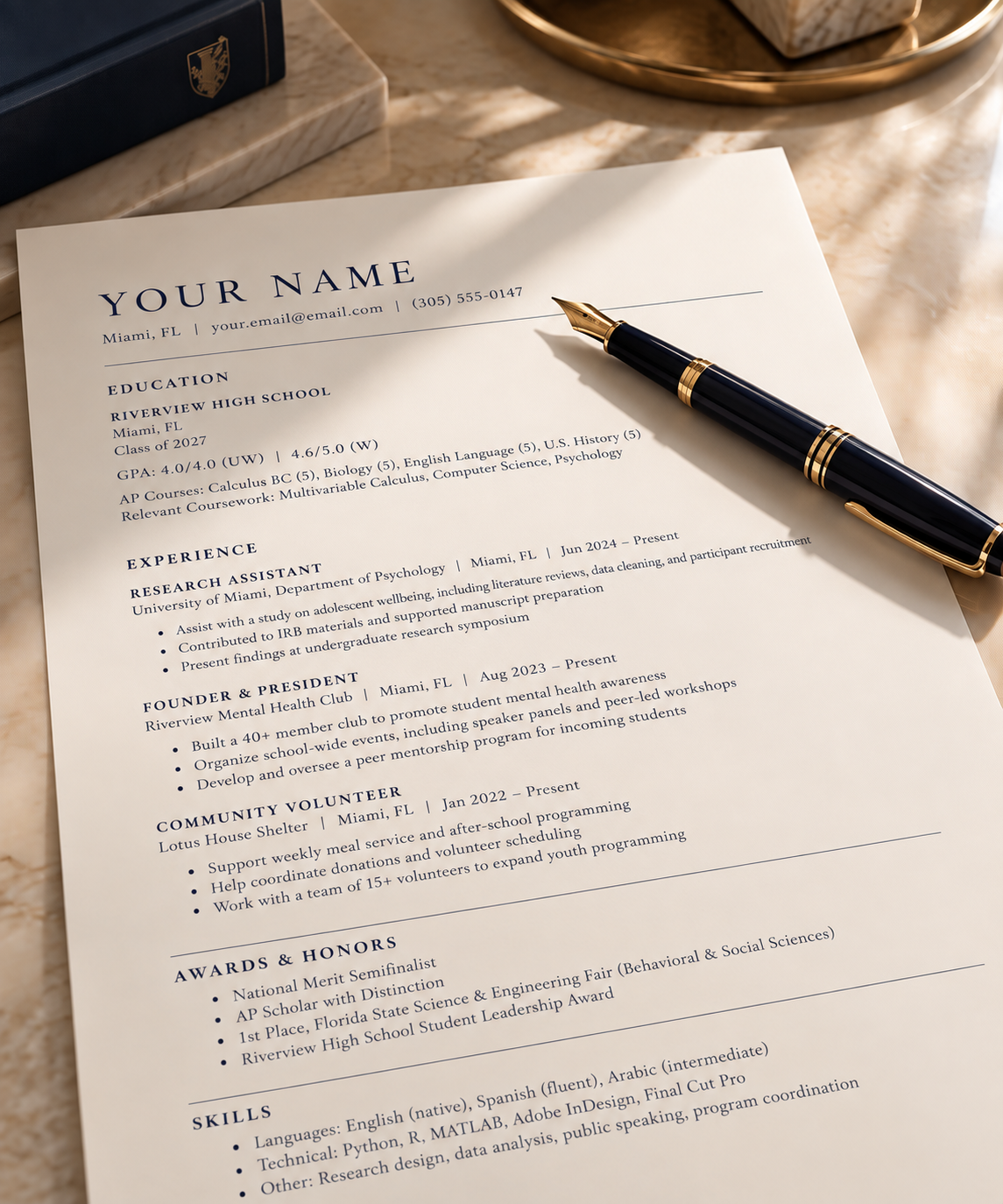
You open a resume template as a high schooler and suddenly you’re asked to summarize your career. But then you're left thinking... "But I'm just in high school." At this point, it’s easy to look at those empty sections and wonder whether you’ve done enough, or whether you need to make everything sound more impressive than it was. You don’t!
A good resume starts with taking your own time seriously, including the work that never came with a fancy title. Let’s figure out how to put that on the page.
Do high schoolers need a resume?
How important is it to write a resumé for a high school student?
If you're crafting a resumé now to apply to colleges, you may be aware that you have other opportunities to discuss your experiences, including your college essays and, more specifically, your activities section.
The problem is space. Those sections give you very limited room to discuss everything you have done, so you will naturally hone in on what seems to matter most. A resume gives you another opportunity to introduce meaningful work that may have not made the cut elsewhere. What is more, the resume offers you the space to elaborate on experiences that deserve more context than the 150 characters in the activities section allowed for. Finally, the resume also allows the reader to see how the different parts of your record fit together.
Yet, the resume is still only one page, so discernment and brevity are key here. Let's get into it: so how to write a stong resumé for a high school student?
What content should be on your resume?
How do you communicate your background effectively in a resume?
First, let's talk about the basics. Presentation will not make an ordinary resume extraordinary, but it can communicate care, judgement, and familiarity with the format before the reader reaches the first bullet point.
Font Choose a clean, highly readable font. A classic Serif font such as Times New Roman or Garamond can work beautifully, but so can a restrained Sans Serif. Your word document may automatically open in Calibri or Aptos. That does not mean you are required to accept its creative direction.
Consistent Style Create a style for each level of information. Bold or capitalize headings. Use italics or underline, if you'd like. Make use of bullet points. The key here is consistency.
One page Your ability to keep it concise makes the document easier to scan, for both yourself and the admissions officer. The former allows you to make useful decisions about what deserves the space.
Next, let's talk about the content of your resume.
Contact Information
Your name. If you go by a nickname, make sure you use the name that is attached to your college application. Again, consistency is key.
Professional email. Use an email you will consistently check, and one that sounds professional enough if your admissions reader were to glance at it.
For example, eyecons2008@gmail.com may have had an excellent run. It can probably sit this one out.
Your cell phone number. Include a number where you can reliably be reached.
Education This section serves as a compact academic record that highlights the most relevant, and most compelling, information.
High School Name
City, STATE
Start year - end year
GPA: weighted and unweighted
Best test scores. Consider your ACT, SAT, SAT Subject Tests, AP test scores.
Relevant coursework. This is a chance to show advanced coursework or courses that reflect your academic interests. A student interested in engineering, for example, does not need to list every class they have ever taken. Calculus, physics, computer science, or advanced undergraduate coursework may tell usconsiderably more.
Experience This is where the resume becomes especially informative. The experience section offers you the chance to discuss the things your admissions reader may want to know more about beyond the application itself. Taken together, these entries should give a bird's-eye view of where you have invested your time and what has happened because you were involved. There are a few important considerations here.
Title versus Responsibility
There is an important distinction to make when writing about your experience. A title tells us what you were called, while responsibility tells us what happened because you were there. You may be tempted to emphasize the grand responsibility that your role supposedly entailed. Instead, ask, and answer, what you did with that responsibility. Ultimately, this is what helps admissions officers envision you on their campus.
Take the following two examples.
One student may have been the President of a basket-weaving club that, naturally, rarely got together. Or, maybe it did, but the club was so small or inactive that there was rarely an opportunity to demonstrate much initiative.
Another student may have been merely a member of a tutoring club but noticed that volunteer tutors had stopped showing up. They critically assessed the situation and figured out why. The late bus had been cancelled, which made the existing tutoring time nearly impossible for volunteers to attend. They informed the president and suggested that they organize the sessions around lunch. The volunteers returned, and the students who needed tutoring had tutors had tutors again.
Ultimately, the club member in the tutoring example demonstrated more initiative, judgment, and responsibility than the President whose title produced very little.
Numbers as Context
Numbers matter because they support your accomplishments with context and scale.
For example, say you were involved in a research lab. Plenty of high school students participate in research, so let's get specific about what that looked like for you.
1) How many literature reviews did you perform?
2) How many manuscripts did you edit?
3) Were you involved in recruiting study participants? If so, how many?
4) Did you help prepare IRB materials?
Compare:
Assisted with research in a psychology laboratory with:
Reviewed 60+ articles for a systematic literature review, screened participant data, and contributed edits to a manuscript prepared for publication.
Verbs for Precision
Once you understand the scope of the experience, consider active verbs that describe exactly what you did. A strong verb does not make an ordinary experience sound important. It makes your role precise.
Led tells us something different from participated.
Designed tells us something different from helped.
Investigated tells us something different from learned about.
There are plenty more options to choose from in the appendix below.
Additional Context
Where relevant, the experience section offers a valuable opportunity to elaborate on what is important to you, as well as what has taken up your time beyond academics and formal extracurricular activities.
If any of the following fit your profile, consider adding them.
1) Taking care of an elderly family member
2) Volunteering at your church/temple/mosque
3) Serving on the board or council for an organization/group
4) Taking summer art classes
5) Teaching your little sister to play the guitar
6) Writing a regular blog about baking cakes
7) Organizing weekly pick-up basketball in your neighborhood
Awards and Honors You know your strengths. This is your opportunity to show that others have recognized them too.
Include the name of the award, the organization involved, and enough specificity to communicate its scope. Compare:
Science Award
with:
1st Place, Florida State Science & Engineering Fair, Behavioral & Social Sciences
Skills Your skills section is an opportunity to reflect on the result of the experiences you've highlighted. When done well, it adds another dimension to the student profile coming through on the page.
Some skills will make perfect sense based on the rest of your resume. It makes sense that the student who took AP Computer Science and spent time coding would also list Python. It makes sense that the student who spent their weekends volunteering at the public library may have developed strong communication skills.
This section can also be a great place to introduce something a little less expected. May you speak conversational French. Maybe you have been teaching yourself Arabic on Duolingo for the past two years. Maybe you know AutoCAD, SketchUp, MATLAB, or Final Cut Pro.
That said, this is also one section where I would caution against taking the brag sheet too far. If your skills section turns into an endless list of traits like "punctual," "passionate," "organized," and "hard-working," you may end up diluting the skills that make you interesting.
Now that we've covered the ground work, let's discuss some finishing touches that again communicate a little résumé savoir-faire as a high-school student. That is, you understand the conventions of the format, but, more importantly, you understand what they are there to accomplish.
DOs of every resume
DO organize your resume clearly. Each section should progressively develop depth on your application. Each experience should be listed in chronological order, typically placing your most recent experiences first. Each description should clearly state what you did and why that work was substantive.
DO convey information effectively. Use strong and precise action verbs. Give the reader scale where scale matters. Pay attention to the cohesive narrative you are building.
DO write with concision. Limit your resume to one-page. Consider what really matters and how to communicate it effectively. Concision is not simply deleting words until the page fits, but using your judgment to know which information has earned the space.
DONTs of every resume
DON'T use personal pronouns (i.e., I, me, we). Resume conventions allows you to begin directly with the action.
DON'T include an "objective." It may look fancy, but it reiterates the obvious. You are applying to college. Let your essays carry this one.
DON'T write "references available on request." Admissions readers already know that they can request additional information where appropriate. That is four words saved. You're welcome.
DON'T confuse impressive language with impressive work. "Spearheaded transformative community engagement initiatives" may sound grad. If what you mean is "organized a weekly food drive," the second version is probably stronger.
GOOD LUCK! Remember, the goal is to make this one page extremely clear about what you have done, and why this next step naturally makes sense.
Appendix
Action Verbs
Communication Verbs: Aided, Advised, Arbitrated, Clarified, Co-authored, Collaborated, Consulted, Coordinated, Counseled, Defined, Enlisted, Formulated, Influenced, Informed, Inspired, Interpreted, Interviewed, Mediated, Merged, Negotiated, Promoted, Publicized, Recommended, Represented, Resolved, Suggested
Creative Verbs: Acted, Abstracted, Adapted, Composed, Conceptualized, Created, Designed, Developed, Directed, Drew, Generated, Illustrated, Imagined, Improvised, Integrated, Innovated, Painted, Performed, Planned, Shaped, Synthesized, Visualized, Wrote
Detail-Oriented Verbs: Analyzed, Approved, Arranged, Classified, Collated, Compared, Compiled, Documented, Enforced, Followed through, Met deadlines, Prepared, Processed, Recorded, Retrieved, Set priorities, Systemized, Tabulated
Financial Verbs: Administered, Allocated, Analyzed, Appraised, Audited, Budgeted, Calculated, Computed, Developed, Evaluated, Figured, Maintained, Managed, Performed, Planned, Projected
Manual Skills Verbs: Arranged, Assembled, Bound, Built, Checked, Classified, Constructed, Controlled, Designed, Developed, Drove, Handled, Installed, Invented, Maintained, Monitored, Prepared, Operated, Repaired, Tested
Providing Service Verbs: Advised, Attended, Cared, Coached, Coordinated, Counseled, Delivered, Demonstrated, Explained, Furnished, Generated, Inspected, Installed, Issued, Mentored, Provided, Purchased, Referred, Repaired, Submitted
Organizing Verbs: Achieved, Assigned, Consulted, Contracted, Controlled, Coordinated, Decided, Delegated, Developed, Established, Evaluated, Negotiated, Organized, Planned, Prepared, Prioritized, Produced, Recommended, Reported
Leadership Verbs: Administered, Chaired, Convinced, Directed, Examined, Executed, Expanded, Facilitated, Improved, Initiated, Managed, Oversaw, Produced, Recommended, Reviewed, Supervised
Research Verbs: Calculated, Cataloged, Collected, Computed, Conducted, Correlated, Critiqued, Diagnosed, Discovered, Evaluated, Examined, Experimented, Extrapolated, Gathered, Identified, Inspected, Investigated, Monitored, Proved, Reviewed, Surveyed, Tested
Technical Verbs: Assembled, Built, Calculated, Computed, Designed, Engineered, Fabricated, Maintained, Operated, Programmed, Remodeled, Repaired, Solved, Adapted
Teaching Skills Verbs: Advised, Clarified, Coached, Developed, Encouraged, Evaluated, Informed, Inspired, Motivated, Participated, Provided, Represented, Supported, Taught, Trained, Verified